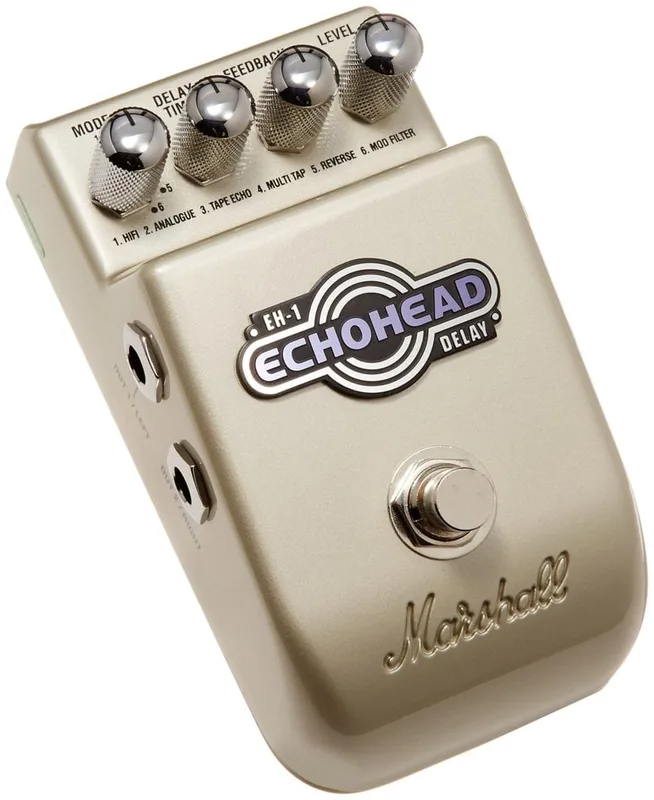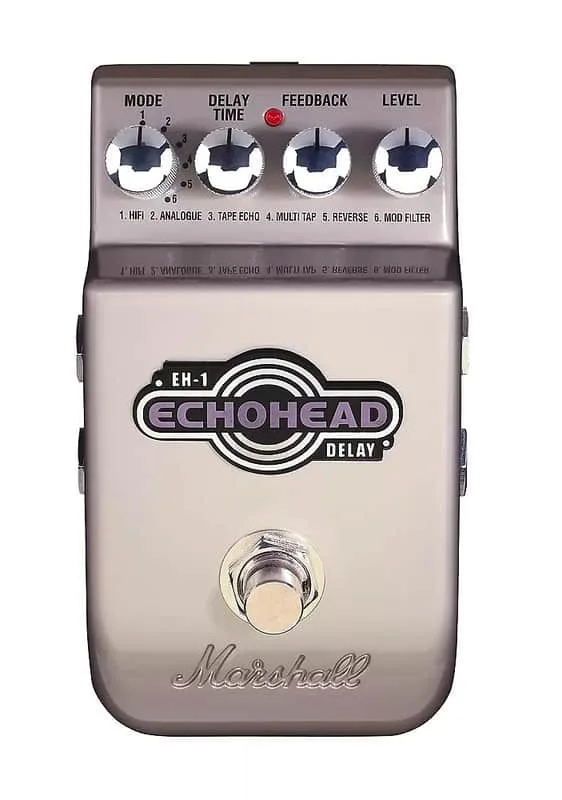


The Marshall EH-1 Echohead is a digital stereo delay pedal with six distinct operational modes: Hi-Fi, Analog, Tape Echo, Multi Tap, Reverse and Mod Filter. It provides up to 2000 milliseconds of delay time, alongside dedicated controls for delay time, feedback and effect level1. Launched in 2006, it was part of Marshall's first wave of compact digital pedals2.
Modes and controls
The six modes cover the main delay flavors players look for, from clean digital repeats (Hi-Fi) through darker, degraded echoes (Analog, Tape Echo) to Multi Tap, Reverse and Mod Filter voicings1. Three knobs handle the essentials: delay time, feedback and effect level1.
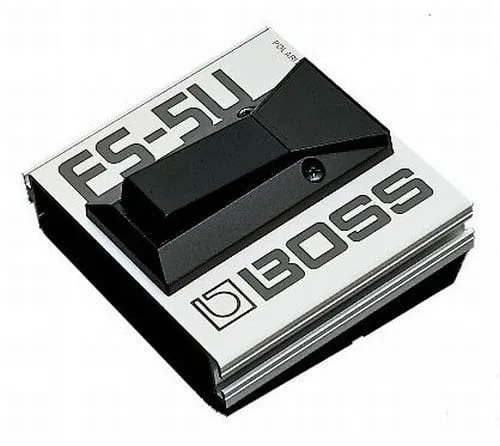
Tap tempo is not built into the pedal's own footswitch. Instead, there is an external tap tempo jack for connecting an optional momentary footswitch to control delay intervals on the fly1. MusicRadar's review confirms the arrangement: alongside the instrument input is a jack socket for a momentary footswitch which functions as a tap tempo control2. If you are shopping for a switch, Vein-Tap.com lists the Echohead among pedals that require a "normally open" Vein Tap4.
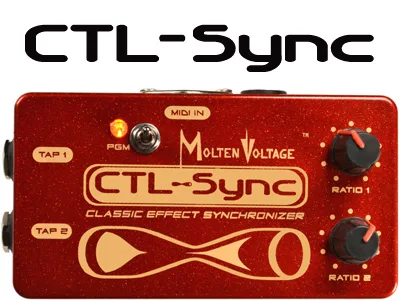
The tap jack also opens another door: Molten Voltage's 2014 roundup of pedals with a tap input jack includes the Echohead among units that can sync to MIDI clock using CTL-Sync through that jack5.
Outputs, stereo and bypass
The dual output jacks are the pedal's most distinctive feature, and how you wire them changes what it does1:
| Connection | What you get |
|---|---|
| Mono, output one | Passive bypass circuit kills the effect completely when disengaged2 |
| Mono, output two | Mono operation, but remaining repeats spill over and decay naturally when the effect is disengaged2 |
| Both outputs | Stereo operation and ping-pong delay; output two's delay time is half that of output one, and there is no spill-over in stereo mode2 |
The EH-1 is not true bypass. Guitar World's 2007 review of Marshall's pedal range describes its "passive bypass circuitry"3, and MusicRadar describes the same passive bypass circuit on output one2. If your rig depends on true bypass switching, this pedal does not offer it.
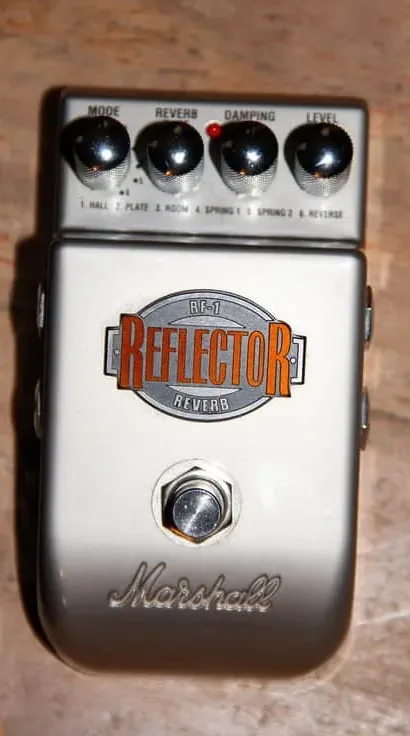
Guitar World's review, covering the Echohead alongside the RG-1 Regenerator and RF-1 Reflector, noted the shared feature set: "Each pedal has six modes, dual output jacks, mono and stereo operation, passive bypass circuitry and a spillover circuit"3.
Power
The Echohead runs on a standard 9-volt battery or an external regulated direct current adapter, 9V DC center negative, drawing 90mA1. That current draw is worth noting if you share a daisy-chain supply across a board.
Build and verdict
The pedal is housed in a heavy-duty metal chassis designed for live stage durability1. MusicRadar's verdict: "The Echohead offers plenty of processing power for the money. It's a versatile delay with a small footprint"2.
For a player comparing delay pedals today, the Echohead sits among the compact digital delays of its era, with its six operational modes and the spillover output as its stand-out practical features. More delay options of the period and since are covered on the Delay Pedals page1.
Videos
Marshall
Marián Marko testy LMSK
Michael Brooks
Questions
Can the Marshall EH-1 Echohead run on a battery?
Yes. Power can be supplied via a standard 9-volt battery or an external regulated direct current adapter. The adapter is 9V DC, center negative, and the pedal draws 90mA, so check the current rating of any daisy-chain supply you plan to share it with.
How long is the maximum delay time on the EH-1 Echohead?
The EH-1 Echohead provides up to 2000 milliseconds of delay time, controlled alongside dedicated knobs for feedback and effect level.
How do you get tap tempo on the Marshall EH-1 Echohead?
The pedal has an external tap tempo jack for connecting an optional momentary footswitch, which controls delay intervals on the fly. Vein-Tap.com lists the Echohead among pedals that require a normally open tap switch.
Does the EH-1 Echohead work in stereo?
Yes. With both outputs connected, the EH-1 gives stereo operation and ping-pong delay. In that configuration the delay time of output two is half that of output one, and there is no spill-over in stereo mode.
What does the second output do on the Echohead?
One output uses a passive bypass, which kills the effect completely when the pedal is disengaged. The other allows echo spill-over: used alone in mono, remaining repeats decay naturally when you disengage the effect instead of cutting off.
Is the Marshall EH-1 Echohead true bypass?
No. The pedal uses passive bypass circuitry. Connected in mono to output one, a passive bypass circuit kills the effect completely when it is disengaged.
Sources (5)
- EH-1 Echohead by Marshall, RockBoard PedalPedia, 2026
- Marshall EH-1 Echohead review, MusicRadar, 2007-12-12
- Marshall RG-1 Regenerator modulator, RF-1 Reflector reverb, EH-1 Echohead delay pedals, Guitar World, 2007-07-24
- Which Pedals Can Use a Tap Tempo Pedal?, Vein-Tap.com, 2011-12-02
- MIDI PedalBoard Devices: 28 Effects that can sync to MIDI Clock with CTL-Sync, Molten Voltage (blog.moltenvoltage.com), 2014-06-12