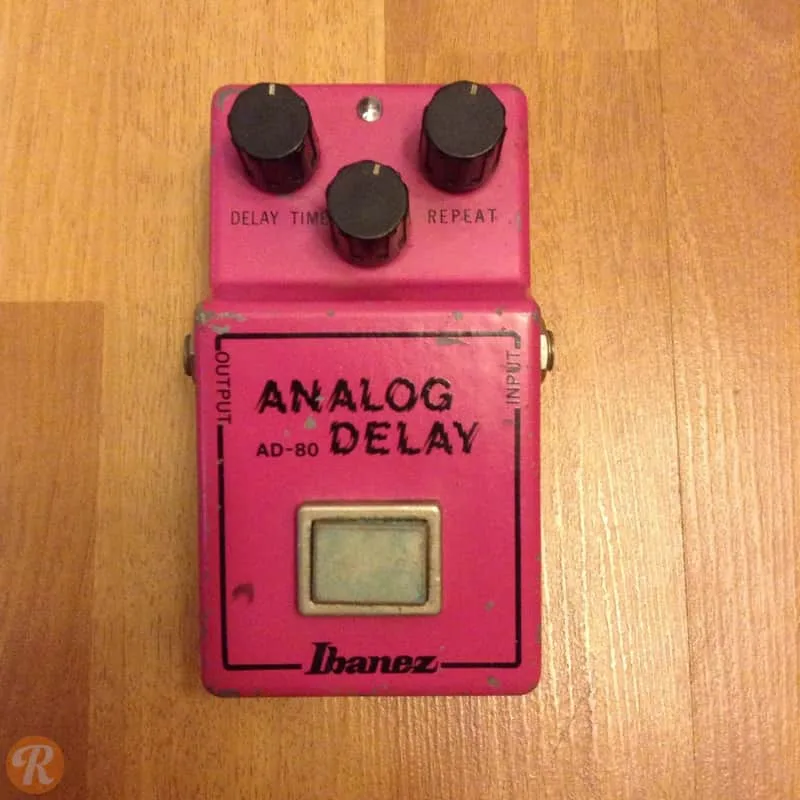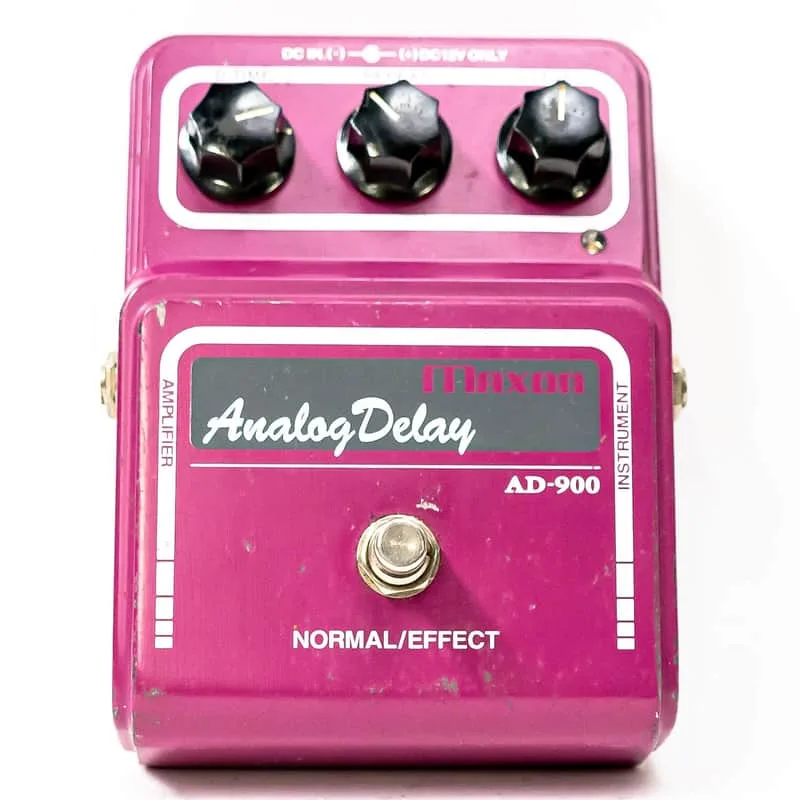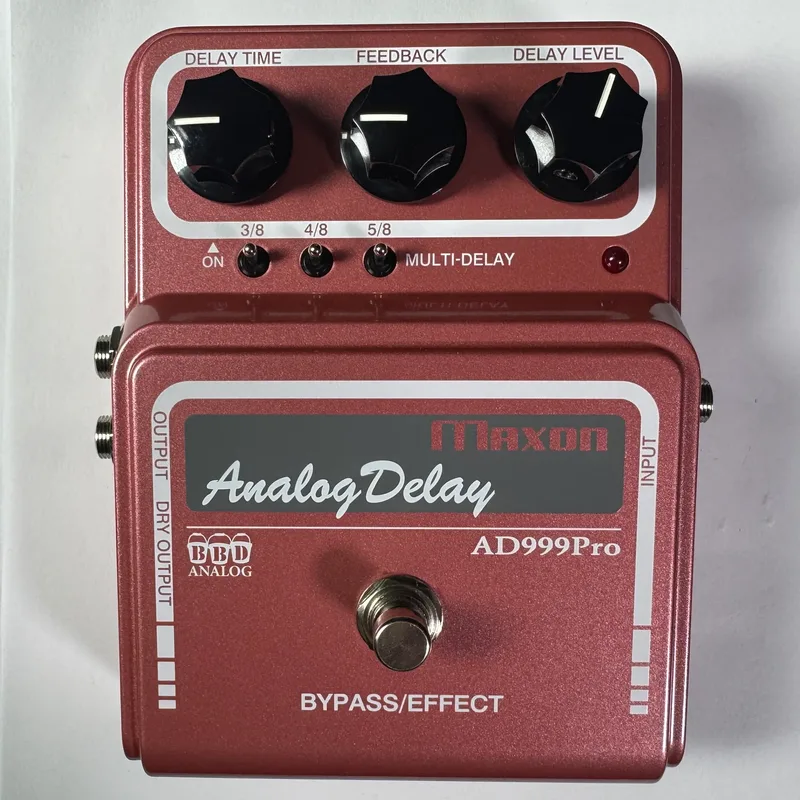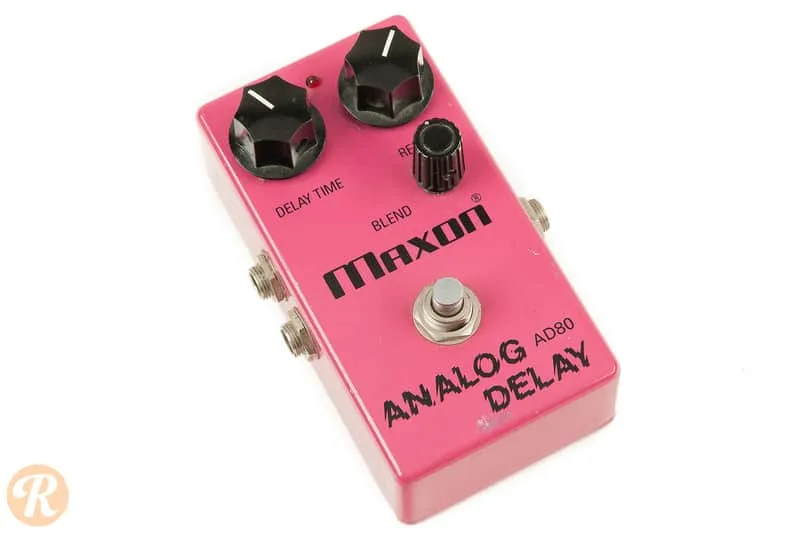


The Maxon AD80 Analog Delay is an analog delay pedal that reissues the Ibanez AD-80, a delay from the late 1970s that has since become a collector's item. Lisa Sharken, writing in Vintage Guitar Magazine in November 2000, described the original as "one of the more sought after pedals in the vintage world and prices can range pretty high"1. The pedal covers delay times from 10 to 300 milliseconds, from quick slapback to wider, more spacious echoes, and carries a list price of $250 as of May 200023.
What it does
The AD80 is, in Sharken's words, "a basic delay pedal with controls for Delay Time, Repeat, and Blend"1. Guitar Player's May 2000 review by Darrin Fox listed the same three controls2. The range of 10 to 300 milliseconds of delay, reported by Dominic Hilton in Guitar World, covers short slapback echoes up to the pedal's maximum of 300 ms3, and Sharken described the pedal as "capable of creating a variety of sounds from quick slapback to wider" echoes, with a warm tone1.
| Control | What it does |
|---|---|
| Delay Time | Sets the delay length, variable from 10 to 300 milliseconds13 |
| Repeat | Sets the number of repeats; at higher settings the US version self-oscillates3 |
| Blend | Mixes the delayed signal with the dry signal1 |
Outputs and stereo use
The pedal has two separate outputs, one carrying the wet (delayed) signal and one carrying the dry, unaffected signal. Sharken noted that these are there "to create a bigger sound when used with two amps"1. Hilton put the same feature another way: "The AD80's dry output allows the unit to operate in stereo for extra sonic real estate"3.
Self-oscillation
A detail that separates the US version of the AD80 from the original circuit: Hilton reported that "This US version has been tweaked to produce self-oscillation at higher feedback settings"3. In practice, that means turning the Repeat control up high sends the repeats into a runaway, regenerating loop, a behavior players associate with vintage analog delays.
Where it came from
The pedal it reissues, the Ibanez AD-80 Analog Delay, was produced in two versions: a narrow box from 1979 to 1980, and a standard box from 1980 to 1981 that belongs to Ibanez's "0 Series"45. Ibanez has not reissued the pedal itself; TONEHOME lists it as "re-issued: no", with the narrow box version rated rare in availability and the later standard box version rated good45. The Maxon reissue appeared in the company's Reissue Series around 2000, when Guitar Player, Guitar World and Vintage Guitar all reviewed it123.
"It's a pink box, like the original AD80, and is capable of creating a variety of sounds from quick slapback to wider"
Related Maxon delays
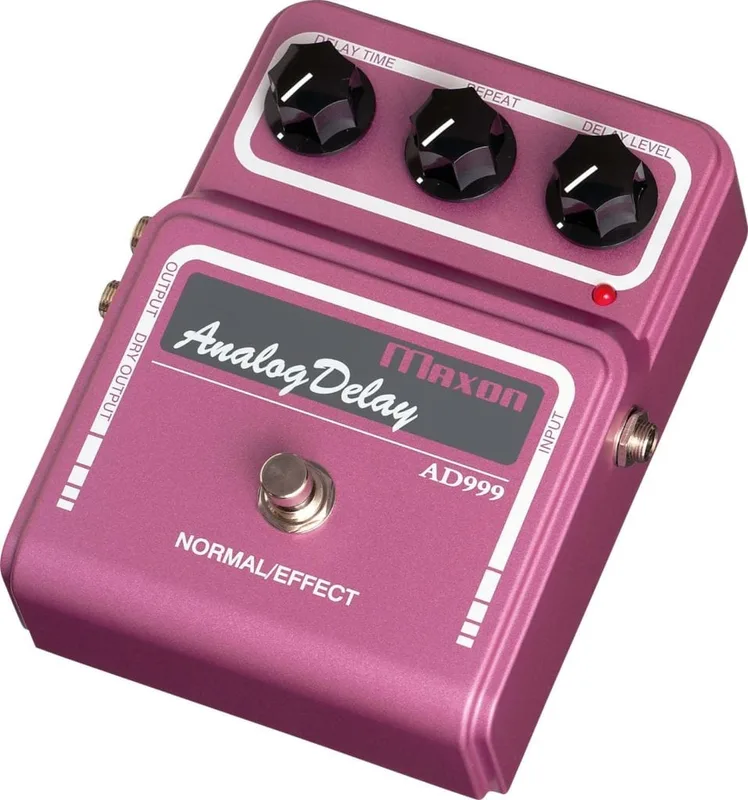
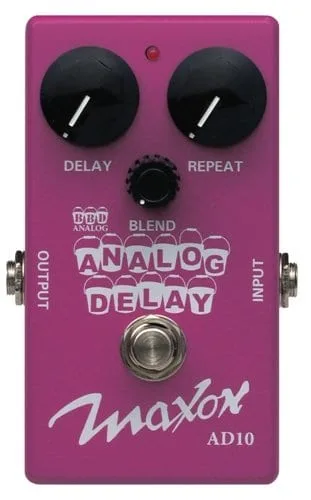
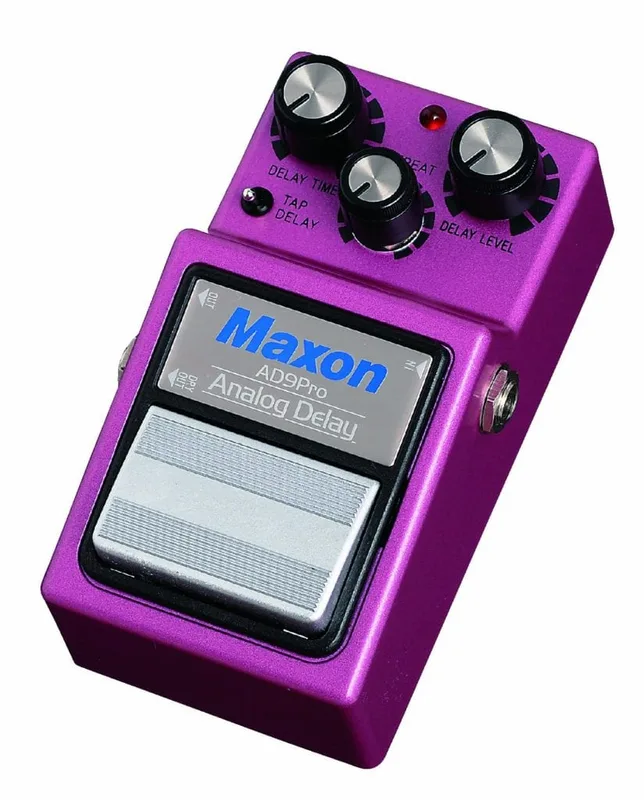
Maxon's later analog delays extend the AD80's format. The Maxon AD999 offers a longer 900 ms of analog delay, the Maxon AD10 Analog Delay is a compact-series take on the same idea, and the Maxon AD-9 Pro Analog Delay is a revised compact analog delay in the Nine Series. For the wider field, see the site's Delay Pedals page.
Videos
Dave Dykhuizen
Parlor Cat
Eom Works
Questions
Is the Maxon AD80 the same as the Ibanez AD80?
The Maxon AD80 is a reissue of the Ibanez AD-80 Analog Delay, an analog delay pedal originally produced in two versions: a narrow box from 1979 to 1980 and a standard box from 1980 to 1981. Vintage Guitar Magazine described the original Ibanez AD80 as one of the more sought after pedals in the vintage world, with prices that can range pretty high. Ibanez itself has not reissued the pedal.
How much delay time does the Maxon AD80 have?
The Maxon AD80 offers a variable delay time of 10 to 300 milliseconds, according to reviews in Guitar World and Vintage Guitar Magazine. That range covers quick slapback echoes through to wider, more spacious repeats.
Can the Maxon AD80 run in stereo?
Yes. The pedal has two separate outputs, one for the wet signal and one for the dry, unaffected signal. Guitar World noted that the dry output allows the unit to operate in stereo, and Vintage Guitar described using the two outputs with two amps to create a bigger sound.
Can the Maxon AD80 self-oscillate?
The US version can. Guitar World reported that this US version has been tweaked to produce self-oscillation at higher feedback settings, letting the pedal recreate the runaway repeat sounds players seek from vintage analog delays.
Is the Maxon AD80 analog?
Yes. The Maxon AD80 is an analog delay pedal, reviewed as such in Vintage Guitar Magazine, and it reissues the Ibanez AD-80, which is also an analog delay.
Sources (5)
- Maxon Reissue Series Effects Review, Vintage Guitar Magazine (republished on maxonfx.com, Godlyke, Inc.), 2000-11
- Maxon Reissue Series Effects Review, Guitar Player Magazine, 2000-05
- Maxon Reissue Series Effects Pedals Review, Guitar World Magazine (republished on maxonfx.com / Godlyke, Inc.), 2000-04
- TONEHOME, TONEHOME (tonehome.de)
- TONEHOME, TONEHOME