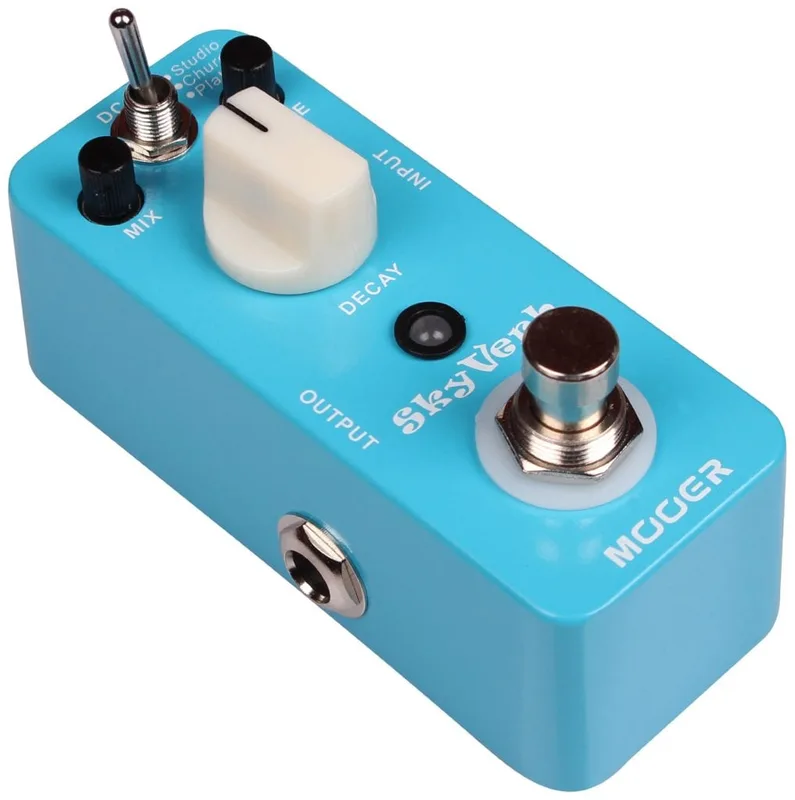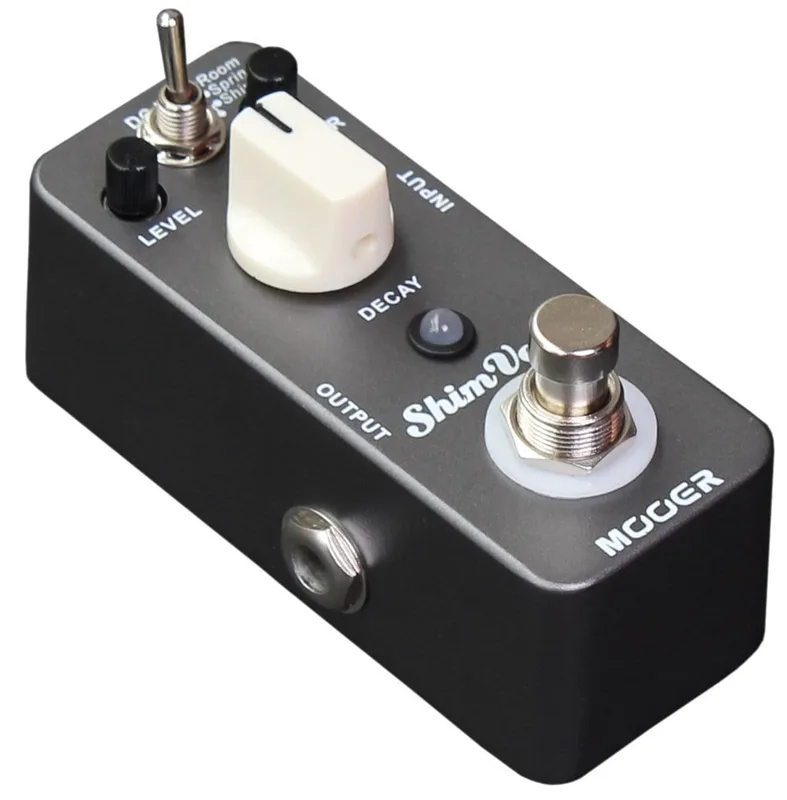


The Mooer ShimVerb is a digital reverb pedal from Mooer Audio, built into the company's micro-series enclosure: a full metal shell measuring 93.5mm deep by 42mm wide by 52mm high and weighing 170g1. It offers three reverb modes, Room, Spring and Shimmer, selected by a toggle switch, with three knobs controlling the sound12. It is true bypass1.
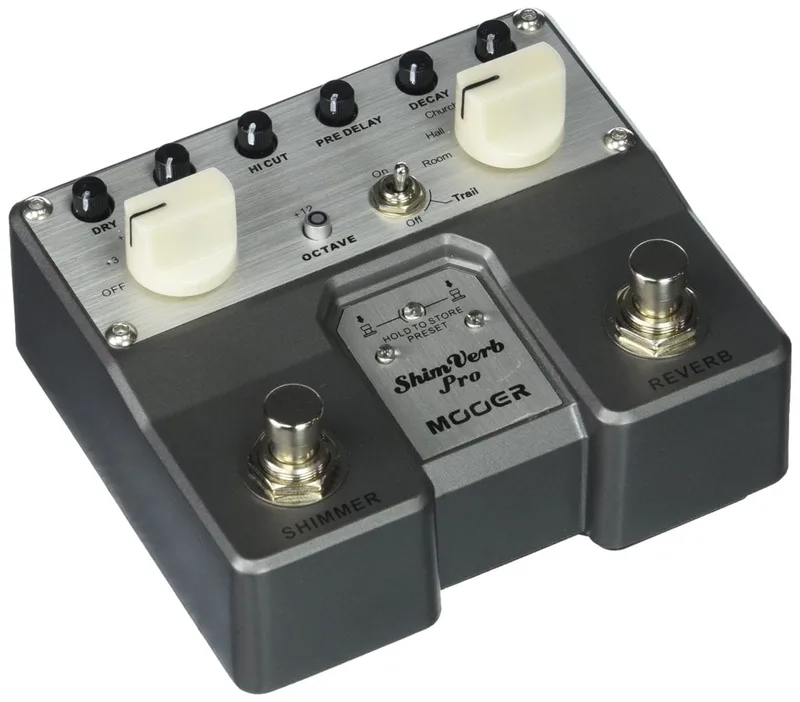
The pedal was part of the wave of compact Mooer micro-series effects that reached reviewers in 20122. Guitar World's Damian Fanelli called it "a wee gem of a pedal"3, and it has since been joined by a larger sibling, the MOOER SHIMVERB PRO, which expands on its shimmer concept4.
Room, spring and shimmer in a micro pedal
The ShimVerb keeps things simple: one toggle switch picks the reverb type, and the three modes cover the main bases a player looks for in a small reverb12.
- Room: Mooer describes it as "Different sized true acoustics reverb, from room to hall"1. Guitar World's reviewer found that "with some tweaking, Room will take you from traditional 'room' to 'hall' reverbs"3.
- Spring: Mooer says it "Simulates a classic spring reverberation, vintage 60's Surfing sound"1. Delicious Audio's reviewer described it as emulating "vintage spring units of the past"6.
- Shimmer: Mooer's description reads "Add rich overtone into the reverb sound, spacy, smooth and shining, very popular in Post Rock music"1. Delicious Audio similarly found it "adds shinning overtones to the reverberated signal making it ideal for Post Rock"6.
The shimmer is the mode the pedal is named for, and it works differently from most shimmer reverbs. MusicRadar's Michael Astley-Brown explains the effect generally: "the 'verb trail is pitch-shifted - usually up an octave - to create an ethereal haze behind your guitar, a little like a synth pad"4. On the original ShimVerb, though, the shift was not an octave: "the original ShimVerb featured only an unusual 5th-up shimmer"4. That fifth-up interval is the pedal's signature and its main limitation compared with the Pro, which offers five intervals that can be combined with octave-up shifting4.
The controls: Decay, Level and Color
Three knobs and a mode switch are the whole interface, which MusicPlayers.com found "pretty much a plug and play application with slight tweak of the controls to meet your personal taste"2.
| Control | What it does |
|---|---|
| Level | Mix of wet/dry signal; controls the amount of reverb added to your signal26 |
| Decay | Controls the time it takes the reverb tails to decay6 |
| Color | Control of the effect coloration/presence; affects different parameters depending on the mode26 |
The Color knob is the one that changes character between modes. In Spring mode, "Color adjusts the level of the clanging springs"6, so it acts as a tone control over the spring character, while in the other modes it shapes the coloration and presence of the reverb26.
Power: 9V, 128mA
The ShimVerb has no internal battery. MusicPlayers.com's reviewer noted that "there is no room for an internal battery, so you'll have to rely upon an external power supply"2, and Gearnews points out that, as with most mini pedals, "it needs an external 9 volt power supply to run"5.
Power comes from a 9V DC AC adapter with a center minus (center negative) plug12. The current draw is 128 mA1, which is on the higher side for a pedal this size, so a player running several digital pedals on one daisy chain should budget for it. Mooer also lists the pedal as "Very small and exquisite" with a full metal shell1; MusicPlayers.com describes the micro-series casing as forged metal with a screw-on back plate, light in weight partly because of a thin gauge metal2.
What reviewers said
Reviews across a decade were broadly positive, with the Shimmer mode drawing the most praise and the Room and Spring modes getting more mixed notices.
MusicPlayers.com gave the ShimVerb Digital Reverb a 3.5 overall rating in 2012, in a scale where 3.6 stars or better earns a Worth It Award, and found that "the ShimVerb delivers some cavernous sounds that are far greater than its diminutive size"2.
Delicious Audio's Gus Green liked two of the three modes strongly:
"I really like Spring and Shimmer . I am a sucker for Spring reverb as it is and this is a really good emulation and I really like that you can adjust Decay and Spring sounds."
He added that "The Shimmer mode brings me back to the 80s. Its added sparkle will add space and shine to your tone"6.
Guitar World's 2017 review, drawing on Premier Guitar's findings, called the Shimmer mode "the star of the show and can dish out startlingly rich, glammy, post-rock colors with fluttering, warm overtones"3. The same review was cooler on the other two modes, finding that "both modes can sound a bit boxy at times, and Room had a touch of sterility"3. The reviewer also liked the pedal's gunmetal gray finish3.
Price and the ShimVerb Pro
At launch in 2012, the ShimVerb carried a $99 MSRP and sold for $88 online2. By 2017 Guitar World's reviewer reported picking one up "for less than $64, including shipping"3, and Gearnews listed it at £61 in 20205.
Mooer later expanded the concept into the MOOER SHIMVERB PRO. MusicRadar notes that "Mooer's ShimVerb is one of the most affordable - and the Pro takes it to another level"4. The Pro offers five reverb types, all with assignable shimmer activated by a separate footswitch, plus preset saving by holding both footswitches4. Where the original gave you only the fixed 5th-up shimmer, the Pro's adjustable intervals drew MusicRadar's verdict that "the adjustable intervals are inspirational, while dropping the wet signal and cutting the highs keeps things from getting cheesy"4.
Videos
Prymaxe
intheblues
Ryan Lutton
Questions
Is the Mooer ShimVerb true bypass?
Yes. Mooer lists the ShimVerb as true bypass on its product page, and Guitar World's review confirms it13.
Does the Mooer ShimVerb take a battery?
No. There is no room for an internal battery in the micro-series enclosure, so it runs only from an external 9V power supply25.
What interval is the shimmer on the original ShimVerb?
The original ShimVerb featured only an unusual 5th-up shimmer, rather than the octave-up shift most shimmer reverbs use4.
Where is the Mooer ShimVerb made?
China, according to both MusicPlayers.com's 2012 review and Guitar World's 2017 review23.
How much did the Mooer ShimVerb cost?
It launched with a $99 MSRP, selling for $88 online in 20122. A 2017 review reported a purchase price under $64 including shipping, and Gearnews listed it at £61 in 202035.
What power supply does the Mooer ShimVerb use?
A 9V DC AC adapter with a center minus (center negative) plug, drawing 128 mA1.
Sources (6)
- ShimVerb_MOOER Audio, MOOER Audio
- Mooer Green Mile Overdrive and ShimVerb Digital Reverb Micro Series Pedals, MusicPlayers.com, 2012-06-12
- Gear Review: Mooer Audio ShimVerb Reverb Pedal, Guitar World, 2017-10-18
- Mooer Shimverb Pro review, MusicRadar, 2015-03-02
- 8 more cheap pedals every guitarist needs to try, www.gearnews.com, 2020-09-12
- Guitar Pedal Reviews: Mooer Micro Pedals Vol. 1, Delicious Audio, 2013-04-15