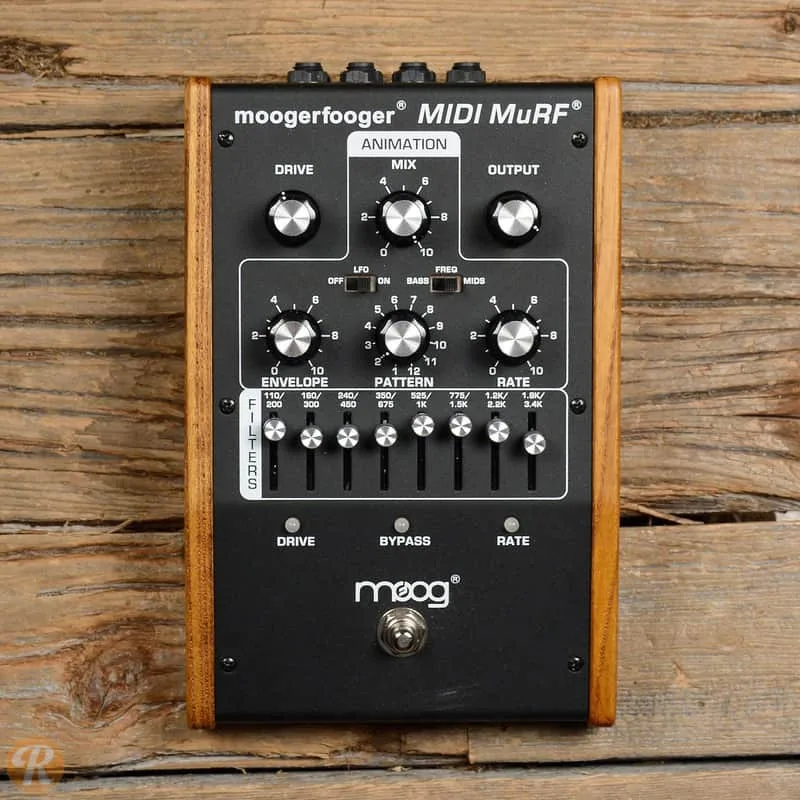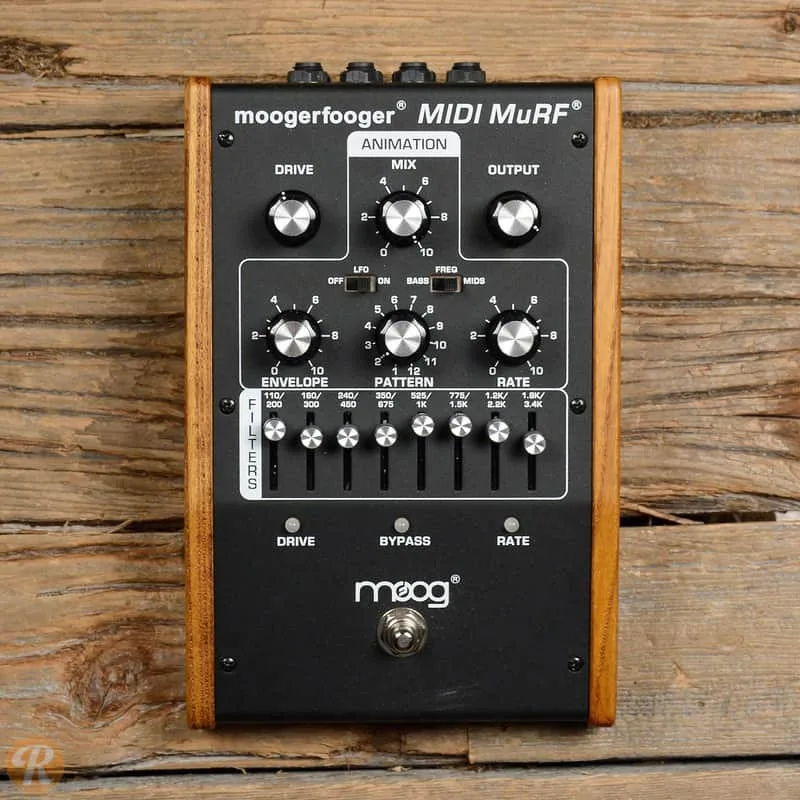


The Moog MF-105M MIDI MuRF is a filter pedal from Moog's Moogerfooger line, released in 2009. It is a filter sequencer: a bank of eight resonant filters whose volumes are switched on and off in rhythm by an internal pattern generator, producing animated, stepped filter effects that Vintage Synth Explorer describes as everything from "morphing drones, stuttering lead lines, filtering drum patterns, or space age sequences"1.
What sets the MF-105M apart from the earlier MuRF pedals is control. All audio processing is 100% analog, but its parameters can be driven from MIDI, expression pedals or CV-compatible instruments, and its pattern rate can sync to MIDI Clock1. It was the third pedal in the MuRF series, shown at NAMM in July 20091.
An eight-band resonant filter sequencer
The core of the pedal is a bank of eight resonant band-pass filters tuned to fixed frequencies. On top of that sits the Animation section: an eight-channel sequencer with one channel for each filter. Patterns trigger an envelope generator that shapes the volume of each filter, so a pattern is really a rhythmic map of which bands speak and when3. The sequencer supports patterns up to 64 steps long1.
Because the filters are tuned to fixed frequencies, the effect is less like a sweeping wah and more like a rhythmic equalizer that pulses in time. Vintage Synth Explorer classifies the unit as monophonic and one part multitimbral, with no oscillators of its own; it processes whatever audio you feed it1.
Mids and Bass modes
The MF-105M's headline feature over its predecessors is a switch between two frequency band sets, so you can animate the range that suits your instrument1.
| Band | Mids mode | Bass mode |
|---|---|---|
| 1 | 200 Hz | 110 Hz (low-pass) |
| 2 | 300 Hz | 160 Hz |
| 3 | 450 Hz | 240 Hz |
| 4 | 675 Hz | 350 Hz |
| 5 | 1 kHz | 525 Hz |
| 6 | 1.5 kHz | 775 Hz |
| 7 | 2.2 kHz | 1.2 kHz |
| 8 | 3.4 kHz | 1.8 kHz |
Frequencies from Vintage Synth Explorer1.
In Mids mode all eight bands act as resonant filters spanning 200 Hz to 3400 Hz, a range Premier Guitar found useful not only for guitar but for synthesizers and voice, since any instrument with a strong midrange benefits from the mode's rich harmonics3. In Bass mode the first filter becomes a low-pass with a cutoff at 110 Hz, letting bass players reach lower frequencies, while the other seven bands run from 160 Hz to 1800 Hz3.
Bass mode is not reserved for bass. Premier Guitar's reviewer noted that guitarists can use it as well, especially those who downtune, because it leaves higher notes less colored by the effect3.
The controls
The front panel keeps things compact. Premier Guitar's review walks through what each control does3:
| Control | What it does |
|---|---|
| Rate | Speeds up and slows down the pattern, from slow volume swells to fast pulsating rhythms; can be clocked via MIDI |
| Envelope | Adjusts attack and decay of the envelope generator, which acts as a square wave |
| Drive | Adjusts the input volume of the signal |
| Output | Sets the overall output level |
| LFO | Off/On switch |
The Envelope control repays a closer look. At 12 o'clock the attack is sharp with a smooth decay; turning counterclockwise shortens the decay and makes notes choppier, while turning clockwise past noon makes the filters crossfade into one another3. Premier Guitar noted this single-knob approach differs from the usual four-slider attack, decay, sustain, release layout, but found it made adjusting the envelope easier and more intuitive3.
Rate can be set three ways: by the knob, by an expression pedal, or with Tap Tempo4.
Patterns and the Pattern Editor
There are 12 patterns for each frequency mode. Premier Guitar reports that patterns 1 and 12 are fixed, with pattern 1 giving you just the filters with no animation, and that patterns can be overwritten using Moog's Pattern Editor software3. Vintage Synth Explorer lists the 12 patterns per mode as user editable3.
Moog shipped the Pattern Editor as a free Mac/PC download that lets you draw custom patterns and transfer them to the pedal1. Premier Guitar's reviewer found a learning curve on first use, but after reading the PDF manual included with the download was able to quickly create and save sequences3.
Power and connections: MIDI, CV and stereo outputs
The back panel carries MIDI In, Audio In, and Audio Left/Mono and Right outputs for stereo operation, plus an array of CV inputs including Tap/Step (for tempo input), LFO/Sweep, Rate, Mix and Envelope3. Control sources listed by Vintage Synth Explorer are MIDI in, tap/step in, and CV for Rate, Mix, Envelope and LFO/Sweep1.
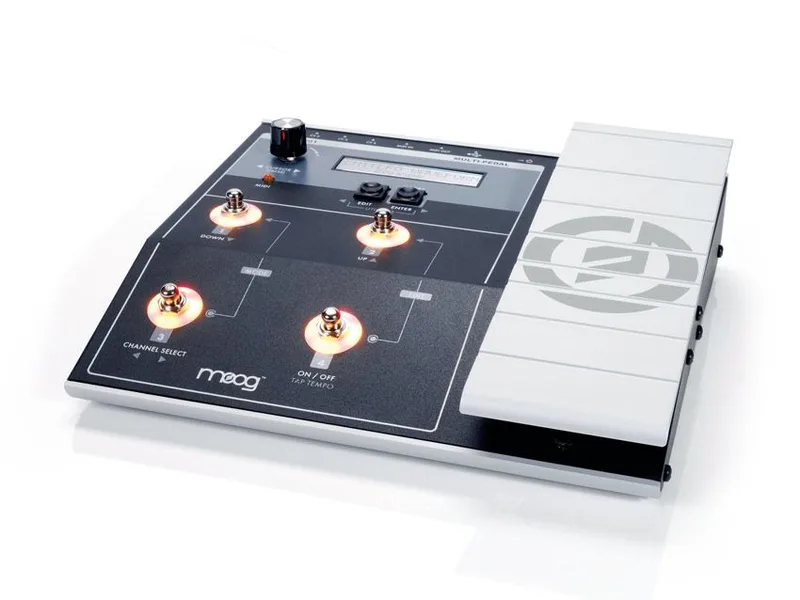
The MIDI implementation is what puts the M in MF-105M: the pedal can sync to MIDI Clock, so its patterns lock to a sequencer or drum machine's tempo rather than being tapped in by hand56. Like all Moogerfoogers, Moog described the enclosure as built like a tank for touring and studio use4.
History: the MuRF and Bass MuRF combined
The MF-105M is a combination of the MF-105 MuRF and the MF-105B Bass MuRF, both designed by Bob Moog, merged into one unit71. It combines the features of its two predecessors1. It was produced in 20091, and it joined the Moogerfooger family as the latest addition to the line2.
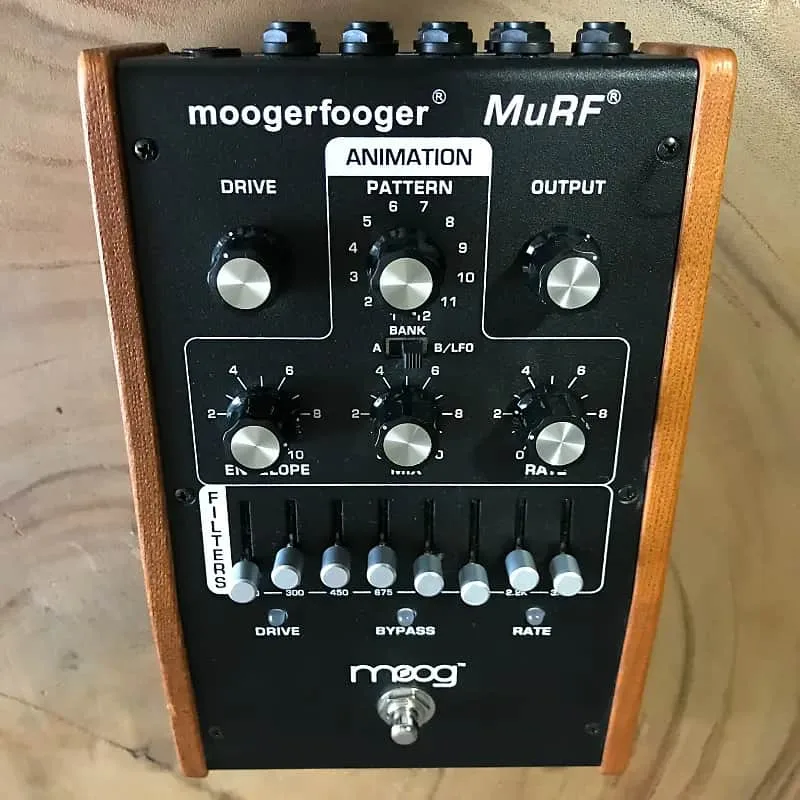
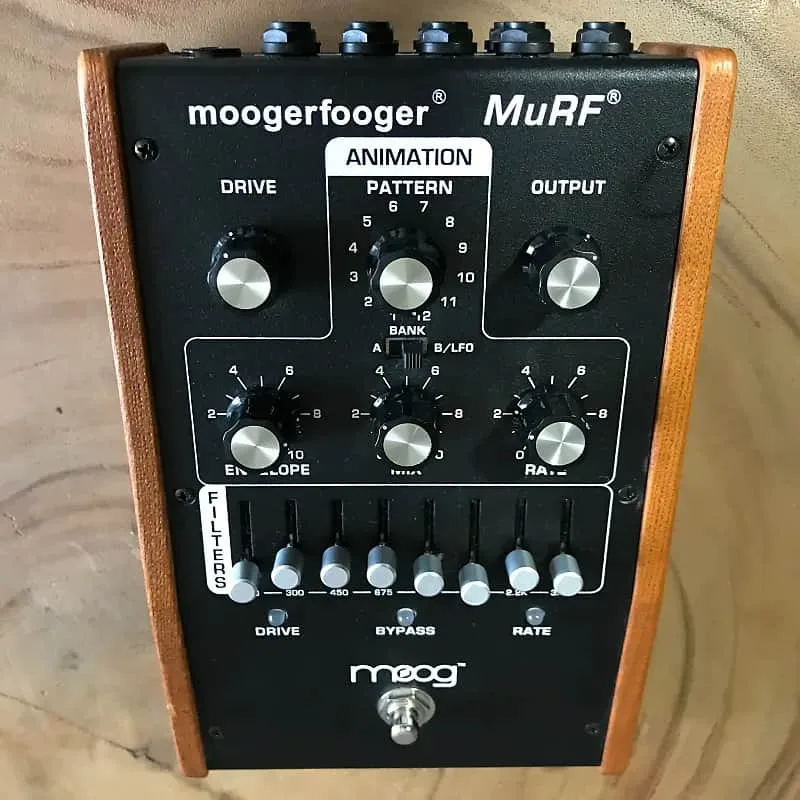
The earlier MF-105 MuRF was itself 100% analog with the same eight fixed band-pass filters at its heart and a 24-pattern Animation sequencer, plus two output jacks for stereo8.
Moogerfooger pedals fetch outlandish prices on the secondhand market9.
What reviewers said
Premier Guitar's review found the pedal "can seem daunting at first, especially with all the MIDI features," but credited the manual as "well written and easy to follow," saying it helped a lot when learning the features3. On value, the reviewer's verdict was blunt: if sequencing is not your thing, "it's pricey for just straight-ahead filtering" at a $459 street price3.
Vintage Synth Explorer carries a February 2013 review by GuyaGuy1. Writing about the earlier MF-105 MuRF during Moog Week, Pedal of the Day's Mike B praised "the very unique and extremely expressive sounds" the filter bank and Animation module produce together8.
Videos
Moog Music
Moog Music
soundpurestudios
Questions
Is the MIDI MuRF analog?
Yes. All audio processing in the MF-105M is 100% analog, a trait it shares with the earlier MF-105 MuRF. The digital side handles control only: MIDI, the pattern sequencer and the Pattern Editor software send instructions to the analog filter array, but the signal path itself stays analog.
Can the MIDI MuRF sync to MIDI clock?
Yes. The MF-105M can synchronize its pattern rate to MIDI Clock through its MIDI In, which was one of the main additions over the earlier MuRF pedals. The Rate control can also be set by an expression pedal or Tap Tempo, and the pattern rate can be clocked via MIDI.
Can guitarists use the MuRF Bass mode?
Yes. Premier Guitar's reviewer noted that Bass mode is not just for bass players, and that guitarists can use it too, especially those who downtune, since it leaves higher notes less colored by the effect. Bass mode puts the first filter at 110 Hz as a low-pass, with the other seven bands from 160 Hz to 1.8 kHz.
How many patterns does the MIDI MuRF store?
There are 12 patterns for each frequency mode. Premier Guitar reports that patterns 1 and 12 are fixed, with pattern 1 offering the filters without animation, and that the rest can be overwritten using Moog's free Mac/PC Pattern Editor software. Vintage Synth Explorer lists all 12 per mode as user editable.
Is the Moog MIDI MuRF stereo?
Yes. The MF-105M has Audio Left/Mono and Right outputs, so it can run in stereo. The earlier MF-105 MuRF also offered stereo operation through its two output jacks.
Sources (9)
- Moog MF-105M MIDI MuRF, Vintage Synth Explorer, 2026
- NAMM Watch: MF-105M MIDI MuRF, No Treble, 2009-07-22
- Moog MF-105M MIDI MuRF Pedal Review, Premier Guitar, 2010-04-15
- Moog Music launches the MF-105M MIDI MuRF, Premier Guitar, 2009-07-22
- MIDI PedalBoard Devices: Guitar Effect Pedals that Sync to MIDI Clock, Molten Voltage (blog.moltenvoltage.com), 2014-10-07
- MIDI PedalBoard Devices: MIDI PedalBoards are finally a reality, Molten Voltage (blog.moltenvoltage.com), 2013-05-07
- Moog launches MF-105M MIDI MuRF Filter Array Pedal, MusicRadar, 2009-07-21
- Moog Moogerfooger MF-105 MuRF, Pedal of the Day, 2015-12-17
- The Best Budget Effects Pedals for Electronic Music Production, gearnews.com, 2025-07-02