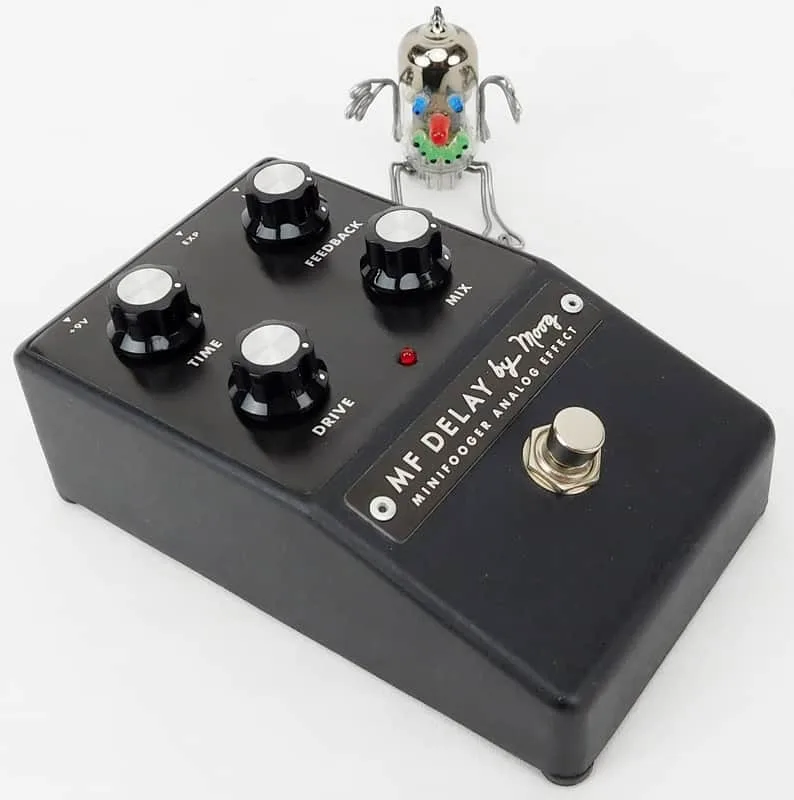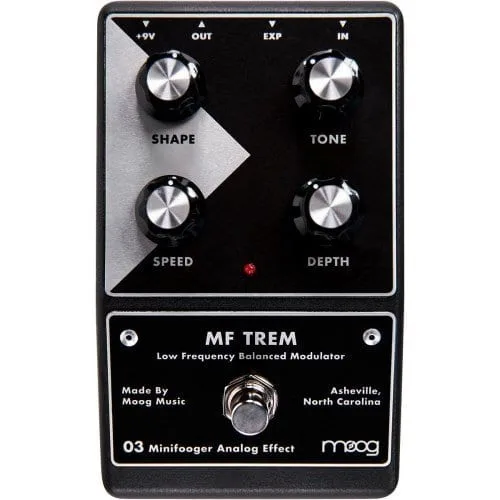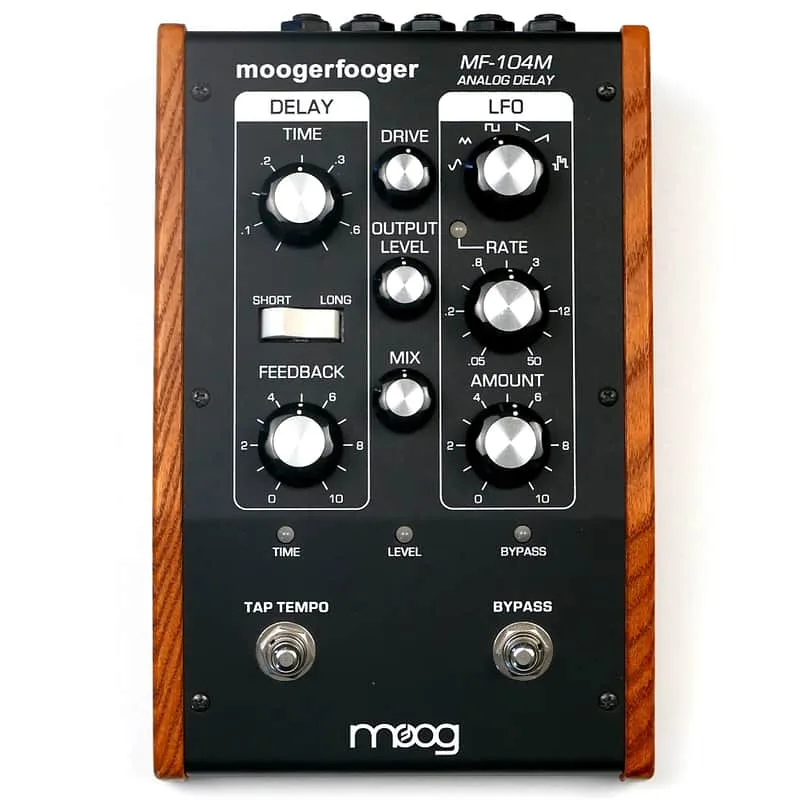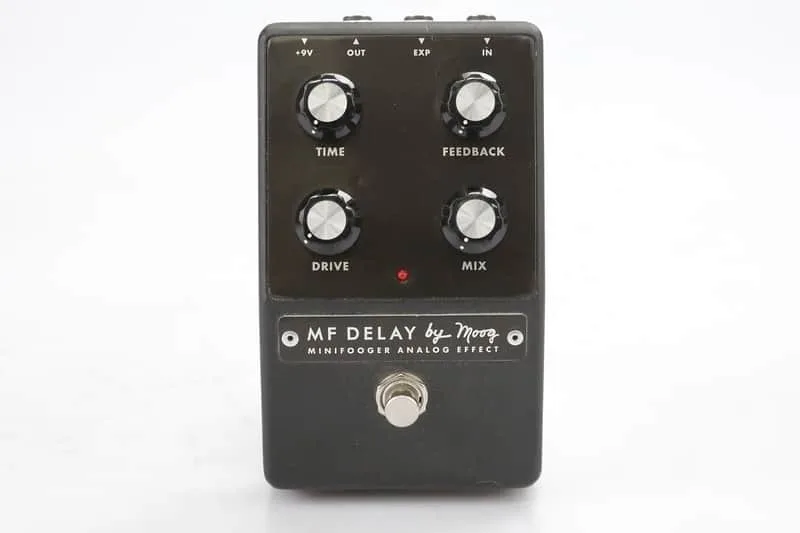


The Moog Minifooger MF Delay is an all-analog delay pedal from Moog, part of the Minifooger line that shrinks the big Moogerfooger rack-style effects into compact pedalboard-friendly boxes12. Its delay circuit is bucket brigade based, the classic analog approach in which the signal is handed off through a chain of capacitor "buckets" inside a BBD chip rather than converted to digital, and reviewers describe the result as warm, rich and full repeats with what Pedal of the Day called "that signature Moog sound"12.
What sets the MF Delay apart from most delay pedals is a built-in Drive section offering more than 22dB of gain, so the pedal can color or push your signal as well as echo it1.
The controls: Time, Feedback, Drive and Mix
The pedal keeps things to four knobs, and reviewers found them straightforward to figure out1.
| Control | What it does |
|---|---|
| Time | Sets how long the delayed signal is, from 35ms up to 750ms, covering slapback through long dark analog repeats1 |
| Feedback | Sets how many repeats, from zero to infinite, up into self-oscillation1 |
| Drive | Up to 22dB of gain, from a mild boost to a warm low gain or a powerful drive1 |
| Mix | Blends the wet and dry signals in any configuration, and can eliminate the dry signal entirely1 |
The Time control is the heart of any bucket brigade delay. In MusicRadar's review of the Minifooger MF Flange, the reviewer noted that in this circuit family "it is the Time control that forms the character, at the heart of which is the BBD (Bucket Brigade Delay)"3.
Feedback is where the pedal gets expressive. Pedal of the Day's Mike B found that "The Feedback section will go from one single repeated note all the way up into self-oscillation territory"1, meaning the repeats build on each other until they sustain on their own, a behavior analog delay players use for drones and textures. Not every Minifooger does this: MusicRadar noted the MF Flange "doesn't feed back into self-oscillation"3.
The Drive section is the MF Delay's distinguishing feature. With up to 22dB of gain it can sit at a mild boost, a warm low gain, or a full drive, and because Mix can remove the dry signal completely, the drive and delay paths can be balanced in any proportion1. Reviewing the closely related MF Analog Delay in 2014, Pedal of the Day put it simply:
"a delay pedal with a Drive section is just brilliant"
The same reviewer found that blending Feedback and Drive together gives "the makings of an incredible soundscape"2.
Expression pedal control
An expression pedal jack on the MF Delay lets you control either the Time or Feedback functions in real time1. This is a shared feature of the Minifooger range: MusicRadar's reviews note the pedals "all have an expression pedal/CV input at the rear for extra control"3, and the series offers "the facility to plug in an expression pedal... for real-time parameter adjustment"4. For a delay, sweeping Time with an expression pedal produces pitch-bending tape-echo effects, while sweeping Feedback rides the repeats from a single echo toward self-oscillation. See expression pedals for more on how these work.
Where it came from
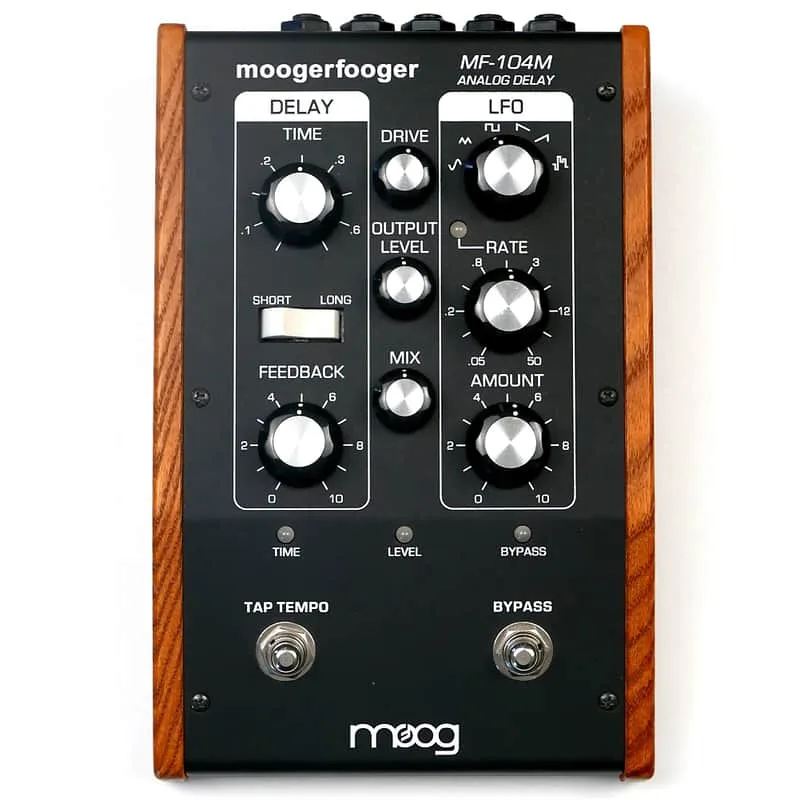
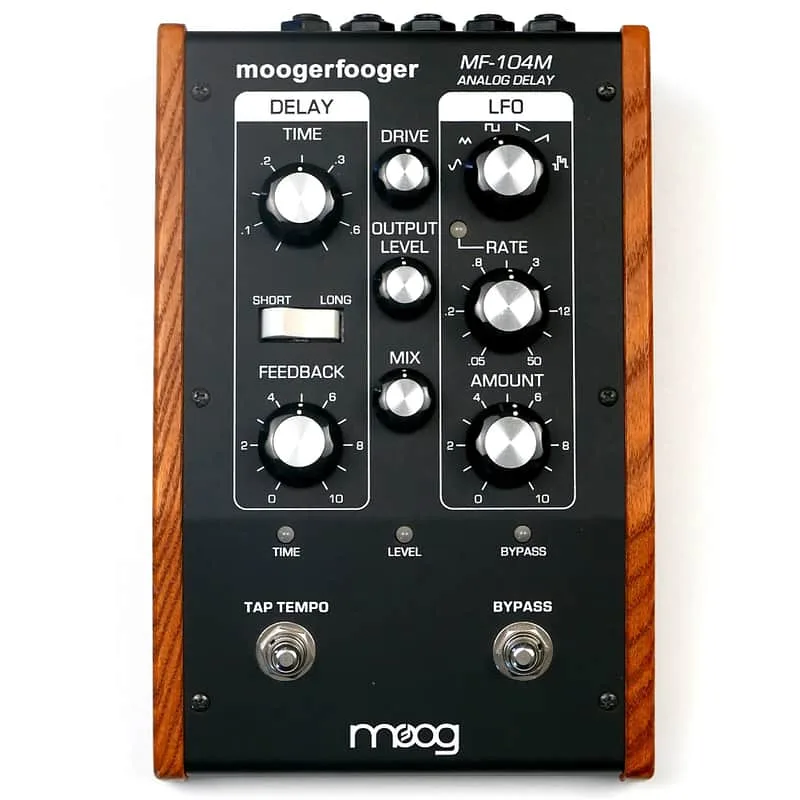
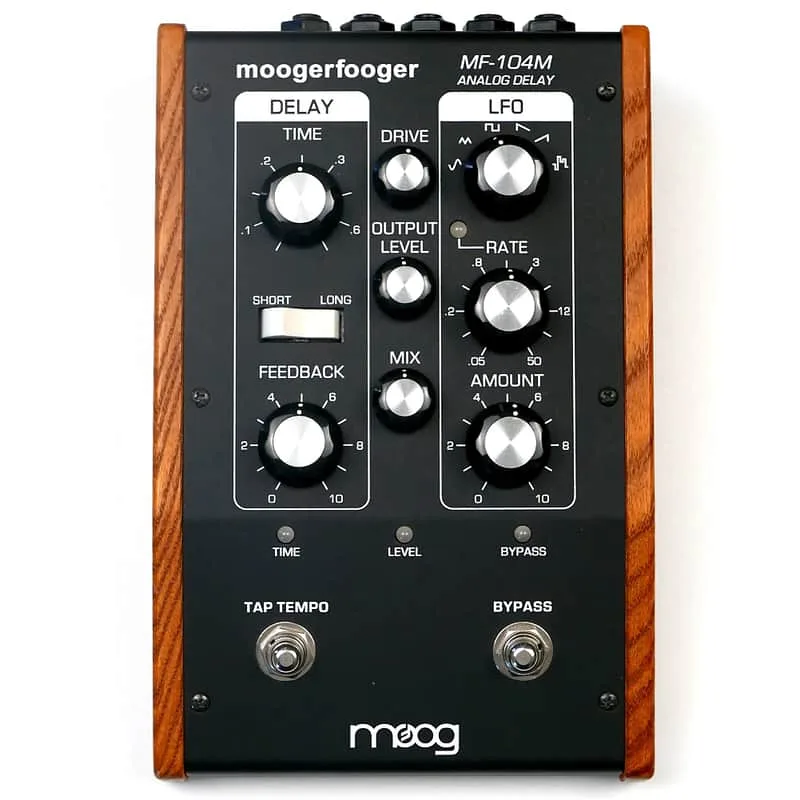
The Minifooger pedals are, as Pedal of the Day put it, "basically compact versions of the big Moogerfoogers"2, Moog's larger effects units such as the Moog MF-104M Moogerfooger Analog Delay. When Pedal of the Day reviewed the line in 2014, the Minifoogers were the newest additions to Moog's pedal line2. The MF Delay itself sits in the line alongside the Moog Minifooger MF Analog Delay, which shares the same four-knob layout of Drive, Time, Feedback and Mix2.
The MF Delay also carries a piece of Moog's analog delay tradition in its circuit. It uses a vintage compander circuit1, the same kind of noise-management approach found in classic analog delay designs, and its drive section offers up to 22dB of gain, so a player can dial it in as a mild boost, a warm low gain or a powerful drive1.
What reviewers said
Pedal of the Day reviewed the MF Delay1. On usability, the reviewer found the controls straightforward compared with other pedals covered that week:
"The controls are pretty easy to figure out here, which is a bit of a change of pace from some of the other pedals we’ll be reviewing this week."
The reviewer also noted the pedal's feature set, including a Mix control that works as a blend knob for the wet and dry signals in any configuration, and that allows the dry signal to be completely eliminated1. The drive section gives up to 22dB of gain for boost and color1, and the pedal includes a vintage compander circuit1.
Videos
ProGuitarShopDemos
Sweetwater
Chicago Music Exchange
Questions
Is the Moog Minifooger MF Delay true bypass?
Yes. The MF Delay carries true bypass switching, which Moog's Minifooger range uses to keep a high-quality signal path when the effect is off. Reviewers covering the Minifooger line have noted true bypass as a standard feature across the pedals.
Is the Minifooger MF Delay analog or digital?
It is all-analog. The delay circuit is bucket brigade based, meaning the signal passes through a bucket brigade device chip rather than being digitized. Reviewers describe the repeats as warm, rich and full, which is characteristic of analog delay.
How long can the delay time go on the MF Delay?
The Time control offers a range from 35ms up to 750ms, covering everything from short slapback echo to long, dark analog repeats. The pedal is also described as offering 700ms of bucket brigade based analog delay.
Can the MF Delay self-oscillate?
Yes. The Feedback control ranges from zero to infinite, and turning it up takes the pedal from a single repeated note all the way into self-oscillation territory, where the repeats build into their own sustained signal.
Can I use an expression pedal with the Minifooger MF Delay?
Yes. The MF Delay has an expression pedal jack that lets you control either the Time or Feedback functions in real time. Expression and CV control is a feature across the Minifooger range.
Can the Drive section be used without the delay?
The Drive control gives up to 22dB of gain, dialable from a mild boost to a warm low gain or a powerful drive. Because the Mix control allows the dry signal to be completely eliminated, the Drive and delay sections can be blended in any configuration.
Sources (4)
- Moog Minifooger MF Delay, Pedal of the Day, 2015-12-14
- Moog Minifooger MF Analog Delay, Pedal of the Day, 2014-11-26
- Moog Minifooger MF Flange review, MusicRadar, 2016-01-30
- Moog Minifooger Drive review, MusicRadar, 2014-07-07