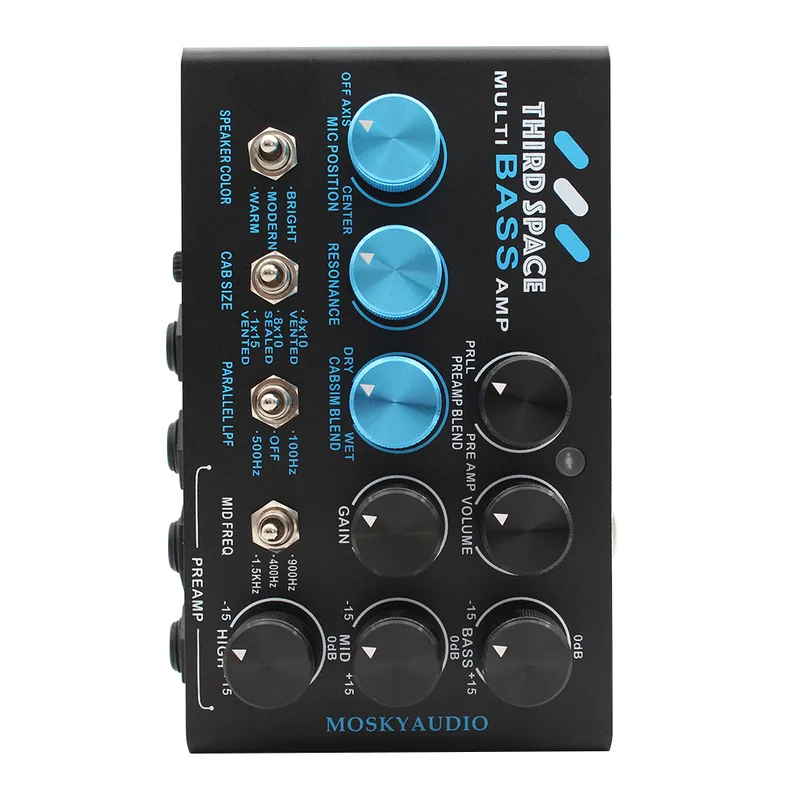

The Mosky Third Space Multi Bass Amp is an analog bass preamp and DI pedal that puts a full amp-style front end on a pedalboard. Mosky describes it as "a full featured preamp based on the classic Ampeg SVT(C) amp," paired with "an amazing analog cabinet simulation, based on the acclaimed Omnicabsim"1. RockBoard's PedalPedia classifies it as a preamp and DI pedal, and calls it "ein analoger 0-Watt-Stereo-Bassverstärker und DI-Pedal," an analog zero-watt stereo bass amplifier and DI pedal2.
What it is and how it fits a rig
The Third Space is built for players who want amp tone without an amp. Because it is a zero-watt design, it carries the preamp, EQ and cabinet simulation of a bass amplifier in a pedal, and its DI output lets it feed a mixing desk or interface directly2. Mosky markets it as "The first Zero watt stereo bass amplifier that will fit in your pedalboard," and the Aux In sends an incoming signal in stereo to the headphone output, so a player can practice silently along with a track1. RockBoard's PedalPedia also notes that it "bietet einen röhrenähnlichen Overdrive," offering a tube-like overdrive2.
It belongs to the wider family of preamp pedals and speaker simulation pedals, and sits alongside other bass-focused tools in the bass pedals category.
Built on the classic Ampeg SVT circuit
The preamp section is based on the Ampeg SVT, the all-tube bass amplifier introduced in 1969. RockBoard's PedalPedia, in a page on an SVT-inspired design, notes that "When the SVT® arrived on the scene in 1969, it rewrote the rulebook for purpose-built bass amplification"3. The amplifier's full name is remembered in Till Hoheneder's account of its origins: "the team came up with a 300-watt all-tube phantasmagoria they called the Super Vacuum Tube-or SVT, to save on vowels"4. Mosky's claim is that the Third Space's preamp stage draws on that circuit, and RockBoard's PedalPedia entry for the pedal agrees, stating that the preamp section is based on the classic Ampeg SVT circuit12.
The controls and EQ
The pedal includes a bass preamp with gain, level, and a three-band EQ with a semi-parametric mid control1. The EQ bands are generous: Mosky specifies a flexible EQ with plus or minus 15dB per band, and a switchable midrange at 400, 900 or 1200Hz1.
| Control | What it does |
|---|---|
| Active/Passive | Lowers the gain for a very hot bass (active), or compensates for a low-level bass signal with a slight 6dB boost (passive)1 |
| High | Controls the high frequency band, plus or minus 15dB at 3.5kHz, shelving1 |
| Mids | Controls the mid band, plus or minus 15dB, bandpass, at the frequency set by the mid freq switch1 |
| Mid freq switch | Switchable midrange center at 400, 900 or 1200Hz1 |
| Level | Sets the preamp master volume level1 |
| MIC POSITION | Responds like a real CENTER/OFF AXIS microphone position, adjusting the precise amount of high-end roll off1 |
The semi-parametric mid is the control that gives the EQ its shape: rather than a fixed mid band, the player picks one of three center frequencies with the switch and then cuts or boosts up to 15dB around it with the Mids knob1.
Cabinet and speaker simulation
The cabinet simulation is analog, based on the Omnicabsim, and Mosky describes the pedal as achieving "unprecedented analog realism thanks to its mic'd cabinet simulation"1. Two switches shape that simulation:
- Cab Size switch, 8x10 Sealed: Mosky describes this setting as a "Huge sounding resonant low end cabinet with modern speakers"1.
- Speaker Color switch, Warm: a vintage speaker with clearer mid response and smoother highs1.
- Speaker Color switch, Bright: aluminum cone speakers with their particular mid high bite1.
The MIC POSITION control works with this simulation, behaving like moving a microphone between center and off-axis positions in front of the cabinet and rolling off the high end accordingly1.
Power and practical notes
The Third Space runs on a 9V DC, center negative supply, the standard for pedalboards, and draws 100mA12.
RockBoard lists the current draw at 100mA2, which is higher than many small pedals use, so a daisy chain shared with several other pedals may not be the right home for it on a crowded board; an isolated supply output with enough current is the straightforward choice.
Videos
Adam Faulkner
Questions
Does the Mosky Third Space work as a DI box?
Yes. RockBoard's PedalPedia lists the Third Space as a preamp and DI pedal, so it can send a balanced signal to a mixing desk or audio interface as well as feeding an amplifier or headphones. That makes it usable as the front end of a rig on its own, taking the bass straight to the board while the cabinet simulation shapes the tone.
Is the Mosky Third Space analog or digital?
It is an analog pedal. RockBoard's PedalPedia lists the circuit type as analog, and Mosky describes the pedal as achieving analog realism through its mic'd cabinet simulation. The cabinet simulation itself is also described by Mosky as analog, based on the Omnicabsim.
What power supply does the Mosky Third Space need?
The pedal runs on 9V DC with a center negative plug, the same standard supply most pedalboards use. RockBoard lists the current draw at 100mA, so a standard isolated pedal power supply output rated at 100mA or more will run it.
Is the Mosky Third Space a real amp with its own power?
No. It is a zero-watt design: there is no output stage driving a speaker. Mosky calls it the first zero-watt stereo bass amplifier that fits on a pedalboard, meaning it delivers the preamp, cabinet simulation and DI functions of an amp without the amplifier hardware, so it is silent on stage or in the practice room.
What does the semi-parametric mid control do?
The Mids control is a bandpass control with plus or minus 15dB of cut and boost, and its center frequency follows the mid frequency switch, which Mosky gives as 400, 900 or 1200Hz. That combination lets a player choose which part of the midrange the control acts on, then set how much cut or boost is applied.
Sources (4)
- THIRD SPACE_Bass Effect Pedal_Products_mosky pedal, moskyaudio.com
- Third Space Multi Bass Amp by Mosky, RockBoard (PedalPedia), 2026
- BassRig Super Vintage by Origin Effects, RockBoard PedalPedia, 2026
- Ron Wood, treblebooster.net (BSM - Finest Treble Booster), 2025