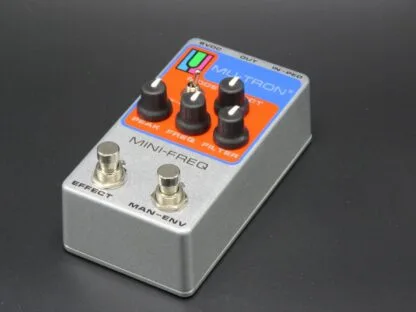
The Mu-Tron Mini-Freq is a state variable filter pedal from Mu-Tron, the maker describes it as a filter with multiple actuating options: it can be run as an envelope filter, a wah-wah pedal, or a parametric EQ with resonance control1. That flexibility comes from the state variable filter at its core, a type of active filter circuit that produces simultaneous lowpass, highpass, and bandpass outputs from a single input1. In practice, that means one pedal can cover auto-wah quack, foot-swept wah, and fixed resonant EQ shaping.
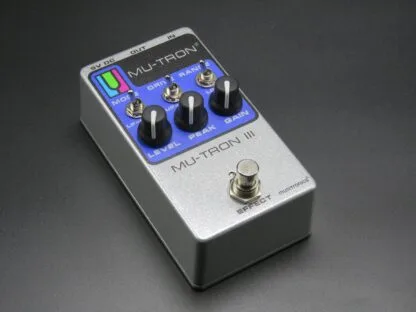
It is an optically controlled state variable filter, the same family of circuit as the classic Mu-Tron III and the Mu-Tron Vol-Wah1. The Mini-Freq carries a list price of $279.001.
A state variable filter with three modes
The Mini-Freq's lowpass, bandpass, and highpass modes let you choose which part of the spectrum the filter sweeps1. Lowpass mode is the familiar envelope-filter sound, opening up as you play harder and closing down as the note decays. Bandpass narrows the effect to a resonant peak, the vocal, quacky auto-wah character. Highpass does the opposite, thinning the signal as the filter moves.
The state variable topology is what makes all three available at once. As Mu-Tron explains it, this type of active filter produces simultaneous lowpass, highpass, and bandpass outputs from a single input1, so the mode switch selects which output you hear rather than reconfiguring the circuit.
The controls
| Control | What it does |
|---|---|
| Frequency | Controls the range of frequency manipulation1 |
| Peak | Can be used as resonance or damper control1 |
| Direct gain | Blends dry signal with the filtered signal1 |
| Up and Down drive | Fine-tuned internally for either envelope1 |
The Direct gain control is worth noting for bass players and anyone who wants to keep their fundamental tone underneath the effect: it allows the dry signal to be blended with the filtered signal1. The Up and Down drive settings, which shape how the envelope responds to attack and decay, are fine-tuned internally rather than sitting on the top of the pedal1.
Power
The Mini-Freq operates on standard 9V DC with a negative center tip, and Mu-Tron rates the power port at 100 mA1. The pedal accepts 9V to 12V DC and draws 52 mA1.
The 52 mA draw is modest, but the pedal needs a proper DC supply with a negative center tip. No battery operation is listed.
An optical filter in the Mu-Tron III line
The Mini-Freq's circuit lineage runs straight back to the 1970s. Both the Mu-Tron III and the Mu-Tron Vol-Wah are optically controlled state variable filters, and the Mini-Freq follows the same approach1. In these circuits, the signal's own volume profile drives a light source and photocell pair that sweeps the filter, rather than a foot rocker like a conventional wah. The Mu-Tron Vol-Wah, by contrast, uses a potentiometer in the foot pedal to sweep current to the LED2, which is the same optical element under manual control.
The pedal also uses a modular optical design, which Mu-Tron says allows for consistency across units1, a practical point for players comparing second-hand units or buying sight unseen.
Questions
What power supply does the Mu-Tron Mini-Freq need?
It runs on 9V to 12V DC with a negative center tip, and draws 52 mA. Mu-Tron rates the power port at 100 mA, so a standard 9V pedalboard supply with a 2.1mm center-negative plug covers it. No battery operation is listed.
Is the Mini-Freq the same as the Mu-Tron III?
No. The Mini-Freq is its own state variable filter pedal with multiple actuating options, but it shares the same optically controlled state variable filter design as the Mu-Tron III and the Mu-Tron Vol-Wah, so it sits in the same circuit family rather than being a reissue.
Can I blend the dry signal with the Mini-Freq?
Yes. It has a Direct gain control that lets you blend your dry signal with the filtered signal, which is useful for keeping low end and body in the sound while the filter sweeps over the top of it.
Where is the Mu-Tron Mini-Freq made?
Mu-Tron states that the Mini-Freq is made in the US. It also uses a modular optical design, which the maker says allows for consistency from unit to unit.
Is the Mini-Freq mono or stereo?
It is mono. The pedal has one 1/4 inch input jack and one 1/4 inch output jack, with no second output or stereo routing listed.
Sources (2)
- Mini-Freq Vintage Silver, Musitronics Mu-Tron (mu-tron.com)
- Super-Freq Vintage Silver, Musitronics Mu-Tron (mu-tron.com)