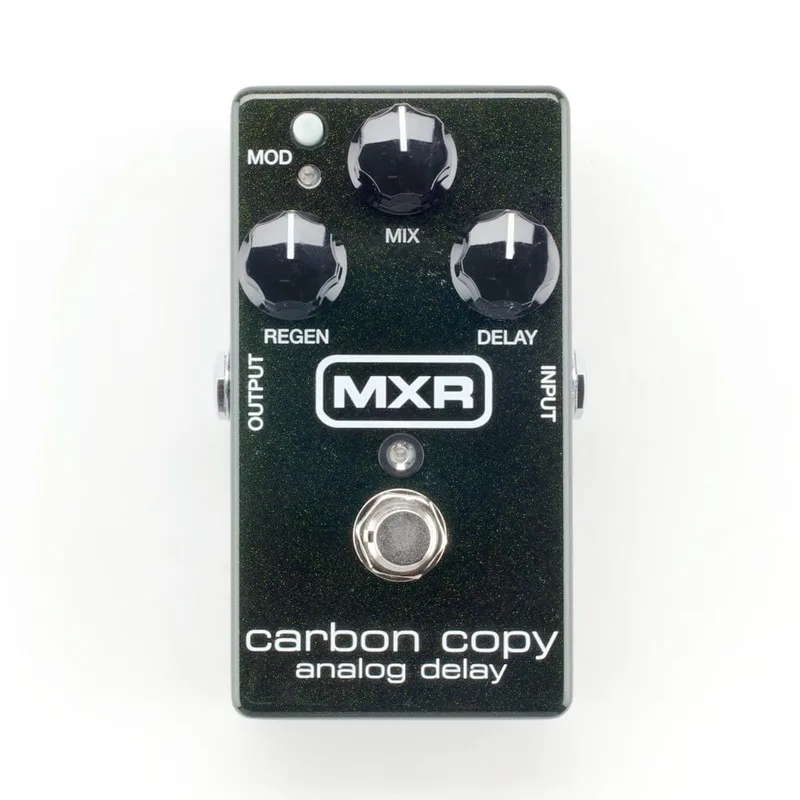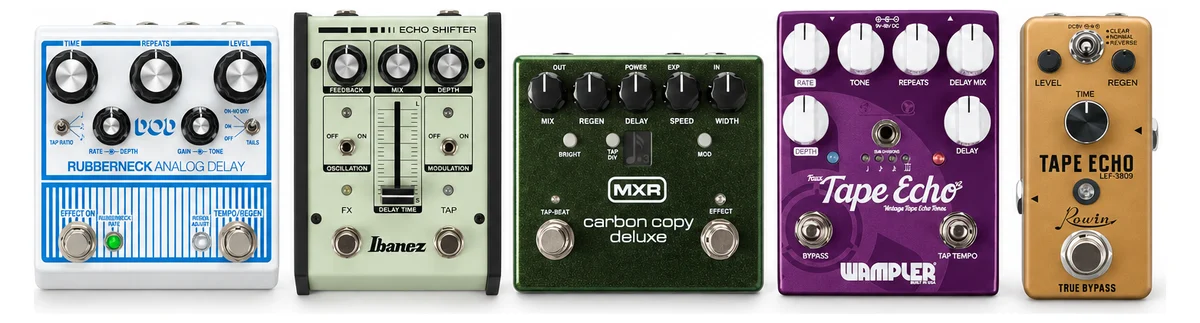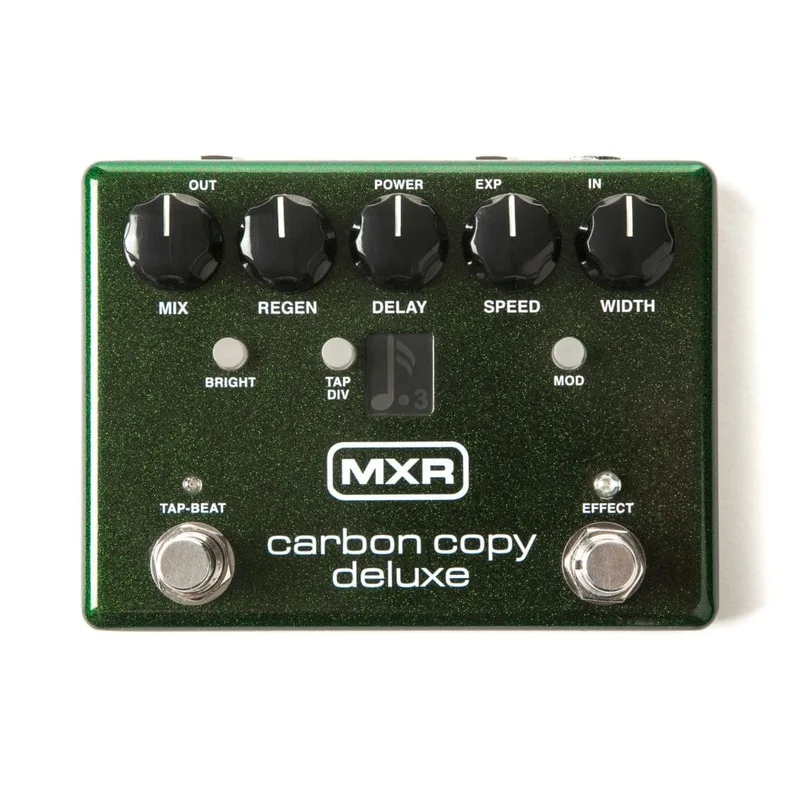


The MXR Carbon Copy Deluxe (model M292) is an analog delay pedal from MXR, released in 2017 as an expanded version of the company's Carbon Copy Analog Delay1. Like the original, it is built on all-analog bucket-brigade technology, the classic circuit approach in which the signal is passed along a chain of capacitor stages to create the repeats2. Where the original Carbon Copy tops out at 600ms, the Deluxe stretches delay time to 40ms to 1200ms34.
What the Deluxe adds over the green original is the feature set players most asked for: tap tempo with four subdivisions, programmable presets, a Bright voicing switch, modulation controls moved from internal trim pots to the outside of the pedal, and a line/instrument level switch so it can live in an amp's effects loop5. MXR's Brian Cahill described the pedal as starting from "the great all analog bucket-brigade technology" of the original and building from there2.
What it does to your sound
Analog bucket-brigade delays are known for repeats that darken and soften as they decay rather than staying crisp like digital delays. Delicious Audio describes the Deluxe's sound as "warm, organic," the quality that made the original what it calls the bestselling analog delay in the world5. The delayed signal rolls off below 200 Hz at the -3 dB point, which is part of why the repeats sit behind your dry tone instead of fighting it3.
The modulation section adds a chorus-like movement to the repeats. On the original Carbon Copy this was controlled by two internal trim pots for width and rate; on the Deluxe the controls are exposed, so you can dial the modulation in from the top of the pedal7.
The controls and switches
The Deluxe keeps the original's core control set of Regen (number of repeats), Mix, Delay and Mod, and adds the switching that gives the pedal its name8. From the M292 manual:
| Control | What it does |
|---|---|
| DELAY knob | Sets delay time3 |
| SPEED knob | Controls the rate of the modulation effect3 |
| Regen, Mix, Mod knobs | Repeat count, wet/dry balance and modulation, carried over from the original8 |
| Bright switch | Engages the Carbon Copy Bright circuit's high-end voicing1 |
| TAP-BEAT footswitch | Sets the tempo of the repeats, indicated by an orange LED3 |
| TAP DIV switch | Cycles through four tap tempo subdivisions, shown on an LED screen3 |
| Effect footswitch | Turns the delay on and off9 |
The four tap subdivisions are dotted 8ths, 8ths, triplets and 16ths3. The EXP jack allows external control of various functions: an external tap switch can act as a tap tempo control, toggle between the A and B preset configurations, or control the Bright, Tap Div or Mod buttons when programmed at power-up3.
Inside the pedal are two internal trim pots. One makes the output 100% wet (Dry Kill), and the other changes the impedance from instrument to line level, which Delicious Audio notes makes the pedal work better with synths and as an outboard mixing effect7.
Power and connections
The Carbon Copy Deluxe is powered by a 9-volt battery, a Dunlop ECB003 9-volt adapter, or the DC Brick and Iso-Brick power supplies, with the adapter and supplies sold separately3. Like the original M169, it runs on both AC and battery power, unlike the Carbon Copy Mini, which is powered only via a 9-volt DC adapter14.
Connections are an input, an output, and the EXP jack for external control of certain parameters5. A Line Level/Instrument Level switch inside the pedal allows it to be used either in front of the amp or in the FX loop5. The bypass is True Hardwire, so the dry signal passes through untouched when the effect is off3.
How it differs from the original Carbon Copy
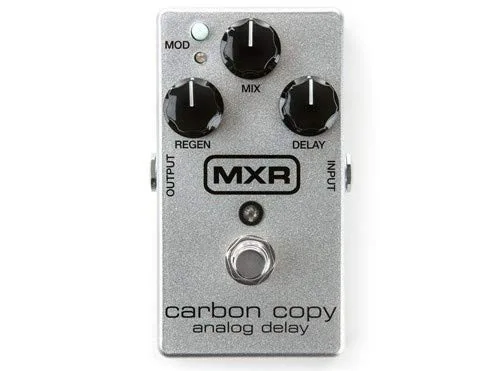
The original Carbon Copy (M169) delivers up to 600ms of analog delay with modulation controlled by internal trim pots4. The Deluxe doubles the delay time to 1.2 seconds and moves the modulation controls outside75. Gearnews summed up the relationship when the Deluxe launched: "MXR's new Carbon Copy Deluxe Delay pedal offers you double the fun of their regular Carbon Copy model"10.
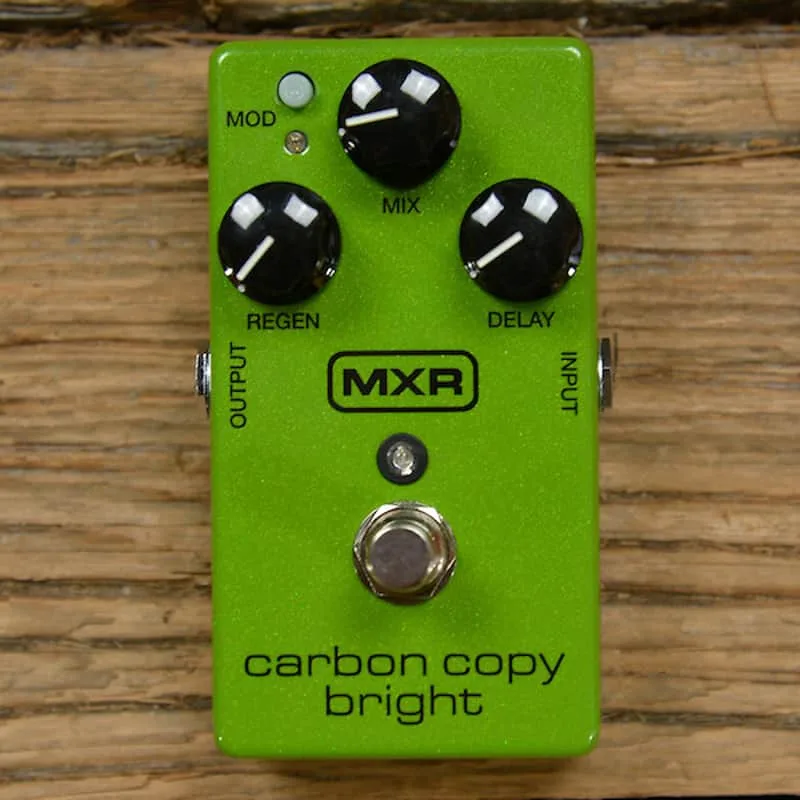
The Bright switch is the other big difference. It engages the vibrant articulation of the Carbon Copy Bright Delay circuit, a voicing MXR introduced in 2015 for players who found the original too dark11. Where the original's echoes are dark and mellow, the Bright's repeats are more defined, with a more distinct vocal quality and enhanced frequency range12. With the switch off, the Deluxe gives you the original's darker tone; with it on, you get the accentuated mids and slight gain in the delays that Cahill described in MXR's demo2.
A quick side-by-side:
| Carbon Copy (M169) | Carbon Copy Deluxe (M292) | |
|---|---|---|
| Delay time | up to 600ms4 | 40ms to 1200ms3 |
| Tap tempo | No | Yes, with four subdivisions3 |
| Presets | No | Two preset slots7 |
| Modulation controls | Internal trim pots7 | Exposed on the pedal7 |
| Bright voicing | No | Bright switch1 |
| Effects loop use | Instrument level | Line/Instrument switch5 |
MXR has since rounded out the family with the Carbon Copy Mini (M299), making three Carbon Copy delays on offer as of 20191.
What reviewers said
Reviewers have generally framed the Deluxe as the original with the missing features added. Pedal of the Day wrote that "the Carbon Copy Deluxe takes the original and makes it better," calling tap tempo "probably the main thing everyone wanted that was missing about the original"13. Guitar World's Paul Riario noted the footswitches for Tap-Beat and Effect, with the orange LED above the Tap-Beat flashing the tempo9.
Delicious Audio's verdict in its best analog delay pedals guide was positive with two caveats7:
"Pros: A classic delay, with more functions - what can go wrong? Cons: The Mix control has a small range..."7
In MXR's Sweetwater demo, Brian Cahill walked through the pedal's features, including the tap tempo and the Bright voicing2:
Videos
ProGuitarShopDemos
Reverb
Questions
Does the Carbon Copy Deluxe have tap tempo?
Yes. The TAP-BEAT footswitch sets the tempo of the repeats, with an orange LED flashing the tempo, and the TAP DIV switch cycles through four subdivisions: dotted 8ths, 8ths, triplets and 16ths, shown on an LED screen3.
Is the MXR Carbon Copy Deluxe true bypass?
Yes. The M292 manual lists the bypass as True Hardwire, and press coverage describes it as true bypass switching3.
Can the Carbon Copy Deluxe run on a battery?
Yes. It is powered by a 9-volt battery, a Dunlop ECB003 9-volt adapter, or the DC Brick and Iso-Brick power supplies, with the adapter and supplies sold separately3.
Can you use the Carbon Copy Deluxe in an amp's effects loop?
Yes. The internal Line Level/Instrument Level switch allows use either in front of the amp or in the FX loop, and an internal trim pot changes the impedance from instrument to line level7.
What does the Bright switch on the Carbon Copy Deluxe do?
It engages the vibrant articulation of the Carbon Copy Bright Delay circuit, engaging high-end frequencies for a more present, defined repeat, in contrast to the original's dark and mellow echoes1.
How many presets does the Carbon Copy Deluxe have?
Two preset slots, which Delicious Audio lists among the Deluxe's expansions over the classic Carbon Copy, alongside tap tempo and subdivisions7.
Sources (13)
- MXR® Carbon Copy® Mini Analog Delay, Dunlop (lifestyle.jimdunlop.com), 2019-05-15
- MXR Carbon Copy Deluxe Analog Delay Pedal Demo, Sweetwater, 2017-10-09
- M292.pdf, Jim Dunlop (jimdunlop.com/mxr), 2019
- MXR® CARBON COPY® ANALOG DELAY, Dunlop (jimdunlop.com)
- MXR Carbon Copy Deluxe, Delicious Audio, 2023-06-09
- MXR® CARBON COPY® MINI ANALOG DELAY, Jim Dunlop (jimdunlop.com)
- 2023 UPDATE: The Best Analog Delay Pedals (Mono & Stereo), Delicious Audio, 2024-01-04
- Best delay pedals: add extra dimension to your tone, MusicRadar, 2022-05-17
- Review: MXR Carbon Copy Deluxe Analog Delay, Guitar World, 2018-03-01
- Summer NAMM 2017, gearnews.com, 2017-07-14
- MXR Carbon Copy Bright & Original Carbon Copy. What Do We Think?, That Pedal Show, 2015-08-14
- MXR Carbon Copy Bright Delay, Pedal of the Day, 2019-01-17
- MXR Carbon Copy Deluxe Analog Delay, Pedal of the Day, 2020-08-30