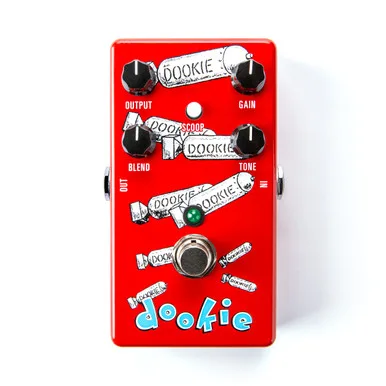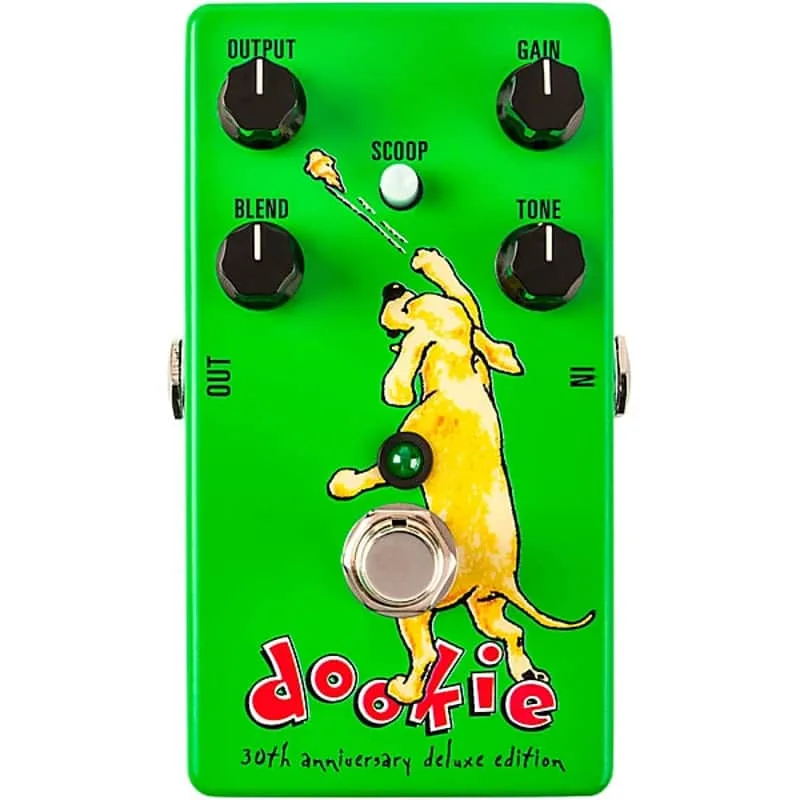


The MXR DD30 Dookie Overdrive 30th Anniversary is an analog overdrive pedal that recreates the amp tones behind Green Day's 1994 album Dookie. MXR built it by borrowing the amps, analyzing their sonic qualities and A/B testing variations to dial in the Dookie sound, and this special edition adds an all-new finish to mark the 30th anniversary of the album's release in 19941. It sits alongside the original MXR Dookie Drive in the company's range of overdrive pedals1.
What it does
The pedal captures the tones of Green Day's amps in a single enclosure, and it does so with two separate gain sections, High Gain and Crunch Gain, each with its own controls1. The Blend control lets you mix the two sections together, which RockBoard's PedalPedia describes as doing in the pedal what Green Day did in the studio1. A Scoop switch adds extra cut in the midrange of the overall output signal when you want it1.
Controls
The manual lays out the full control set, including two internal trimmers:
| Control | What it does |
|---|---|
| GAIN knob | Sets intensity of the High Gain circuit's overdrive2 |
| CRUNCH GAIN knob (internal) | Sets intensity of the Crunch Gain circuit's overdrive2 |
| BLEND knob | Sets the mix of the High Gain and Crunch Gain circuits2 |
| TONE knob | Controls overall EQ2 |
| OUTPUT knob | Sets overall volume2 |
| CRUNCH VOLUME knob (internal) | Sets output level of the Crunch Gain circuit2 |
| SCOOP switch | IN position cuts midrange frequencies for a modern scooped sound2 |
| FOOTSWITCH | Toggles effect on and bypass; a green LED indicates on2 |
The Blend knob is the heart of the design: clockwise for more of the High Gain sound, counterclockwise for more of the Crunch Gain sound2. The two internal knobs, CRUNCH GAIN and CRUNCH VOLUME, sit under the hood and set the Crunch Gain circuit's drive intensity and level independently of the front-panel controls2.
Power
The DD30 runs on 9 volts DC, center negative1. Jim Dunlop's manual names the Dunlop ECB003 9-volt adapter or an MXR Brick Series power supply2. It can also run from a single 9-volt battery, fitted by removing the bottom plate2.
Current draw is 11 mA2, so the pedal is a light load on a pedalboard power supply, and a battery is a practical option since the manual includes one.
Videos
Tech Sphere Pro
Beyond Gadget Zone
B's Music Shop
Questions
Is the MXR DD30 Dookie Overdrive analog?
Yes. The DD30 Dookie Overdrive 30th Anniversary is an analog circuit, according to MXR's product listing. It is a single overdrive pedal rather than a digital modeler, and its two gain sections are hardware circuits that you set with the pedal's knobs and blend together with the Blend control.
What power supply does the MXR DD30 Dookie Overdrive need?
The DD30 runs on 9 volts DC with a center negative plug. Jim Dunlop's manual names the Dunlop ECB003 9-volt adapter or an MXR Brick Series power supply. The pedal can also run from one 9-volt battery, installed by removing the bottom plate.
What does the Blend knob do on the DD30?
The Blend knob sets the mix between the pedal's two gain circuits, High Gain and Crunch Gain. Rotating it clockwise gives more of the High Gain sound, and counterclockwise gives more of the Crunch Gain sound. MXR describes this as letting you mix the two sections together just like Green Day did in the studio.
What does the Scoop switch do?
The Scoop switch cuts midrange frequencies for a scooped sound. Pushed to the IN position it removes mids from the overall output for what the manual calls a modern scooped sound, and MXR describes it as adding extra scoop in the midrange of the overall output signal.
How much current does the MXR DD30 draw?
The DD30 draws 11 mA, according to both Jim Dunlop's manual and MXR's product listing. That is a light load, well within what a standard 9-volt pedalboard power supply output provides.
Sources (2)
- DD30 Dookie Overdrive 30th Anniversary by MXR, RockBoard PedalPedia, 2026
- DD30.pdf, Jim Dunlop, 2024