

The MXR Flanger/Doubler is a two-space rackmount effects unit, the M-126, that MXR built in the 1970s to do two related jobs with one analog delay line: flanging and double tracking12. It emerged in 1976 and lasted most of MXR's early period before the company's bankruptcy in 1984 ended production2. In flanger mode it sweeps a very short delay to produce the jet-like whoosh players know from the era's records; in doubler mode it uses a longer delay to simulate two guitars playing the same part, thickening and widening a single track21.
The unit has kept a cult following, and in August 2026 MXR brought the circuit back as the MXR M226 Flanger/Doubler pedal, with PastFX releasing its own take, the doppelflänger, the following month345.
How the circuit works
The Flanger/Doubler is essentially a delay-line manipulator: the same basic topology is honed for two different jobs, and the two modes deliver different short delay times through two different bucket-brigade device (BBD) chips6. A BBD passes the signal down a chain of internal capacitors in steps, which is how the delay itself is made; modulating that delay with an LFO produces flanging, and holding it at a longer, fixed time produces doubling.
The two chips split the work:
| Mode | Chip | Stages | Delay time |
|---|---|---|---|
| Flanger | Reticon SAD1024 BBD | Dual 512-stage | 0.33 ms to 5.5 ms56 |
| Doubler | RD5101 | 4096 stages | 14 ms to 66 ms56 |
The doubler's 14 to 66 ms range is what lets it sit far enough behind the dry signal to read as a second guitar rather than a comb filter5. The unit also used a Vactrol, a light-dependent resistor, in its modulation path, and reviewers note a slight noise floor at higher intensity settings, one of the quirks that comes with the vintage parts6. Those components combined to give what Guitar Pedal X describes as:
"a very flavourful, slightly metallic-tinged output."6
Controls and connections
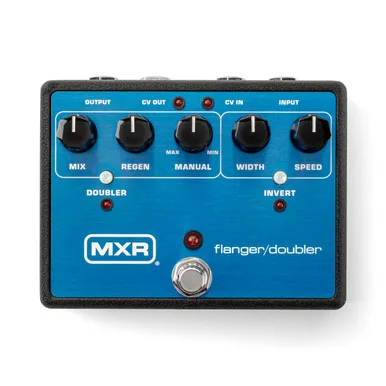
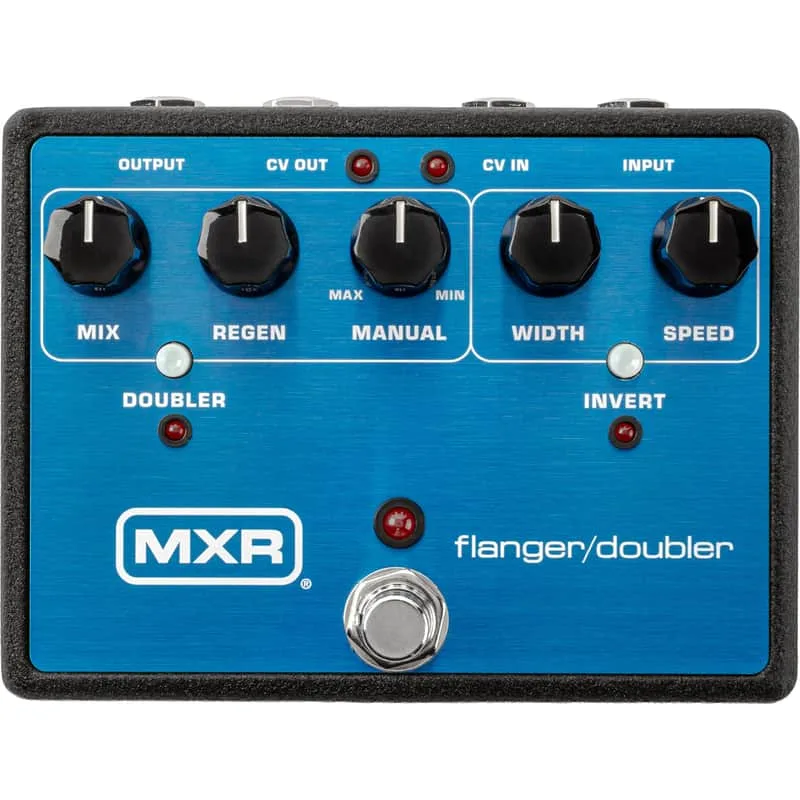
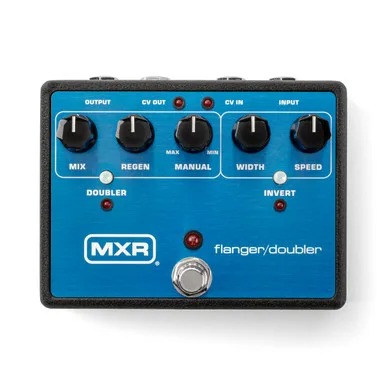
The control set carried over from the rack unit into the modern pedal, which is how players today know it. The core of it is three knobs plus a set of switches748:
- Manual (Delay Time): sets where the delay sits, the center point of the sweep2
- Width: sets how far the LFO sweeps around that point85
- Speed: sets the modulation rate85
- Regen / Feedback / Intensity: controls how much of the delayed signal feeds back on itself, from subtle movement to the extreme jet sweep2
- Doubler button: switches the Delay Time to the more expansive range the doubler needs2
- Phase Invert button: flips the phase relationship of the modulated signal2
The rack unit also carried an input level arrangement that MXR kept in the reissue: an INPUT LEVEL switch adjusts input and output gain staging, with a Line Level setting for the highest headroom when connecting synths and sequencers, and an Instr. Level setting for the lowest possible noise with a guitar58. The modern pedal adds a rear-panel line-level input switch for the same purpose, and a CV OUT jack that sends a 0 to 5V signal derived from the internal LFO to control modulation on other CV-compatible pedals, synths, or external devices57.
Who played it
The rack unit was a guitar rig favorite for a documented list of players63:
- Dimebag Darrell34
- Zakk Wylde6
- Eric Johnson6
- Eddie Van Halen6
- Billy Corgan6
Dunlop's own history of the rackmount era notes that heavy players the world over flocked to the Flanger/Doubler for its massive tone thickening and widening, and Gearnews reports the original rack still has quite a cult following34.
From the rack unit to the M226R pedal
The pedal recreates the rack unit's all-analog flanger and doubler effects with authentic bucket-brigade devices and the original control set, and takes a design cue from the black frame of the original rack unit with a black framing effect of its own572. MXR's manual describes the relationship plainly:
"The Flanger/Doubler recreates the original MXR rack unit in pedal form, authentically capturing classic all-analog flanger and doubler effects."5
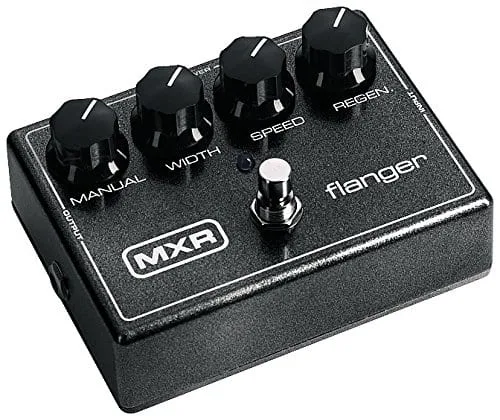
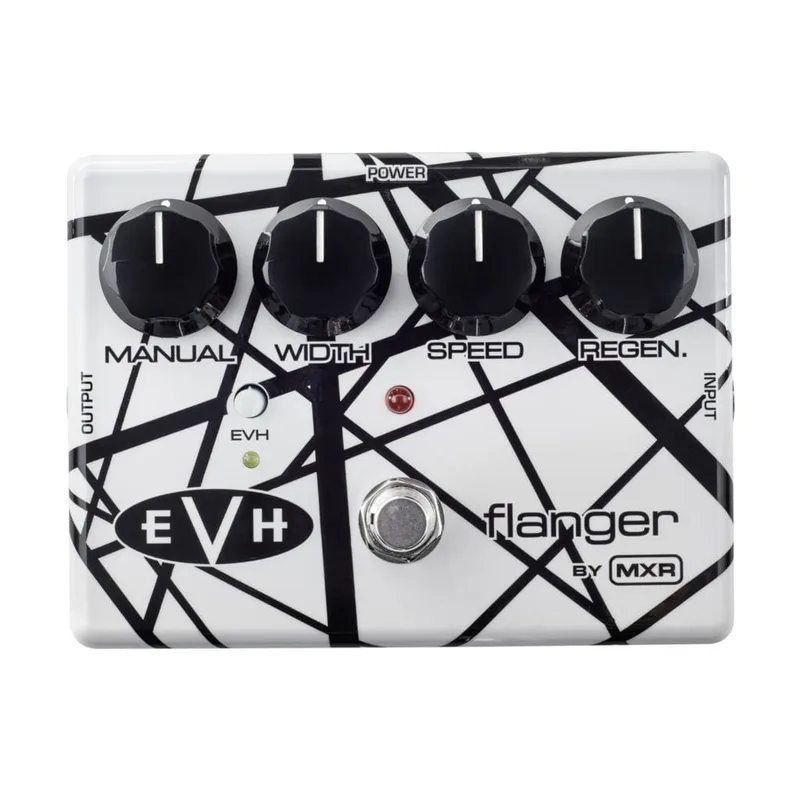
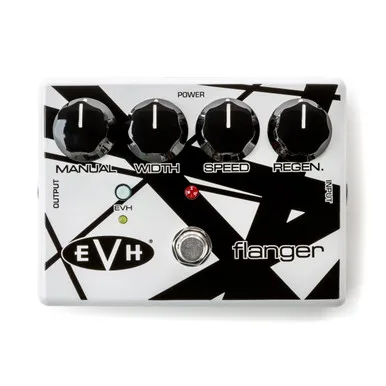
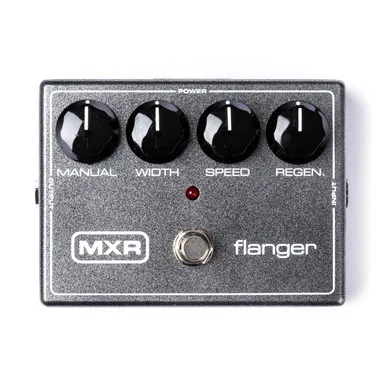
PastFX followed with the doppelflänger, its own vintage-spec, high-headroom compact take on the same 1970s rack unit, so the circuit is now available in two pedal forms alongside the surviving racks6. Players who want the wider MXR flanger family can also look at the MXR Flanger and the MXR EVH Flanger, both descendants of the same era of analog delay-line design.
Videos
Dagan Wilkin
Sweetwater Soundcheck
Kayla Kent
News
Questions
Is the MXR Flanger/Doubler analog?
Yes. The rack unit is an all-analog design built around bucket-brigade device (BBD) chips, which move the signal along a chain of capacitors to create short delays. MXR describes the circuit as authentic bucket-brigade devices, and the same analog architecture carried over into the modern M226R pedal reissue.
What chips does the MXR rack flanger/doubler use?
The rack unit used two different bucket-brigade chips: a Reticon SAD1024, which is a dual 512-stage device, for the flanger mode, and an RD5101 with 4096 stages for the doubler mode. The two modes simply deliver different short delay times through these two chips.
Why did MXR stop making the rack Flanger/Doubler?
The rack unit lasted most of MXR's early period before the company's bankruptcy in 1984, which ended production. MXR later revived the circuit as the M226R Flanger/Doubler pedal, released in August 2026, which recreates the rack unit in a mid-size pedal enclosure.
Which famous guitarists used the MXR Flanger/Doubler?
Documented users include Dimebag Darrell, Zakk Wylde, Eric Johnson, Eddie Van Halen, and Billy Corgan. Dunlop's own history notes that heavy players flocked to the Flanger/Doubler for its tone thickening and widening, and the original rack retains a cult following.
Sources (8)
- MXR: Rackmount Era, Dunlop (lifestyle.jimdunlop.com), 2014-03-28
- Guitar Pedal X, Guitar Pedal X, 2026-08-13
- MXR Flanger/Doubler: Analog BBD Modulation, gearnews.com, 2026-08-11
- MXR revives Dimebag's favorite rack unit in pedal form, Guitar World, 2026-08-11
- M226.pdf, Jim Dunlop, 2026
- Guitar Pedal X, Guitar Pedal X, 2026-09-25
- MXR® FLANGER/DOUBLER, Jim Dunlop (jimdunlop.com)
- MXR reimagines Dimebag Darrell's favourite rack unit as a pedal, MusicRadar, 2026-08-11