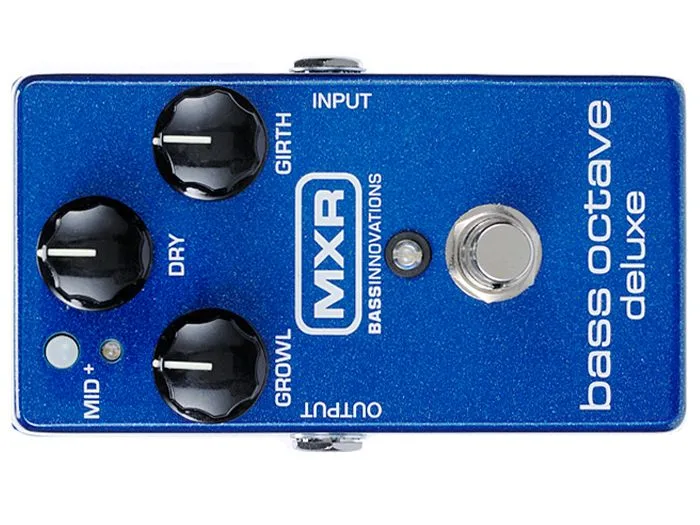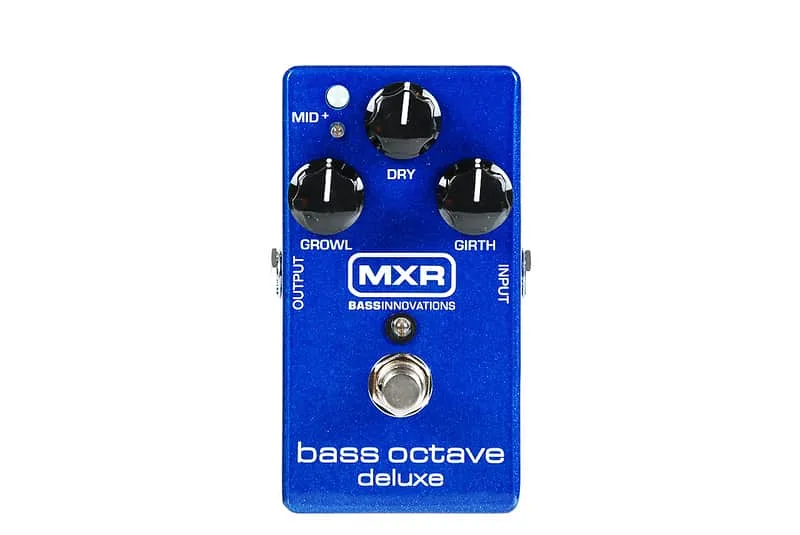


The MXR M288 Bass Octave Deluxe is a bass octave pedal with two independent sub-octave voices, built as an all-analog circuit. Guitar World's octave pedal guide describes it as "excelling at fat, chunky retro sounds," while Dunlop's manual describes the tone as "Organic analog tone."12
Controls
The pedal carries four controls on its face: a dry level knob, the two octave-voice knobs, and the Mid+ button. The footswitch toggles the effect on and into bypass, with a blue LED showing when it is on.12
| Control | What it does | Range |
|---|---|---|
| Dry | Dry signal level | -∞ to +2.5 dB1 |
| Growl | Volume of the throaty, midrange sub-octave voice | -∞ to +6 dB1 |
| Girth | Level of the low-end sub-octave voice | -∞ to +1 dB1 |
| Mid+ | Adds midrange boost, blue LED indicates on | +4 dB to +14 dB, internally adjustable1 |
| Footswitch | Toggles effect on/bypass, blue LED indicates on | 1 |
Girth and Growl
The two tone knobs shape the octave signal rather than your dry bass. Guitar World explains: "The two tone controls are 'Girth' and 'Growl', for the octave signal's low-end and midrange respectively."2 The manual describes the Growl knob as controlling the volume of a "throaty, midrange sub-octave voice," which pairs with the deeper Girth voice so you can blend the two sub-octave characters against each other and against your dry signal.1
Mid+
The Mid+ button is a midrange boost: the manual specifies up to +14 dB of internally adjustable midrange, with a gain range of +4 dB to +14 dB and a blue LED showing when it is engaged. Guitar World frames it in practical terms, calling it "a midrange boost, letting the MXR slam its way through a dense mix with a serious push at either 400Hz or 800Hz (adjustable internally)."12
Power
The M288 runs on 9 volts DC and draws 14 mA. It can be powered by one 9-volt battery, fitted by removing the bottom plate, or by a 9-volt adapter such as the Dunlop ECB003/ECB003EU or a DC Brick power supply.1
How it compares
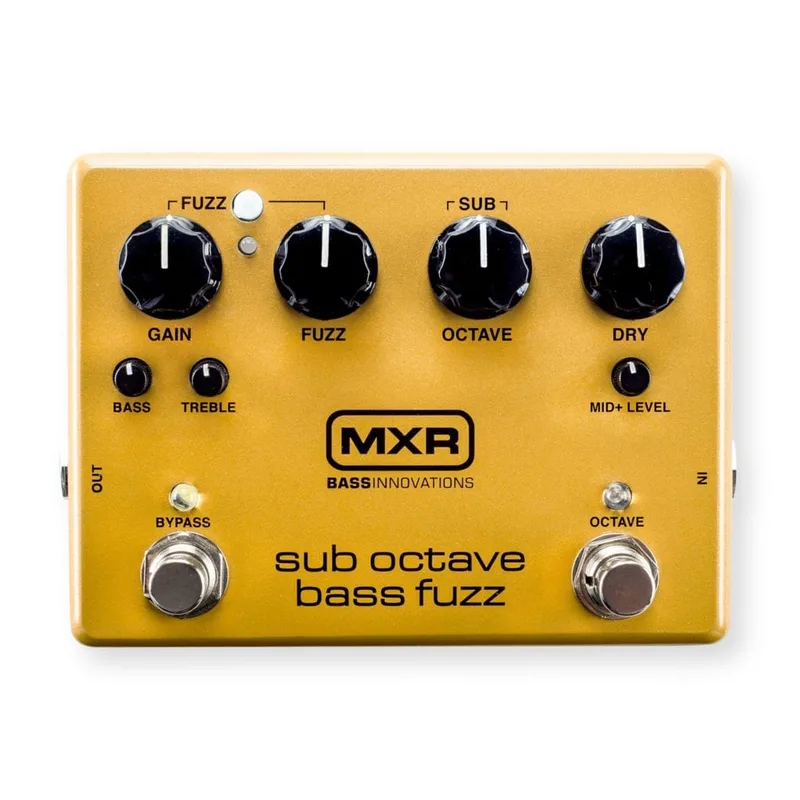
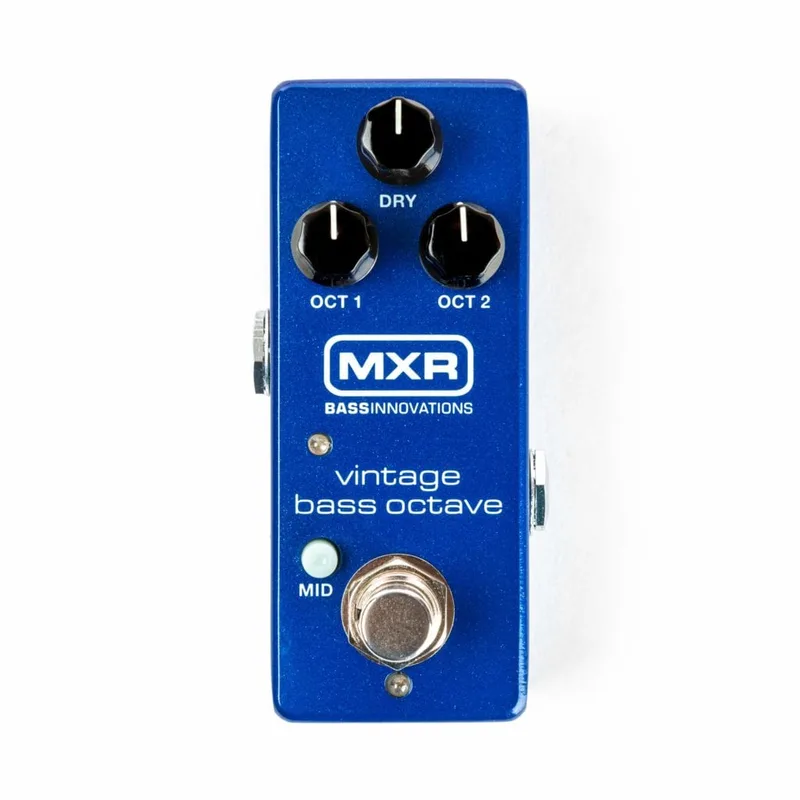
Guitar World's guide places the M288 among analog octave designs for bass, and its verdict notes a trade-off: "Being analogue, it isn't the last word in versatility."2 Players who want more than a sub-octave voice can look at other MXR bass effects in the same family, such as the MXR Sub Octave Bass Fuzz, the MXR Vintage Bass Octave, or the newer MXR M-228 Bass Octave Deluxe, alongside the wider field of octave and pitch pedals and bass pedals.
Videos
tunnelvisionmusic
FreeBassTranscriptions
BassTheWorld.com
Questions
What is the difference between Girth and Growl on the MXR M288?
Girth and Growl are the two tone controls for the octave signal. Guitar World describes Girth as covering the octave signal's low-end and Growl as covering its midrange. The manual describes the Growl knob as controlling the volume of a throaty, midrange sub-octave voice, with Growl running from off up to +6 dB and Girth from off up to +1 dB.
What does the Mid+ button do?
The Mid+ switch adds a midrange boost of up to +14 dB, adjustable internally, with a blue LED showing when it is on. Guitar World describes it as a midrange boost that lets the pedal push through a dense mix, with the boost center set at either 400 Hz or 800 Hz depending on the internal adjustment.
Does the MXR M288 run on a battery?
Yes. According to the manual, the pedal is powered by one 9-volt battery, which is fitted by removing the bottom plate. It can also run on a 9-volt DC adapter such as the Dunlop ECB003/ECB003EU or a DC Brick power supply, drawing 14 mA.
Is the MXR M288 fully analog?
Yes. Guitar World calls it an all-analog circuit, and the maker's manual describes its tone as organic analog. Guitar World also notes that being analog means it is not the most versatile octave design available.
What type of bypass does the MXR M288 use?
The manual specifies True Hardwire bypass. The footswitch toggles the effect on and into bypass, with a blue LED indicating when the effect is on.
What input impedance does the MXR M288 have?
The manual lists a 1 megohm input impedance and an output impedance of less than 600 ohms.
Sources (2)
- M288.pdf, Dunlop Manufacturing, Inc., 2019
- Best octave pedals for bass 2026: Pitch-shift your playing with our pick of essential pedalboard additions, Guitar World, 2026-06-03