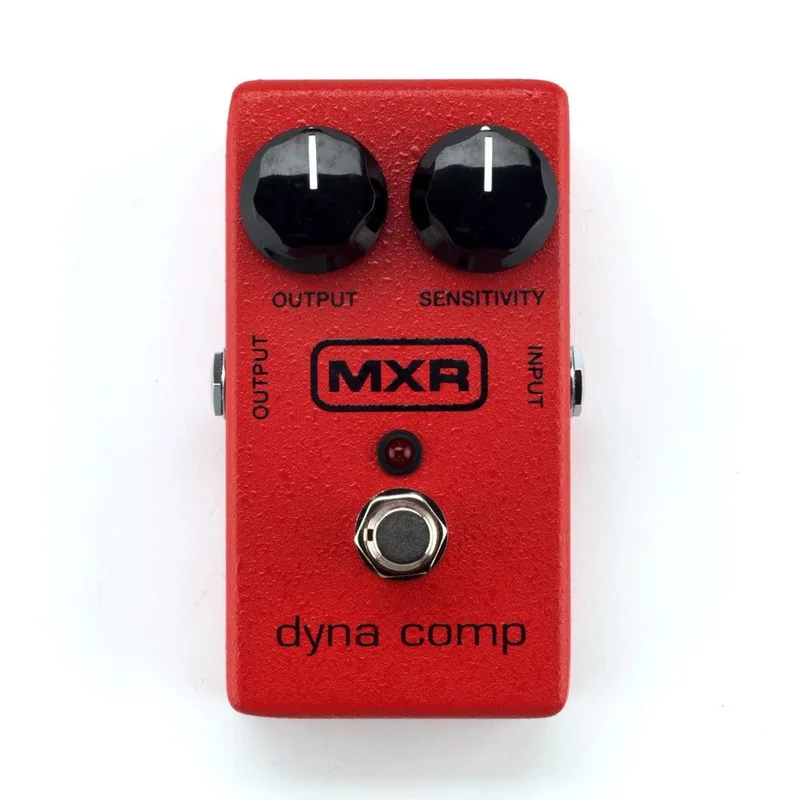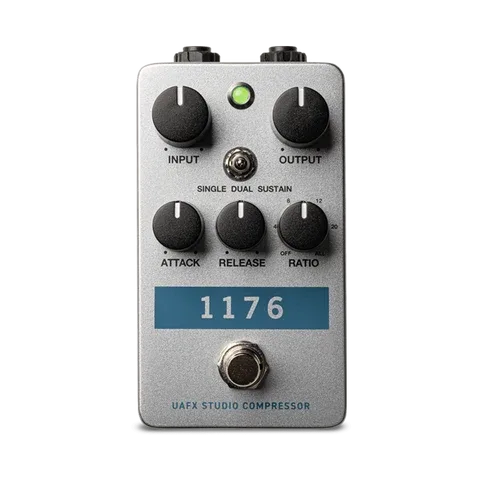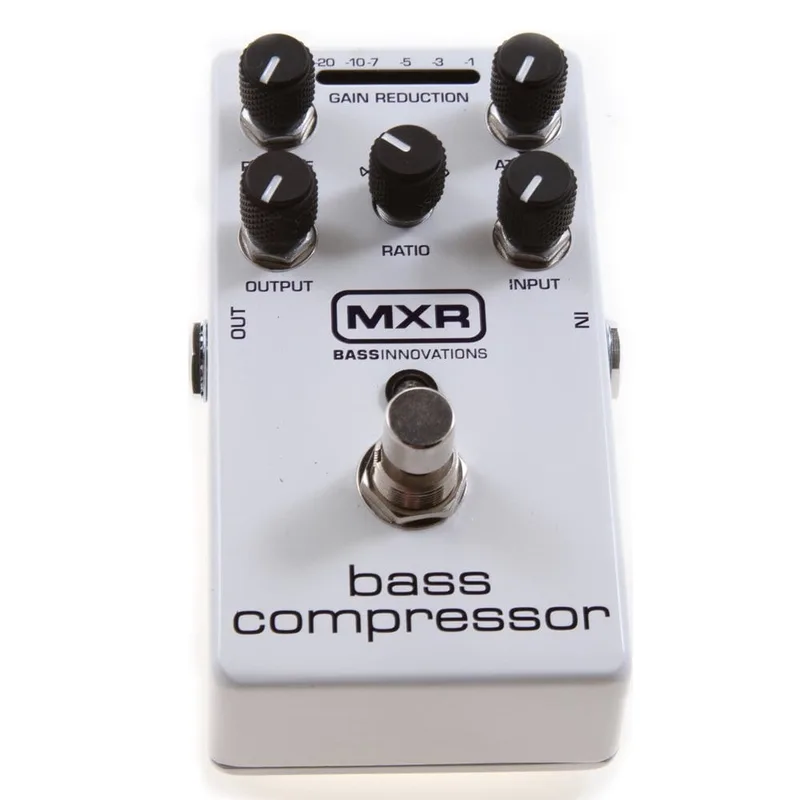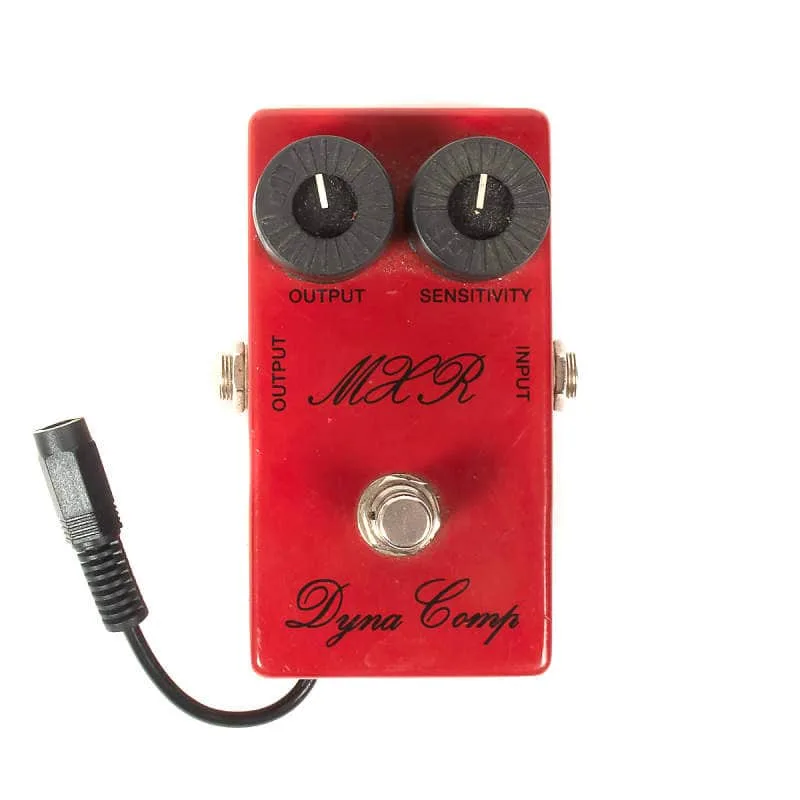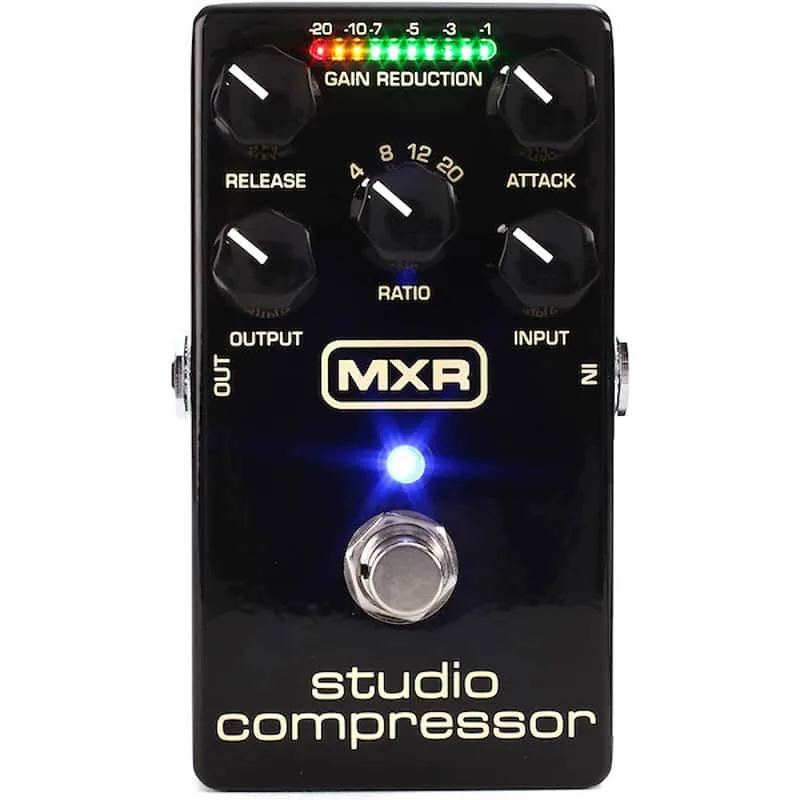


The MXR M76 Studio Compressor is a compressor pedal from MXR that packs what the maker calls a "classic studio compressor in a Phase 90-sized pedal" into a standard small-format stompbox1. Instead of the simpler two-knob approach of pedals like the MXR Dyna Comp, it gives you the variable controls of a recording-studio unit: preset compression ratios, attack and release shaping, and a meter that shows exactly what the circuit is doing to your signal.
MusicRadar's reviewer, Trevor Curwen, characterized it as "a naturally transparent-sounding compressor rather than one providing an obvious sonic signature," and noted that it is "based on the sort of classic compressors you would find in studios, with a choice of compression ratios as found" on Urei's rackmounted 11762. In other words, it is built to even out your dynamics without stamping an audible character on your tone.
The controls
The M76's control set is what separates it from simpler compressor pedals. Each knob maps to a function you would find on a studio unit rather than a single "sensitivity" control21.
| Control | What it does |
|---|---|
| OUTPUT | Controls overall effect volume; clockwise to increase, counterclockwise to decrease1 |
| RATIO | Sets the degree of compression, from mild to extreme1 |
| ATTACK | Shapes the envelope of the sound2 |
| RELEASE | Controls how quickly your signal returns to its uncompressed level; clockwise quickens the release, counterclockwise slows it1 |
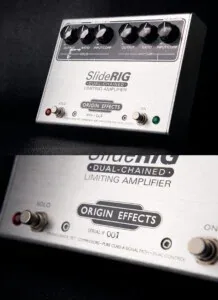
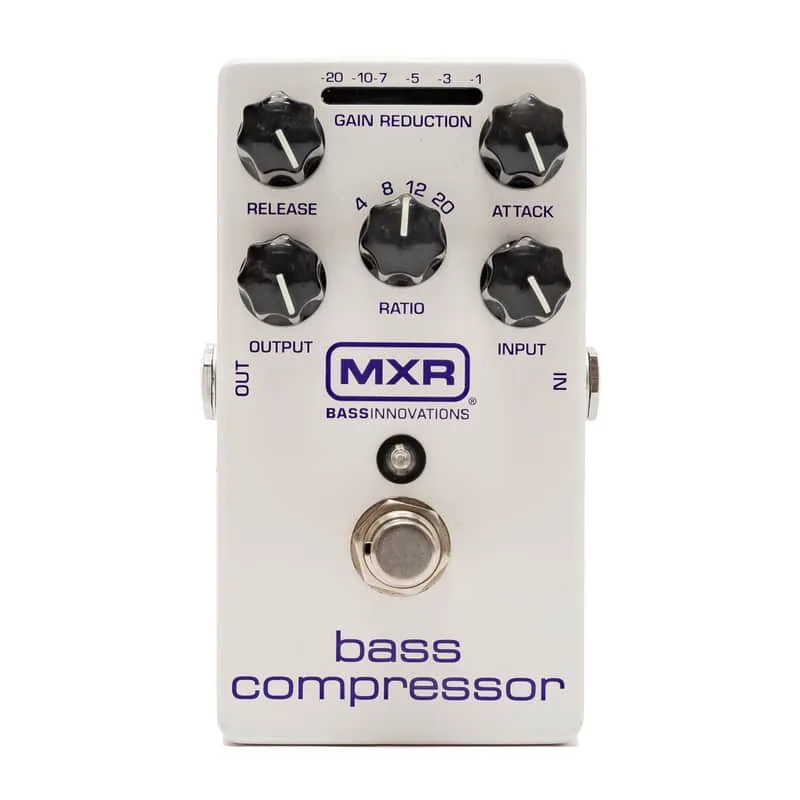
The RATIO knob selects between four preset compression ratios: 4:1, 8:1, 12:1 and 20:11. That is a fixed set of steps rather than a continuously variable control, a distinction that matters when comparing compressors. Reviewing the closely related M87, ovnilab's Cyrus Joaquin Heiduska noted that "the MXR has four preset ratios, while the ratio knob on the Cali is adjustable throughout the range," comparing it against the Origin Effects Cali763.
Alongside the knobs sits the GAIN REDUCTION meter: ten status LEDs that show the gain reduction level and the compressor's response time, reading right to left1. The manual suggests short string taps as an easy way to see the meter display the pedal's reaction to your picking1. For a player learning how compression actually works, that visual feedback is one of the pedal's most useful features, since you can watch the attack and release settings do their thing in real time.
Power and electrical specs
The M76 runs on 9 volts DC or a single 9-volt battery installed under the bottom plate1. Its published specifications from the maker's manual1:
| Specification | Value |
|---|---|
| Power supply | 9 volts DC |
| Current draw | 14 mA (LEDs off); the manual also lists 19 mA |
| Input impedance | 1 MΩ |
| Output impedance | 600 Ω |
| Max input level | +14 dBV |
| Max output level | +8.5 dBV |
| Gain | 31 dB |
| Attack time | 20 µs to 800 µs |
| Release time | 50 ms to 1.1 s |
| THD | < 0.5% (20 dB gain reduction, 1.1 s release setting, 50 Hz to 20 kHz) |
| Noise floor | -90 dBV (A-weighted, all controls at mid position) |
| Bypass | True Hardwire |
The manual gives two different current draw figures, 14 mA and 19 mA, both with the LEDs off. Either value is a light load for an isolated supply.
The attack and release ranges are worth a closer look. Attack spans 20 µs to 800 µs, which covers everything from near-instantaneous clamping down on transients to letting a pick attack through before compressing. Release spans 50 ms to 1.1 s, from a quick bounce back to a long, slow recovery that keeps sustained notes smooth. Together with the four ratio settings, those ranges are what give the pedal its studio-style flexibility1.
Relationship to the M87 Bass Compressor
The M76 did not appear from nowhere. MXR's M87 Bass Compressor came first, a pedal its maker describes as a "classic studio compressor in a Phase 90-sized pedal"31. The M87 is sold as a bass compressor, and it packs the concept of a high-quality studio compressor into a compact box45.
Both pedals share the same core identity: the M87 is described as a "classic studio compressor in a Phase 90-sized pedal"31, and Vintage Guitar's review of the M87 praised it as a pedal "which incorporates the concept of a high-quality studio compressor in a compact box," adding that "it's the size of a Phase 90, and it's a package tough to beat"45. The practical difference for a player is positioning: the M87 is sold as a bass compressor42, while the M76 carries the Studio Compressor name aimed at players more broadly.
What reviewers said
MusicRadar's overall verdict on the M76 was positive. Curwen concluded it is "a solidly performing compressor with plenty of variables to get your sound just right," calling it "a classy performer with very few reasons to avoid"2. The transparency he described cuts both ways depending on what you want: a player looking for the audible squash of a vintage-style compressor pedal may find the M76 too clean, while a player who wants dynamics controlled without hearing the pedal working will find exactly that2.
Videos
StompboxTV
Top 5 Wiki
Top 5 Reviews
Questions
Does the MXR M76 run on a battery?
Yes. The M76 can be powered by one 9-volt battery, installed by removing the bottom plate. It also runs on a 9-volt DC power supply, so you can use either depending on your board setup.
Is the MXR M76 true bypass?
Yes. The manual lists its bypass as True Hardwire, so with the pedal disengaged your signal passes through without the circuit coloring it.
What are the four ratio settings on the M76?
The RATIO control offers four preset compression ratios: 4:1, 8:1, 12:1 and 20:1. MXR describes the knob as setting the degree of compression, from mild to extreme, echoing the ratio choices found on classic studio compressors such as the Urei 1176.
How much current does the M76 draw?
The manual gives two figures, 14 mA and 19 mA, both with the LEDs off. The two entries disagree, so treat the higher figure as the safer one when sizing a power supply. Either way it is a light load for a modern isolated supply.
Is the M76 the same as the M87 Bass Compressor?
Very close. MusicRadar's reviewer described the M76 as more of the same as the M87 Bass Compressor, but with a new look and name aimed at more universal appeal. The M87 predates the M76 and both are studio compressors in a Phase 90-sized pedal.
What does the row of LEDs on the M76 show?
The ten Gain Reduction LEDs form a meter that shows the gain reduction level and the compressor's response time. Short string taps are an easy way to watch the meter display how the pedal reacts to your playing.
Sources (5)
- M76.pdf, Dunlop Manufacturing, Inc., 2019
- MXR M76 Studio Compressor review, MusicRadar, 2016-09-14
- Origin Effects Cali76, ovnilab.com
- M87.pdf, Jim Dunlop, 2019
- The MXR M234 Analog Chorus and M87 Bass Compressor, Vintage Guitar magazine, 2013-08-27