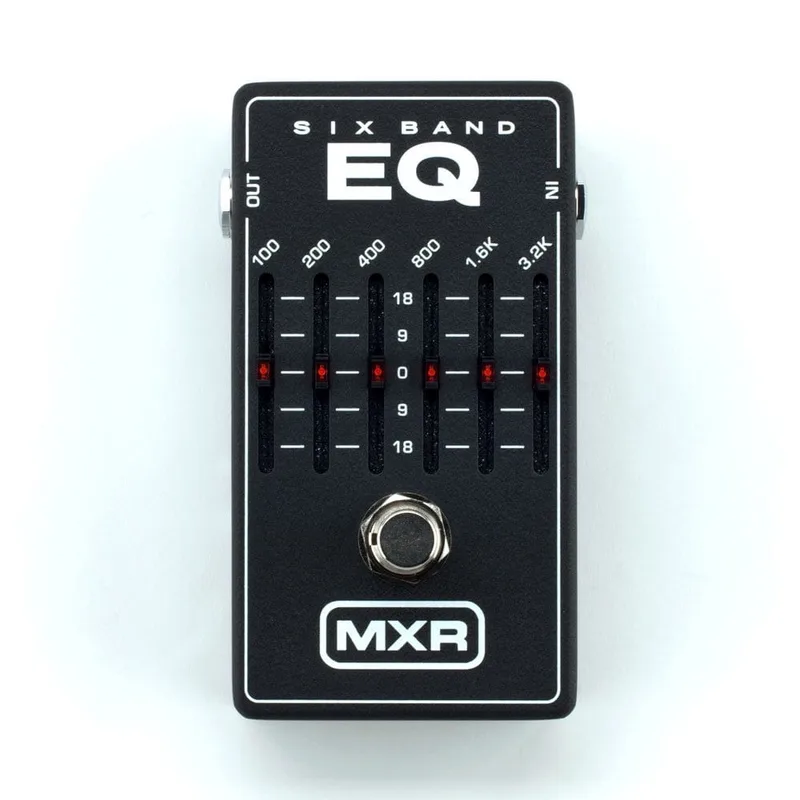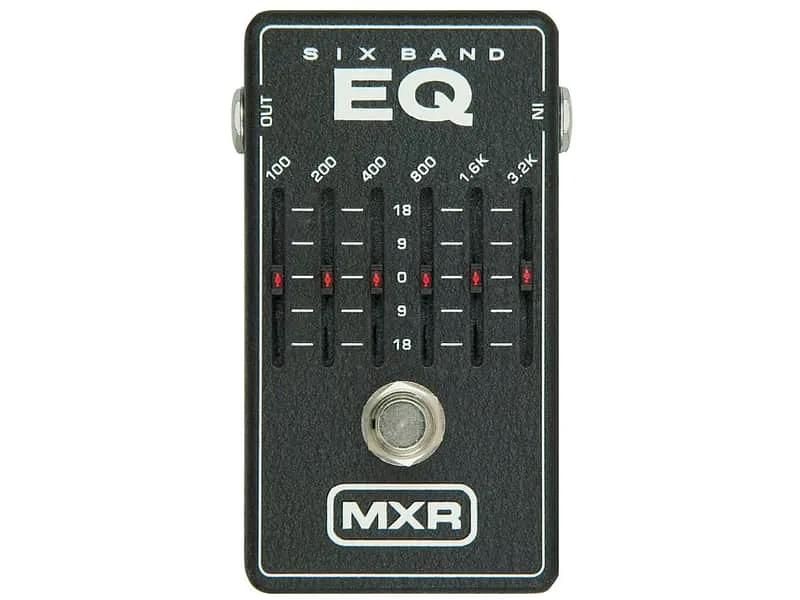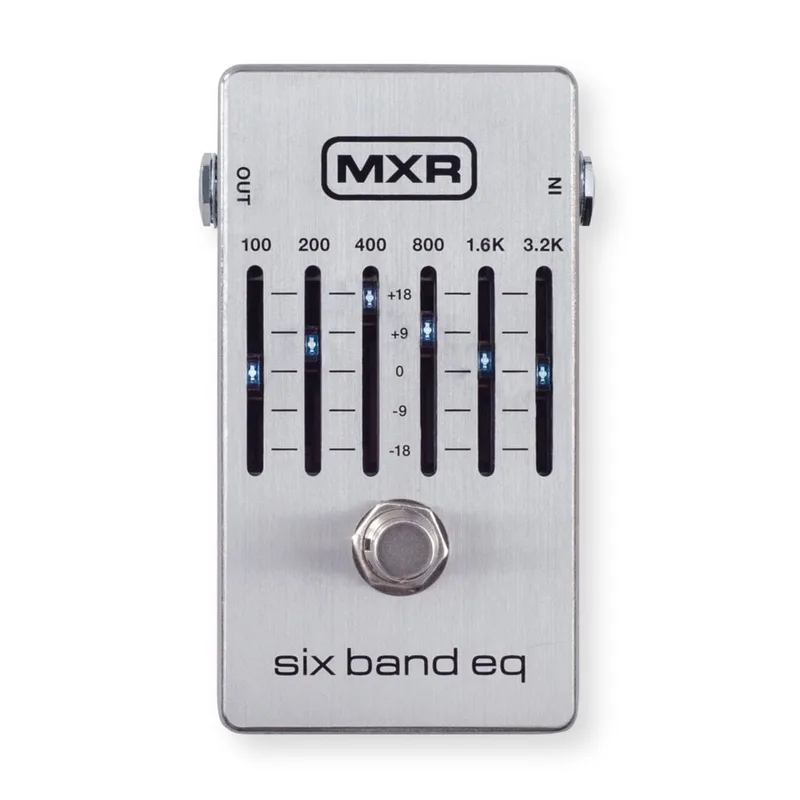


The MXR Six Band EQ is a compact graphic EQ pedal from MXR that puts six sliders on the frequencies a guitar actually uses. Each slider cuts or boosts its band by up to ±18 dB, letting you reshape your tone in ways a tone knob cannot: pulling harshness out of a bright amp, adding low-end weight to a thin-sounding pickup, or carving a scooped-mid rhythm setting. MXR says it "covers all the essential guitar frequencies," and the current version has been upgraded with noise-reduction circuitry in a lightweight aluminum housing1.
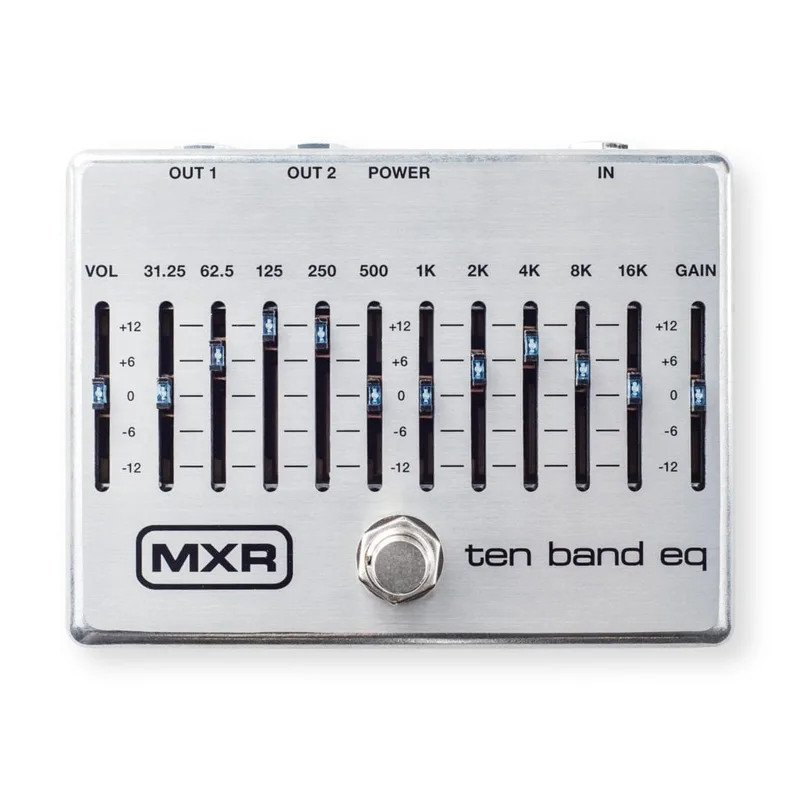
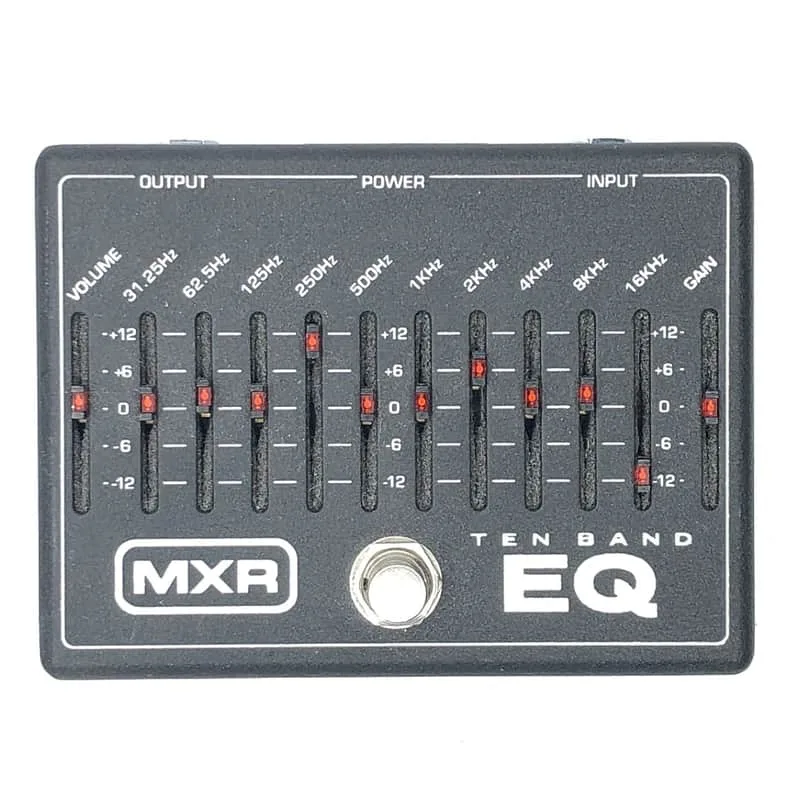
It is a streamlined alternative to bigger EQ pedals like the MXR Ten Band EQ: fewer bands, smaller box, same idea. Gearnews describes it as "a streamlined EQ pedal that covers the essentials with six sliders from 100 Hz up to 3.2 kHz"2.
The controls: six sliders at ±18 dB
The front panel is six vertical sliders, one per band. Each slider cuts or boosts its associated frequency by up to 18 dB in either direction, with the center position leaving that band flat13. A single footswitch toggles the effect on and off, and blue LEDs on the sliders light up when the EQ is active, so you can read your settings on a dark stage3.
| Slider | Frequency | What it does |
|---|---|---|
| 1 | 100 Hz | Low-end weight and boom |
| 2 | 200 Hz | Body and warmth |
| 3 | 400 Hz | Low mids, boxiness |
| 4 | 800 Hz | Midrange core of the guitar |
| 5 | 1.6 kHz | Presence and bite |
| 6 | 3.2 kHz | Upper mids, edge and clarity |
The manual lists the filtering as ±18 dB at 100, 200, 400, 800, 1.6K, and 3.2K, and also specifies a ±18 dB shelf at 16 kHz3. With all sliders set to 0 dB, the pedal's frequency response is ±1 dB from 20 Hz to 20 kHz, so it leaves your tone alone when the sliders are centered3.
Because the bands sit where a guitar's energy lives, small moves go a long way. A few dB of cut at 800 Hz thins out a muddy distortion tone; a few dB of boost at 100 and 200 Hz fattens a single-coil bridge pickup without touching the treble. MXR's own examples run wider than that: the company says the pedal "can create scooped-mid rhythm tones with massive low end, add natural sounding warmth to a quacky acoustic pickup, eliminate onstage feed-back, and much more"13.
Power and connections
The Six Band EQ runs on a 9-volt battery, or on a Dunlop ECB003 9-volt adapter1. It is also compatible with the DC Brick, Iso-Brick, and Mini Iso-Brick power supplies, which MXR notes are not included1. Current draw is 14.5 mA3, low enough that it shares a daisy chain or isolated output without straining most supplies.
Connections are standard 1/4" instrument jacks in and out, with an input impedance of 470 kΩ and an output impedance of 5 kΩ3. Maximum input and output levels are both +14 dBV with all sliders at 0 dB at 1 kHz3, comfortably above what guitar-level signals produce.
The pedal is true bypass (the manual calls it True Hardwire)13, so when it is switched off your signal passes through without buffering. On a long pedalboard of other true-bypass pedals, that can add up to noticeable treble loss from cable capacitance; some players place a buffer elsewhere in the chain to compensate.
Noise and build
The current M109S version has been upgraded with noise-reduction circuitry, and the manual measures the noise floor at -101.7 dBV, A-weighted at 5.2 Vrms3. Gearnews credits the pedal's "true bypass, low-noise circuitry, and a rugged aluminum chassis" with making it "reliable on stage"2. The housing is the lightweight aluminum build MXR uses across its compact pedal line1.
How it compares
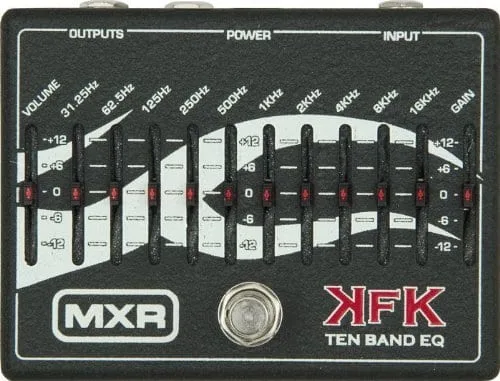
Within MXR's own range, the Six Band sits between the simpler two-knob tone shaping of an overdrive's tone control and the fuller resolution of the MXR M108S Ten Band Graphic EQ and the MXR Kerry King Ten Band EQ. The ten-band pedals divide the spectrum more finely and add gain and volume sliders; the Six Band trades that resolution for a smaller footprint and simpler operation. Gearnews positions it as the pick of MXR's EQ line for players who want "the essentials" without the extra bands2.
Videos
Musix Box
10best Picks
maruhachi08
Questions
Is the MXR Six Band EQ true bypass?
Yes. MXR specifies true bypass switching on the product page and in the M109S manual, which lists the bypass as True Hardwire. Gearnews also notes the true bypass alongside low-noise circuitry and a rugged aluminum chassis, so the pedal passes your signal untouched when switched off.
Does the MXR Six Band EQ take a battery?
Yes. MXR states the pedal can be powered by a 9-volt battery. It also runs on a Dunlop ECB003 9-volt adapter, and it is compatible with the DC Brick, Iso-Brick, and Mini Iso-Brick power supplies, which are sold separately. Current draw is 14.5 mA.
What frequencies does the MXR Six Band EQ cover?
The six sliders filter at ±18 dB at 100 Hz, 200 Hz, 400 Hz, 800 Hz, 1.6 kHz, and 3.2 kHz, which MXR describes as all the essential guitar frequencies. The manual also lists a ±18 dB shelf at 16 kHz. With all sliders at 0 dB, frequency response is ±1 dB from 20 Hz to 20 kHz.
Is the MXR Six Band EQ good for acoustic guitar pickups?
MXR says the Six Band EQ can add natural sounding warmth to a quacky acoustic pickup and eliminate onstage feedback, alongside uses like scooped-mid rhythm tones with massive low end. It is a general-purpose guitar EQ rather than a dedicated acoustic pedal, but the maker lists acoustic pickup shaping among its intended uses.
Sources (4)
- MXR® SIX BAND EQ, Dunlop (jimdunlop.com)
- The 7 Best EQ Pedals for Every Budget: Shape Your Tone in Seconds!, gearnews.com, 2025-09-15
- M109S.pdf, Dunlop Manufacturing, Inc., 2019
- MXR® KERRY KING TEN BAND EQ, Dunlop (jimdunlop.com)