

What the six sliders do
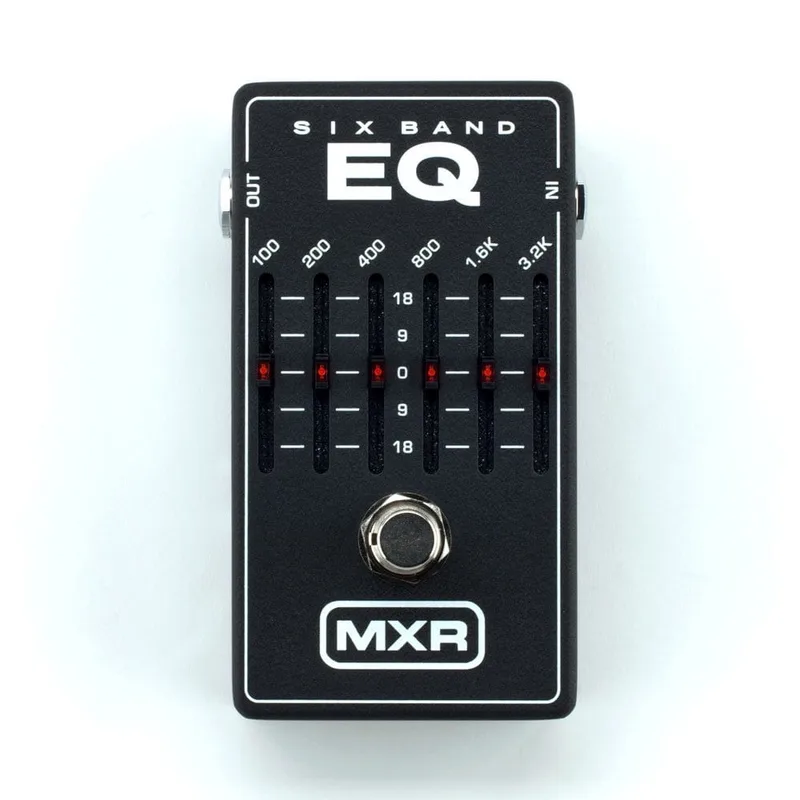
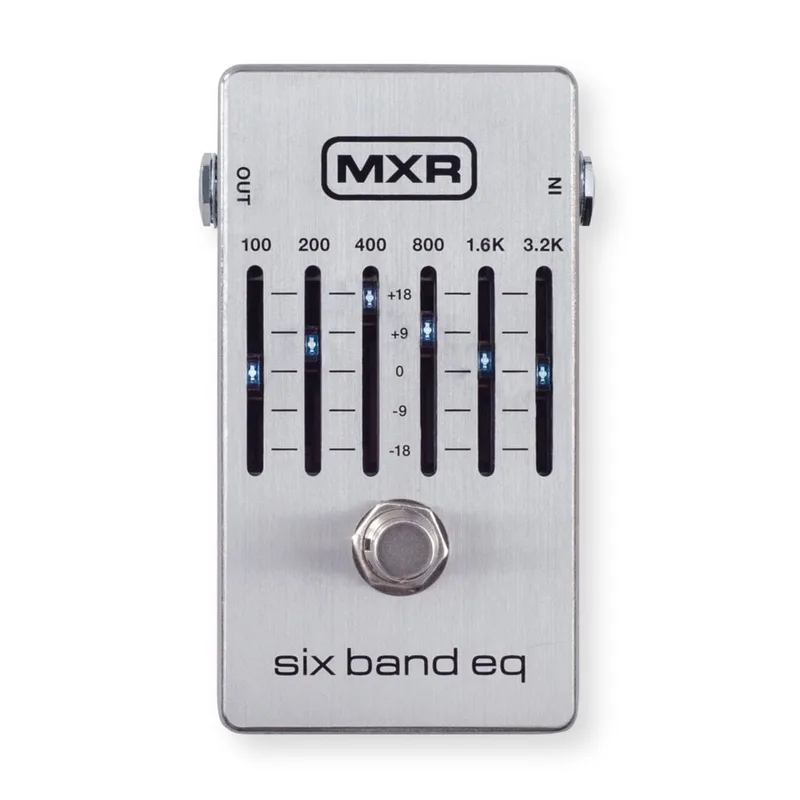
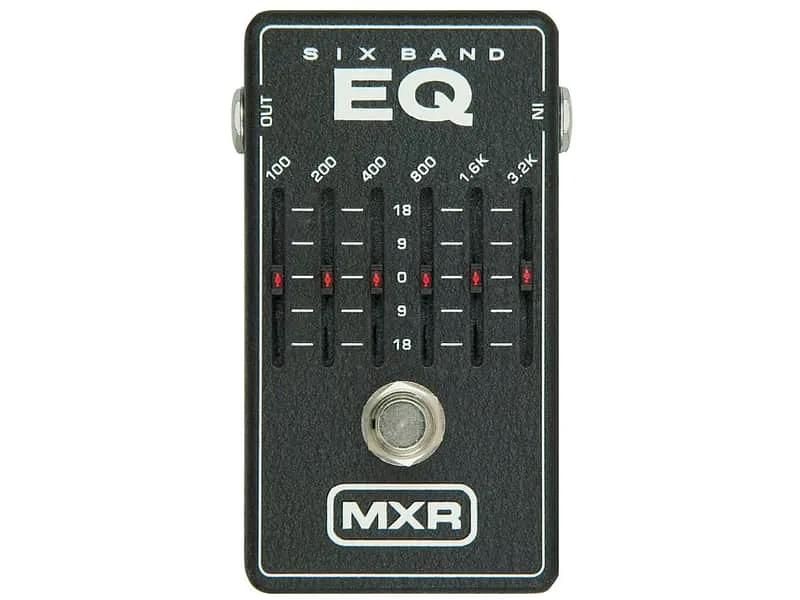
Each slider controls one frequency, and the six together cover most of the guitar's frequency range: 100Hz, 200Hz, 400Hz, 800Hz, 1.6kHz and 3.2kHz. Each band gives 18dB of boost or cut, which the DIY Fever reviewer called more than enough for practical use.1
| Slider | Frequency | Range |
|---|---|---|
| 1 | 100Hz | ±18dB |
| 2 | 200Hz | ±18dB |
| 3 | 400Hz | ±18dB |
| 4 | 800Hz | ±18dB |
| 5 | 1.6kHz | ±18dB |
| 6 | 3.2kHz | ±18dB |
In practice, the low two bands shape body and warmth, the middle bands handle the mids where a guitar sits in a mix, and the top bands add presence and cut. Because the pedal is analog, it does this without digital conversion.12
Power and battery
The M109 runs on 9V DC, center negative, and draws 3mA, so it is light on any power supply. It also supports 9V battery operation.12
The M109S version
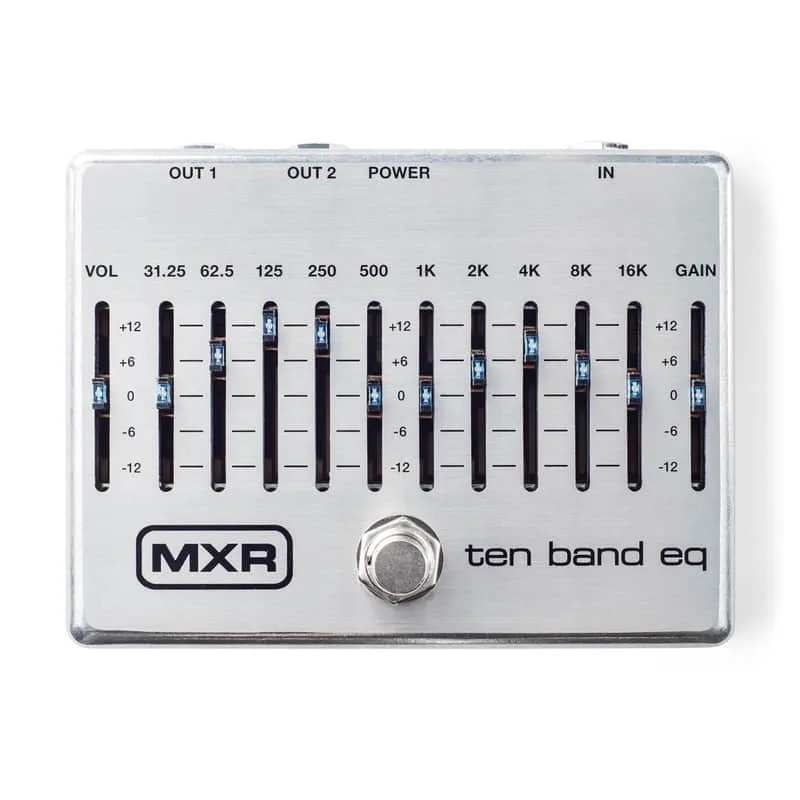
The M109S Six Band Graphic EQ is the current version of the design, documented in Dunlop Manufacturing's 2019 manual. It filters at the same six frequencies, 100, 200, 400, 800, 1.6K and 3.2K, with the top band acting as a ±18dB shelf at 16kHz. Dunlop specifies a maximum input and output level of +14 dBV with all sliders at 0 dB at 1 kHz, a frequency response of ±1 dB from 20 Hz to 20 kHz under the same conditions, and a noise floor of -101.7dBv A-weighted at 5.2Vrms.3
The M109S manual describes the pedal as covering "all the essential guitar frequencies", and its specifications are given by Dunlop for the M109S specifically. The original M109 and the M109S share the six-band layout, so check which version is on a listing before comparing figures.3
Build and what reviewers said
The DIY Fever review, dated 26 October 2026, found the build quality very good and described a cast metal enclosure that is very tough, built to last. The reviewer also highlighted the illuminated sliders as useful for dark rooms and stages, and noted that they look cool.1
Videos
tunnelvisionmusic
Fritz's Guitars
Questions
Does the MXR M109 6 band EQ take a 9V battery?
Yes. The M109 runs on a 9V battery or a DC adapter, and it draws only 3mA, so it is easy on a battery and on a shared power supply. The pedal uses 9V DC center negative, the standard polarity for most pedalboard power supplies.
What frequencies does the MXR M109 control?
The six sliders control 100Hz, 200Hz, 400Hz, 800Hz, 1.6kHz and 3.2kHz. Together these bands cover most of the guitar's useful frequency range, from low-end body through midrange presence to top-end bite.
Are the sliders on the MXR M109 lit?
Yes. The DIY Fever review notes illuminated sliders, which the reviewer found useful for dark rooms and stages, and adds that they look cool as well.
What is the difference between the MXR M109 and the M109S?
The M109S is the current Six Band Graphic EQ from MXR, documented in Dunlop's 2019 manual. It filters at the same six frequencies, 100Hz through 3.2kHz, with a ±18dB shelf at 16kHz on the top band, and is specified with +14 dBV maximum input and output levels and a -101.7dBv noise floor.
Is the MXR M109 analog?
Yes. The circuit type is analog, so the pedal shapes the signal without digital conversion.
Sources (3)
- Reviews > Effects > MXR 6 vs 10 Band EQ : DIY Fever, DIY Fever (diy-fever.com)
- M109 6 band EQ black version by MXR, RockBoard, 2026
- M109S.pdf, Dunlop Manufacturing, Inc., 2019