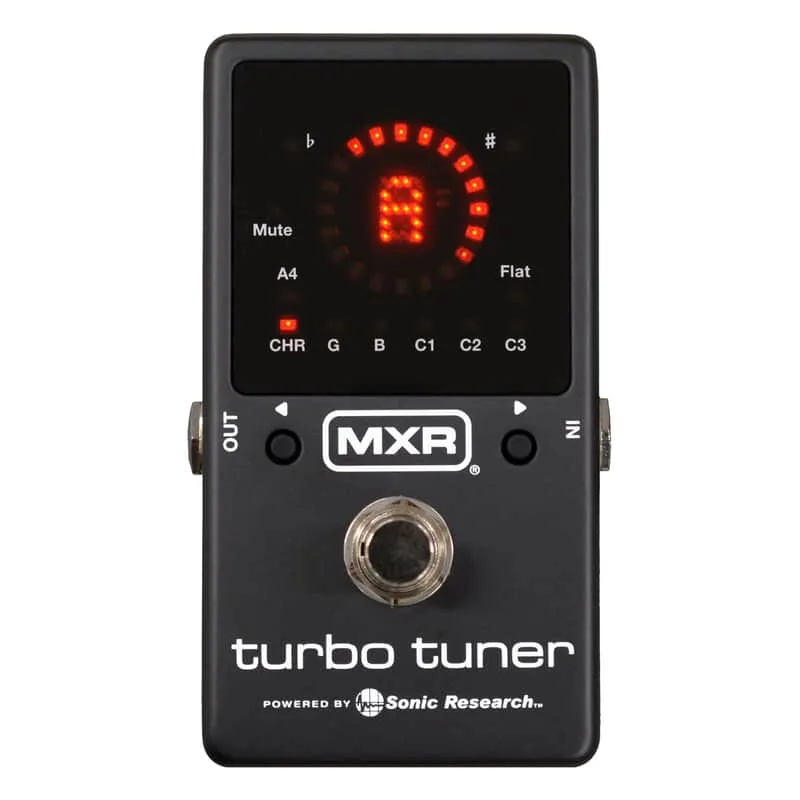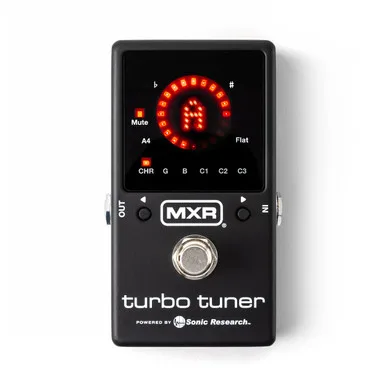


At the center of the pedal is a big, bright strobe display that tracks how close you are to pitch. The display is driven by the analog signal straight from your instrument, so it tracks with zero latency and no simulated display1. The manual lists accuracy of ± .02 cents from a calibrated crystal oscillator, with a tuning range of C0 (16.35 Hz) to C8 (4,186.0 Hz)2.
A true strobe tuner
Most pedal tuners use a needle or LED arc that averages your pitch and reports a result. A true strobe works differently: the display is driven directly by the analog signal from your instrument, so it tracks with zero latency and no simulated display1. MXR says Sonic Research engineered the M400 to deliver the same tour-grade precision and speed as the original Turbo Tuner, accurate to a fraction of a cent1.
The manual's figure is ± .02 cents, which is far tighter than most players can hear, and the tuning range runs from C0 (16.35 Hz) up to C8 (4,186.0 Hz), well beyond the needs of guitar or bass2. The reference pitch is adjustable from A4 = 300.0 Hz to 599.9 Hz in .1 Hz increments, and an A4 LED on the face illuminates whenever the reference is set to anything other than 440.0 Hz, a useful reminder on a dark stage2.
Guitar Pedal X's Stefan Karlsson called it "a really attractively priced high-spec compact tuner" at $1503.
How the strobe display reads
The strobe display is a ring of LEDs. The pattern in the ring rotates left if the note is flat, and rotates right if the note is sharp. The closer you get to pitch, the slower the rotation, until the pattern appears frozen, which means you are in tune1.
Around the ring, the manual describes these display elements2:
| Display element | What it does |
|---|---|
| Strobe ring | Rotates left when flat, right when sharp; slows as you approach pitch |
| LED note display | Shows the note name in Chromatic mode, or the string number in Open Tuning mode |
| A4 LED | Lights when the A reference is set to anything other than 440.0 Hz |
| Sharp/Flat LEDs | Indicate the note is more than 50 cents out; active only in Open Tuning mode |
The display has four brightness levels, so it stays readable in any light1. Guitar Pedal X noted the LED display is readable in direct sunlight and dimmable for indoor use3.
Modes and presets
The pedal has a Chromatic mode that tracks all twelve notes, plus five customizable presets1. The manual breaks these into six tuning presets: CHR (Chromatic), G (Guitar), B (Bass), and three Custom slots, C1, C2, and C32.
- Chromatic: responds to all 12 notes of the chromatic scale2
- Guitar and Bass modes: track your open strings and show the string number instead of the note name; the Bass preset supports standard 4-string and 5-string tunings (G2, D2, A1, E1, B0)12
- Custom presets (C1, C2, C3): each can be configured for open tunings with up to 12 strings, or custom chromatic temperaments2
- Offsets: each of the five presets can be reprogrammed with offsets of ±50 cents in 0.1-cent increments1
Three of the presets come pre-loaded with standard guitar, drop D, and 6-string bass tunings1. The pedal can also be loaded with open tunings for True Temperament necks, including Formula 1, D.W.G., and TT Low Tune presets2. A reset option returns everything to the defaults: Chromatic mode, A4 at 440 Hz, flats cleared, and buffered bypass mode set to mode 12.
The left arrow button changes the tuning preset in normal operation; hold it down during power on to change the A4 reference2.
Bypass options: true bypass or buffered
The M400 gives you both bypass types, selected by an internal switch2.
True Bypass is the factory default, just like the original Turbo Tuner, and switching is achieved by relay2. In this mode the tuner mutes your output while it is on, for silent tuning, and drops completely out of the signal path when off1.
Buffered Bypass is selected by flipping the internal toggle switch. MXR describes it as transparent buffered bypass that keeps your high end intact across long cable runs1. The buffered mode has three selectable submodes2:
| Mode | Behavior |
|---|---|
| Mode 1 (default) | Output mutes when the tuner is on |
| Mode 2 | Passthrough: input always passes to output |
| Mode 3 | Monitor: tuner always on, footswitch toggles output muting |
Guitar Pedal X summarized the same three options as "Muted, Tuner always on with foot switch mute, output always on and foot switch turns tuner on and off"3.
Built on the Sonic Research engine
The M400 is a collaboration between MXR and Sonic Research, and it is built around the core engine of the original Sonic Research Turbo Tuner13. The heavy-duty footswitch and button design is exclusive to Sonic Research, which MXR says is "built to keep you in tune for decades"1.
The original Sonic Research tuners have a track record in the press. That Pedal Show has used a Sonic Research Turbo Tuner 200 in its own rig4.
"This is a really attractively priced high-spec compact tuner ($150)"
USB and connections
The pedal carries an onboard USB-C port for firmware updates and editor software, which MXR says makes all the preset tweaks even easier to make1. Guitar Pedal X likewise noted the USB port is for ease of customizing3.
The full connector set is: Input and Output on 1/4" jacks, 9V DC In, 9V DC Out, and USB-C2. The dual power jacks mean you can daisy-chain power to another pedal from the tuner itself3. The IN jack receives your instrument signal and the OUT jack sends it on2.
Videos
jimdunlopusa
yodchula
Questions
Is the MXR Turbo Tuner true bypass?
Yes. True Bypass is the factory default mode, and switching is handled by a relay. In this mode the tuner mutes your output while it is on for silent tuning, and when it is off it drops completely out of the signal path.
Does the MXR Turbo Tuner have a buffer?
Yes, as an option. An internal toggle switch selects buffered bypass instead of true bypass, which MXR says keeps your high end intact across long cable runs. The buffered mode has three submodes covering muting, always-on operation, and passthrough.
What is the USB port on the MXR Turbo Tuner for?
The onboard USB-C port is for firmware updates and editor software, which MXR says makes customizing presets and settings easier. You can use it to configure custom tunings and update the pedal's firmware.
How accurate is the MXR Turbo Tuner?
The manual lists accuracy of plus or minus .02 cents, using a calibrated crystal oscillator. The display is driven by the analog signal straight from your instrument, so it tracks with zero latency and no simulated display.
Is the MXR Turbo Tuner the same as the Sonic Research Turbo Tuner?
Not the same pedal, but closely related. The M400 is built around the core engine of the original Sonic Research Turbo Tuner, and Guitar Pedal X described it as presumably an update and revision of Sonic Research's own ST-300 Turbo Tuner.
Sources (4)
- MXR® TURBO TUNER, Jim Dunlop (jimdunlop.com)
- M400.pdf, Jim Dunlop, 2026
- Guitar Pedal X, Guitar Pedal X, 2026-10-13
- Awesome Reverb Pedals For Guitar Meris Mercury X, Poly Verbs, Boss RV-200 & EHX Oceans 3-Verb, That Pedal Show, 2024-03-08