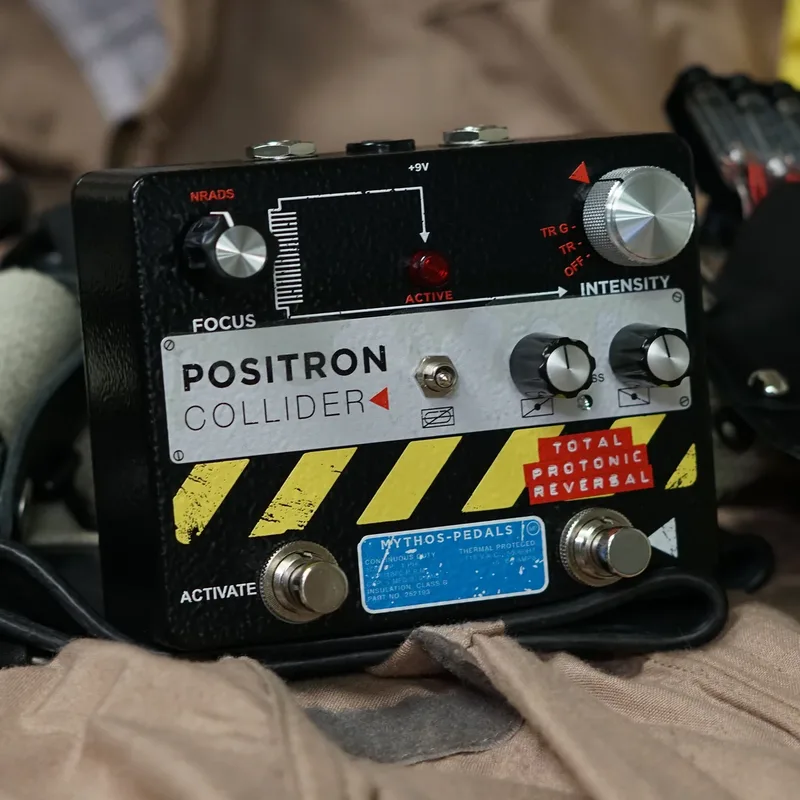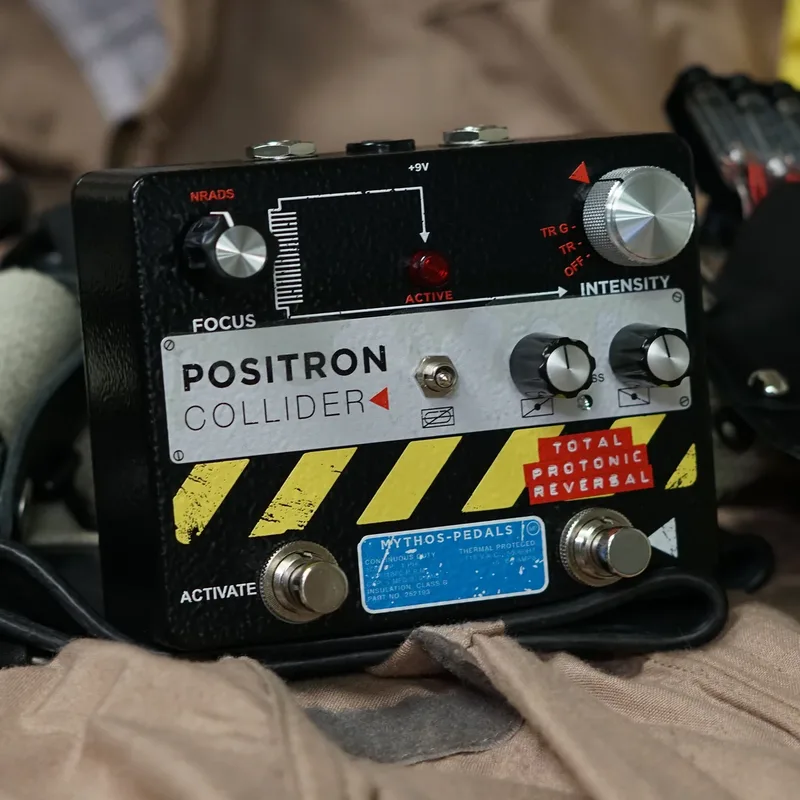


The Mythos Positron Collider Fuzz is a limited-edition fuzz pedal from Mythos Pedals, announced in October 2018 and themed after the paranormal catching equipment from the 1984 film Ghostbusters1. The enclosure and its labels draw on the film's Proton Pack and Ghost Trap props, down to a footswitch called Total Protonic Reversal2.
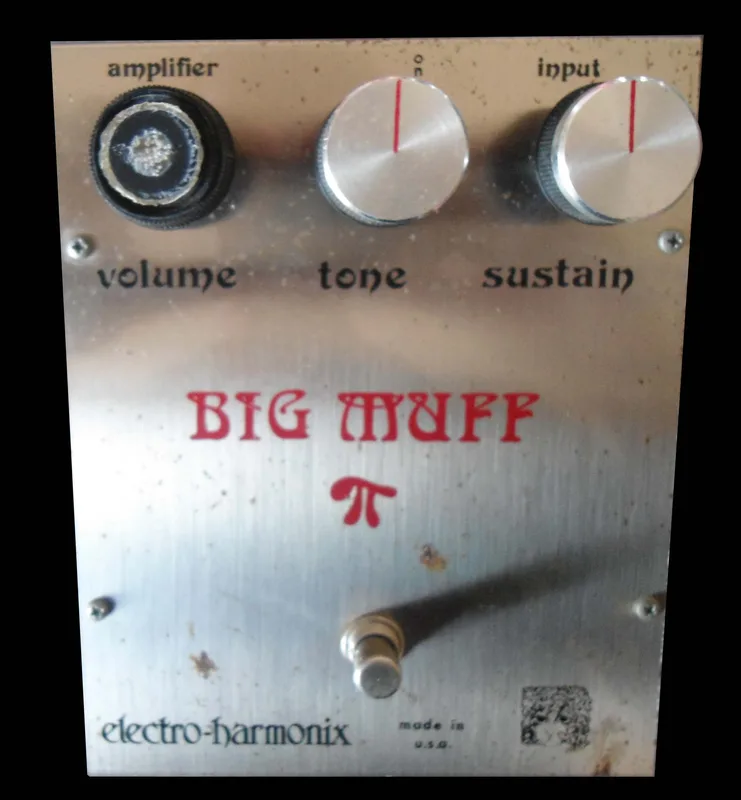
Under the theme, the circuit is a take on a classic Big Muff. Mythos describes it as the company's tweaked version of the Ram's Head Muff circuit, the mid-1970s Big Muff voicing3, and launch coverage called it a highly modified Ram's Head rather than a straight copy4. The hand-assembled unit was offered at $279 when it was announced1.
A Ram's Head Muff with a Ghostbusters theme
The Ram's Head Muff is a well-known Big Muff variant, and it is the base Mythos started from. Delicious Audio's write-up put it plainly243:
"The base circuit began as a classic 'Ram's Head' style fuzz but soon became much more than that."2
The modifications are what separate the Positron Collider from a stock-style Muff build: a clipping switch with two diode types, independent treble and bass controls, and a second footswitch that takes the tone stack out of the signal path31. The Ghostbusters theme runs through the whole pedal, from the prop-inspired artwork to the control names, and a small white LED on the unit dynamically pulses as you play4.
The controls
Mythos gives the Positron Collider four knobs, a clipping switch, and two footswitches3. The knob names keep the theme while the functions are familiar:
| Control | What it does |
|---|---|
| Focus | Sets the output level (volume)34 |
| Intensity | Adjusts the gain, from low-gain fuzzy tones to huge high-gain fuzz34 |
| Treble | Top-end voicing, interactive with the Bass knob31 |
| Bass | Low-end voicing, interactive with the Treble knob31 |
| Clipping switch | Selects silicon or LED clipping31 |
| Total Protonic Reversal footswitch | Bypasses the tone circuit for a full-range voicing with extra volume342 |
The maker says the control range runs from versatile low-gain fuzzy tones to huge high-gain fuzz sounds, and that the treble and bass knobs can be set anywhere from classic Muff sounds to less mid-scooped, fuller tones3. Because the two tone knobs are interactive, adjusting one changes how the other responds, which is what lets a player dial the pedal in for different guitars and amps1.
The clipping switch is the main circuit modification a player will hear. Silicon diodes and LEDs clip at different thresholds, so the two positions give the fuzz different compression and openness, and the switch makes that comparison a foot- or hand-reach away rather than a soldering job1.
The second footswitch, labeled Total Protonic Reversal, is a Ghostbusters joke with a practical function: it lifts the treble and bass tone stack entirely, which gives a more full-range voicing and extra volume342. For players who find Big Muff-style tone stacks scoop out too much of the midrange, that bypass is the escape hatch.
Guitar and bass use
Mythos voices the Positron Collider for both instruments. The company says the interactive treble and bass knobs let the user fine-tune voicings for both guitar and bass1, and MusicRadar's launch coverage described it as offering a wide variety of tones for guitar and bass courtesy of the treble and bass tone stack4. Bass players can also use the Total Protonic Reversal footswitch to run the pedal full-range rather than through the tone circuit.
Availability and reissue
The original Positron Collider Fuzz was a hand-assembled limited edition at $27914. Mythos has since brought the pedal back, listing it as a limited-time reissue on the company's product page3. Players looking at the current version can find it on the Mythos Pedals Positron Collider page.
Videos
Andertons Music Co
Premier Guitar
Mythos Pedals
Questions
Is the Mythos Positron Collider based on a Big Muff?
Yes. It is built around a modified Ram's Head Muff circuit, the mid-1970s Big Muff variant, tweaked by Mythos. Launch coverage described it as a highly modified Ram's Head circuit rather than a clone, adding switchable clipping and a tone-stack bypass41.
Does the Positron Collider work with bass?
Yes. Mythos says the interactive treble and bass controls allow fine-tuning of voicings for both guitar and bass, and launch coverage described a wide variety of tones for both instruments14.
What does the Total Protonic Reversal footswitch do?
It bypasses the tone circuit, lifting the treble and bass tone stack for a more full-range voicing with extra volume342.
What clipping options does the Positron Collider have?
A clipping switch enables both silicon and LED clipping options1.
How much does the Mythos Positron Collider cost?
The original hand-assembled limited edition was offered at $279 in October 201814.
Sources (4)
- Mythos Pedals Unveils 'Ghostbusters'-Inspired Positron Collider Fuzz, Guitar World, 2018-10-31
- Pedal Update: Mythos Positron Fuzz, Delicious Audio, 2022-10-31
- Positron Collider Fuzz, Mythos Pedals
- Mythos Pedals announces Positron Collider Fuzz, MusicRadar, 2018-10-31