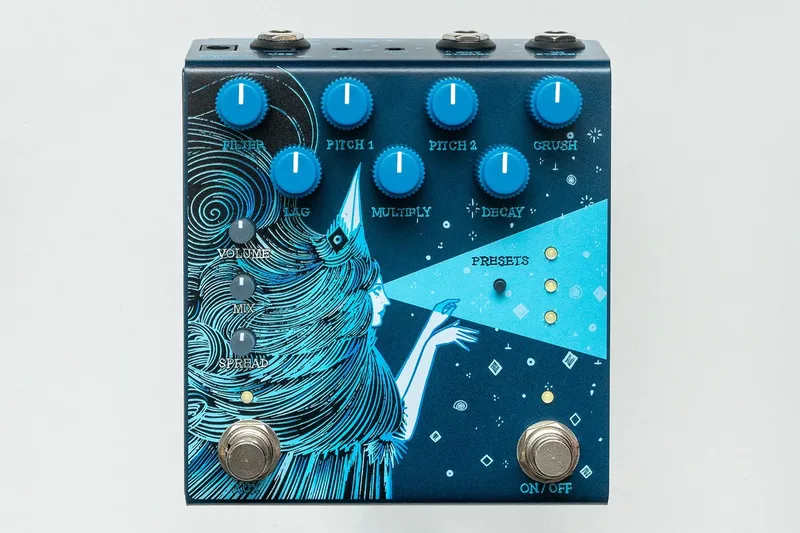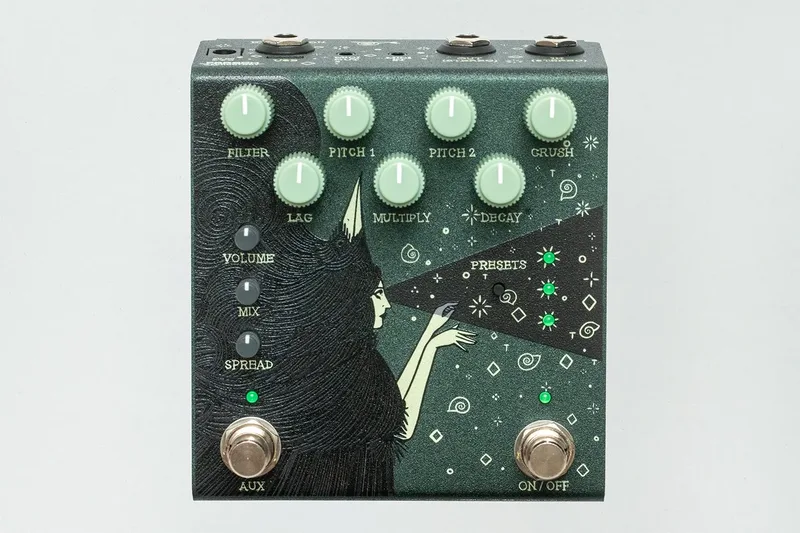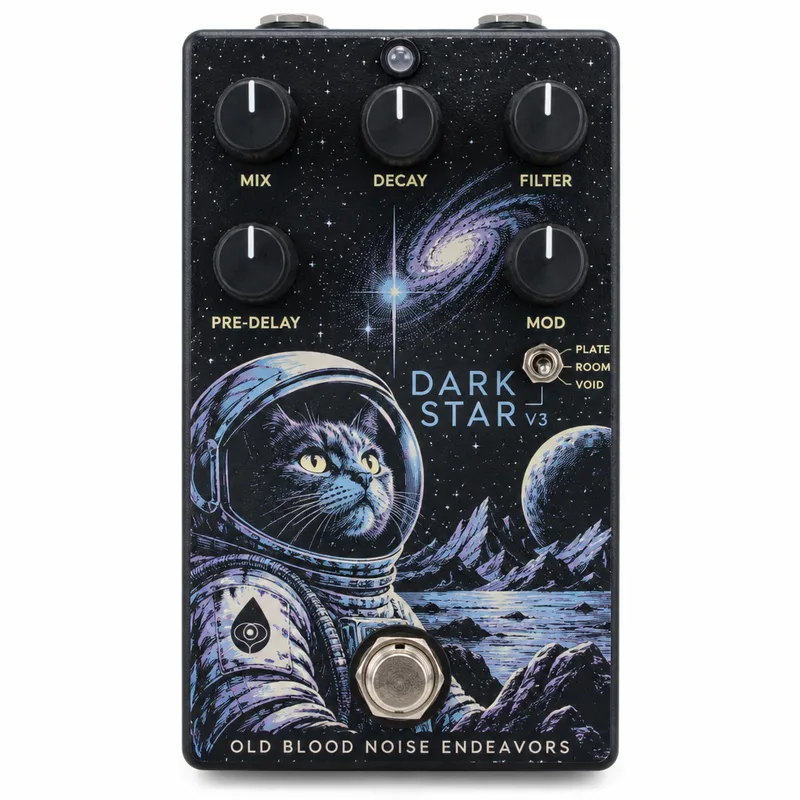

The Dark Paw is a B's Music Shop exclusive edition of the Old Blood Noise Endeavors Dark Star V3, a stereo digital reverb pedal with pitch shifting. It is a reimagining of OBNE's stereo lo-fi reverb pedal, with the standard artwork replaced by the shop's own original space-cat illustration, and the same core feature set underneath: stereo I/O, full MIDI and expression support, and a sound RockBoard's PedalPedia describes as a lush, ambient wash with haunting trails, shimmering pitch shifts, and glitchy crushed textures1.
What the Dark Paw is
At its core, the Dark Paw is the Dark Star V3: a reverb and pitch shifter in one box, sitting in the octave and pitch and reverb spaces rather than being a straight reverb. RockBoard's PedalPedia describes what it does to a signal as transforming it into "a lush, ambient wash with haunting trails, shimmering pitch shifts, and glitchy crushed textures"1. In practice that puts it in the textured reverb camp, where pitch material and lo-fi crushing sit alongside the reverb itself rather than behind it.
The pedal is digital, which is what makes the pitch shifting and crushed textures possible alongside the reverb1. It has stereo inputs and stereo outputs, so it can sit in a stereo rig and pass a full stereo image through its effects1. It also carries full MIDI support and full expression support, meaning it can be controlled from a MIDI switcher or controller and its parameters can be swept from an expression pedal1.
The B's Music Shop edition
What sets the Dark Paw apart from the standard Dark Star V3 is the artwork and the availability. It is exclusive to B's Music Shop, and the shop replaced the original art with its own illustration. As the product listing puts it1:
"Exclusive to B's Music Shop, the Dark Paw swaps the original art for an intergalactic floofy friend lovingly illustrated"
The listing describes the artwork as "our own original space-cat artwork that we've been brewing up for a long time"1. The enclosure itself is finished to match: the chassis is galactic purple sparkle and the knobs are dreamy lavender1.
Power and connections
The Dark Paw runs on 9V DC with a center-negative plug and draws 350mA1. That is a meaningful current draw for a single pedal, and it is worth checking before adding it to a shared supply output, since a low-current daisy-chain output may not keep up. A dedicated supply output rated for at least 350mA is the straightforward choice.
The Dark Paw draws 350mA at 9V DC, center negative1. A supply output rated below that will not run the pedal reliably, so plan the power layout accordingly.
Videos
B's Music Shop
Questions
Is the Dark Paw analog or digital?
The Dark Paw is a digital pedal. It is a reverb with pitch shifting, a combination that relies on digital processing, and the published specification for the pedal lists its circuit type as digital. That sets it apart from analog drive, fuzz and filter pedals, where the signal never leaves the analog domain, and it is typical of textured reverb pedals that layer pitch and crushed textures onto a reverb wash.
Does the Dark Paw have MIDI?
Yes. The Dark Paw has full MIDI support, alongside full expression support. That means it can be controlled from a MIDI controller or switcher for preset changes and other MIDI commands, and an expression pedal can be used to sweep its parameters in real time. Not every pedal at this size offers MIDI, so it is worth knowing when planning a board with a MIDI switcher.
Does the Dark Paw have stereo inputs and outputs?
Yes, the Dark Paw has stereo I/O, meaning it takes stereo inputs and provides stereo outputs. For a reverb and pitch shifter, stereo operation matters: pitch-shifted and textured material can be spread across both channels, and the pedal can sit in a stereo rig or feed two amps without collapsing the image to mono.
What power supply does the Dark Paw need?
The Dark Paw runs on 9V DC, center negative, and draws 350mA. That current draw is high enough that a low-output daisy-chain supply or a battery-style adapter may not keep up, so a dedicated supply output rated for at least 350mA is the safe choice. Check the current rating on your supply before adding it to a shared output.
Sources (1)
- Dark Paw, RockBoard PedalPedia, 2026