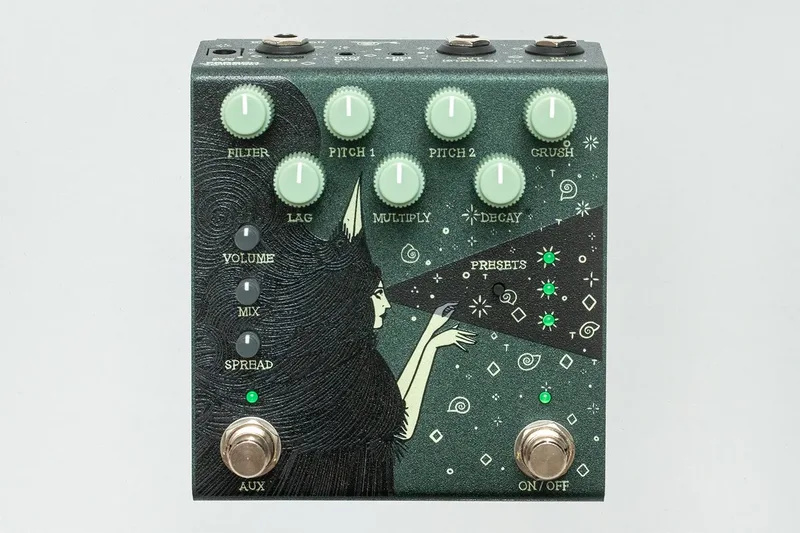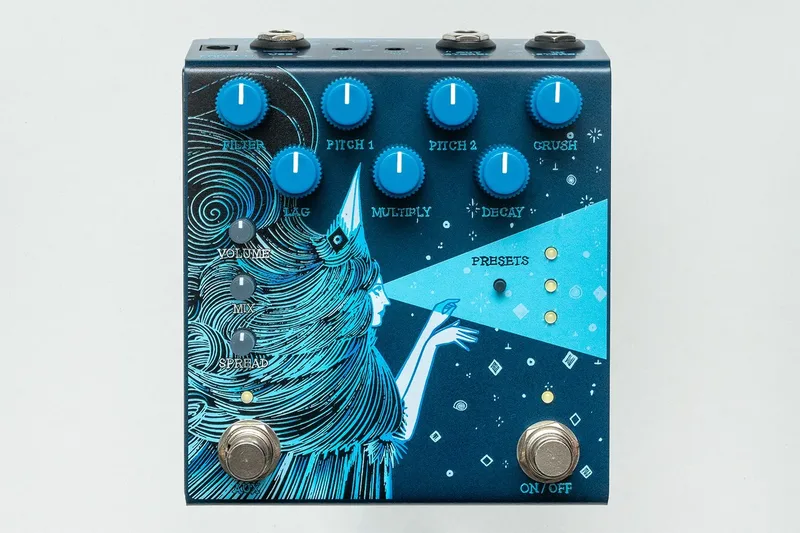


The Dark Star Stereo is a reverb pedal from Old Blood Noise Endeavors, a characterful lo-fi reverb the maker describes as ideal for slow attack and pad generation. Where a conventional reverb pedal adds space around your playing, the Dark Star takes the reverb trail and processes it, layering pitch shifting, delay and sample-rate reduction or overdrive into the wash so the tail becomes a sound of its own. Old Blood Noise calls it "a reverb for anywhere in your signal chain, and almost an instrument of its own"1.
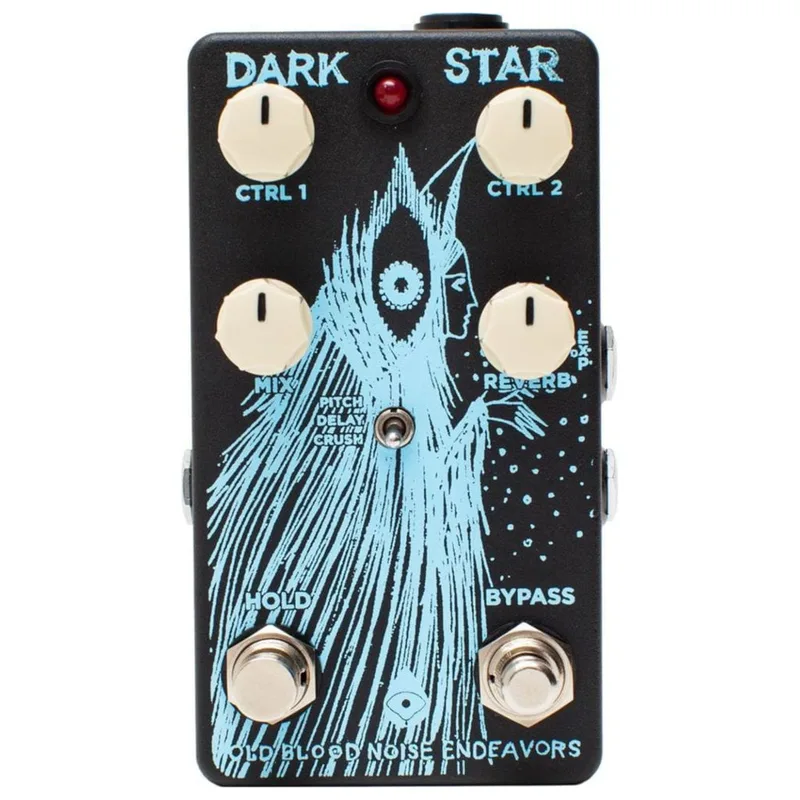
It is the stereo evolution of the company's Dark Star line. The original Dark Star Pad Reverb was a compact mono pedal with three separate and independent modes of operation: Pitch, Delay and Crush2. The Stereo version, released in 2024, keeps that processing but lets you blend all three modes at once, and adds stereo inputs and outputs, presets, expression and MIDI control3. Premier Guitar's reviewer placed its character clearly: "The result is a pad reverb, as synthetic as but less sparkly than a shimmer"4.
A lo-fi pad reverb
The Dark Star line goes back to the mid-2010s. The original Dark Star pad reverb was released at the tail end of 201567, and Delicious Audio notes it "shines in creating long and cavernous reverbs, with an optional lo-fi character" since its launch in 20167. Guitar World has described the pedal's core idea as "a reverb modulated by pitch, delay and bit-crusher"8.
The Stereo version is what Guitar Pedal X called "the next evolution of OBNE's Dark Star," a souping-up of the former compact mono pedal into a full stereo ambient reverb2. Where the older pedal made you choose one of its three modes at a time, the Stereo blends them together, so a single trail can carry pitch shifting, delay and crushed texture simultaneously23.
For a player, that means the Dark Star Stereo sits closer to a sound-design tool than a room or hall emulation. It is built for slow swells, sustained pads and long decays rather than subtle ambience, and Premier Guitar found that stereo is where this iteration, which follows the mono Dark Star and Dark Star V2, "really comes alive"4.
The controls
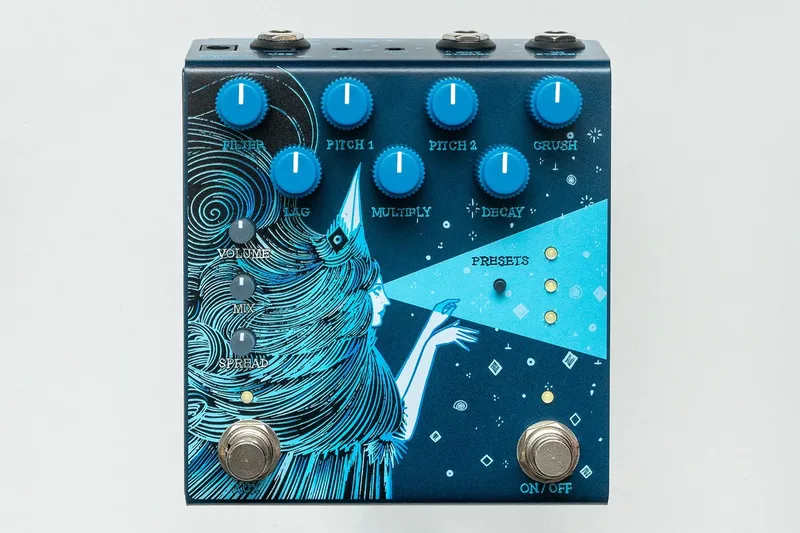
The Dark Star Stereo carries six knobs, each mapped to a clear job1:
| Control | What it does |
|---|---|
| Volume | Sets overall volume |
| Spread | Simultaneously pans left and right in opposite directions |
| Decay | Sets the main trail length of the reverb |
| Lag | Introduces additional delay to the reverb |
| Multiply | Adds feedback to the whole system, enhancing effects like rising and falling pitch shifts |
| Crush | Introduces either sample rate reduction or overdrive |
Premier Guitar's reviewer read the same panel slightly differently in use, describing controls for lag (pre-delay), multiply (feedback) and decay4. On the original mono Dark Star, the two CTRL knobs corresponded with whichever mode was selected7; on the Stereo, the equivalent functions are named directly on the knobs.
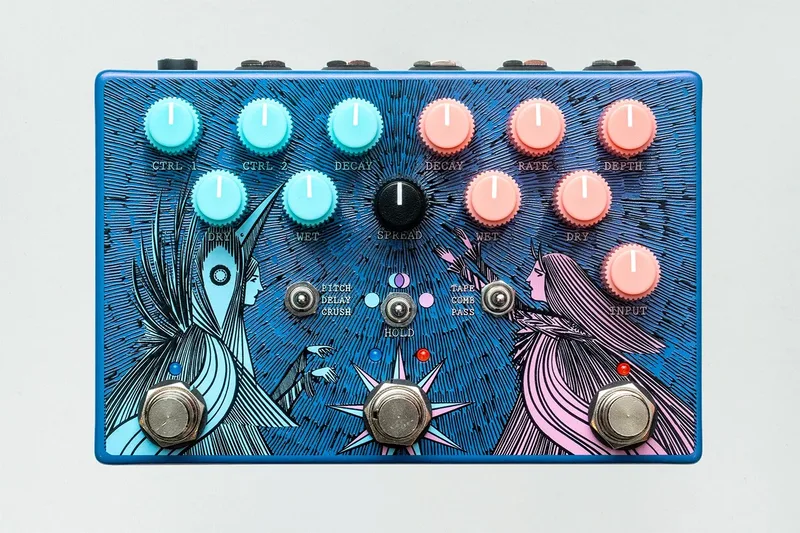
The enclosure art is by Jon Carling1, and the pedal comes in three colors: Blue (the standard finish), Black and Pink1.
Stereo, expression and MIDI
The Dark Star Stereo has TRS stereo in and TRS stereo out19, with analog dry through, meaning your dry signal stays analog rather than being converted and back again1. The Spread knob works with the stereo outputs, panning the wet signal left and right in opposite directions for movement across two amps1.
Control options run deep for a reverb pedal:
- Presets, for saving and recalling sounds1
- Expression control over every knob1
- MIDI control over every element, with MIDI In and MIDI Out connections12
- Aux control, as noted in Premier Guitar's review4
- Two footswitches, with the second a multi-purpose switch assignable to preset toggling5
That feature set puts the Dark Star Stereo in the same territory as other deep ambient pedals, and makes it a candidate for players who want a reverb that integrates with a MIDI-controlled board rather than sitting at the end of it14.
Power: 9V, 350mA
The Dark Star Stereo requires a 9V DC center negative power supply with a 2.1mm jack, capable of 350mA, and the supply is not included1.
At 350mA, the Dark Star Stereo draws far more current than the original mono Dark Star, which needed 110mA101. A typical compact-pedal output on a power supply may not be enough, and there is no battery option. Check your power supply's per-output current rating before building the pedal around it.
The original Dark Star also ran on 9V DC center negative through a 2.1mm jack, so the polarity convention carries over between versions10.
What reviewers said
Guitar.com's review of the Dark Star Stereo was direct about its strongest suit51112:
"Sounds preposterously huge and blissful through two amps"
Richard Purvis, Guitar.com5
The same review noted a naming quirk worth knowing: the enclosure, packaging and manual name only "Dark Star," because that was the name of the old mono version, so the pedal you receive may not carry the word "Stereo" on it at all5.
Guitar Pedal X, covering the launch, wrote that the Soundscape version "sounds superb in the various demos"2, and in its 2024 roundup of spatial, immersive and time-based effects the site called it "a really cool sounding reverb for sure, and one which is very much on my target list for next year"13. Delicious Audio's buying guide flagged the Stereo version, released in 2024, as a standout among delay and reverb pedals for its ability to blend all three modes at once3.
Videos
Old Blood Noise Endeavors
The Pedal Zone
Harp Lady
Questions
What is the difference between the Dark Star and Dark Star Stereo?
The original Dark Star was a mono compact pedal with three separate and independent modes of operation: Pitch, Delay and Crush. The Stereo version, released in 2024, adds stereo inputs and outputs and lets you blend all three modes at once rather than choosing one at a time. It also brings presets, expression control over every knob and MIDI control over every element.
Is the Dark Star Stereo true bypass?
It offers selectable switching: you can run it in true bypass mode or in buffered trails mode, where the reverb tail continues after you switch the pedal off. The soft-touch bypass footswitch is designed for true bypass and minimal switch noise, and the pedal keeps analog dry through in both configurations.
Does the Dark Star Stereo have trails?
Yes. The Dark Star Stereo has selectable buffered trails or true bypass switching, so you can let reverb tails ring out after disengaging the pedal. The Decay knob sets the main trail length of the reverb, and the Multiply knob adds feedback to the whole system for longer, more sustained washes.
What colors does the Dark Star Stereo come in?
The Dark Star Stereo comes in three colors: Blue, which is the standard finish, plus Black and Pink. All versions carry the same enclosure art by Jon Carling and the same $329 list price.
Is a power supply included with the Dark Star Stereo?
No. The pedal requires a 9V DC center negative 2.1mm jack power supply capable of 350mA, and the supply is not included. That current draw is well above what a typical compact pedal needs, so plan on an isolated or high-current output on your pedalboard power supply.
Sources (13)
- Old Blood Noise Endeavors, Old Blood Noise Endeavors
- Guitar Pedal X, Guitar Pedal X, 2024-11-21
- Best Delay + Reverb Pedal Combos In 2024, Delicious Audio, 2024-11-07
- Old Blood Noise Dark Star Stereo Pedal Review, Premier Guitar, 2025-03-06
- Old Blood Noise Endeavors Dark Star Stereo review, Guitar.com, 2025-04-18
- EVERTHING YOU NEED TO KNOW ABOUT OLD BLOOD NOISE PEDALS, JHS Pedals
- Old Blood Noise Endeavors Dark Star Pad Reverb, Delicious Audio, 2021-05-25
- Noveller's BilT guitar: Sarah Lipstate breaks down its FX, Guitar World, 2019-10-24
- Old Blood Noise Endeavors, Old Blood Noise Endeavors
- Old Blood Noise Endeavors, Old Blood Noise Endeavors
- Walrus Audio Lüm review, one box, three colossal reverb effects | Guitar.com, Guitar.com
- Walrus Audio Qi Etherealizer review, a dynamic dreamscape generator | Guitar.com, guitar.com
- Guitar Pedal X, Guitar Pedal X, 2024-12-20