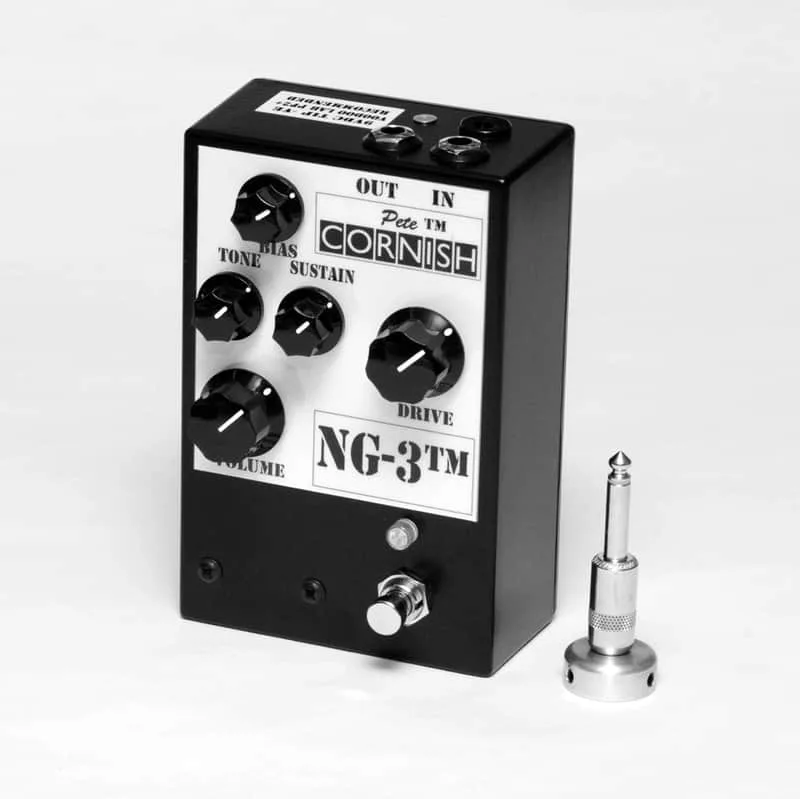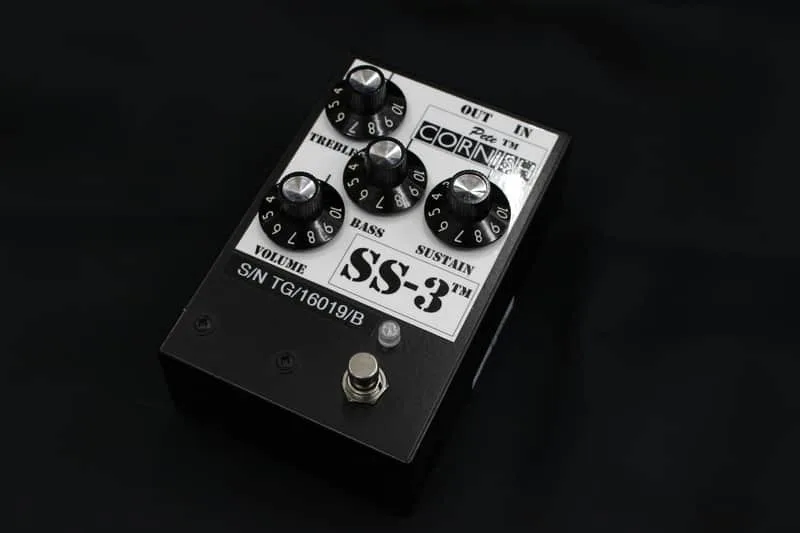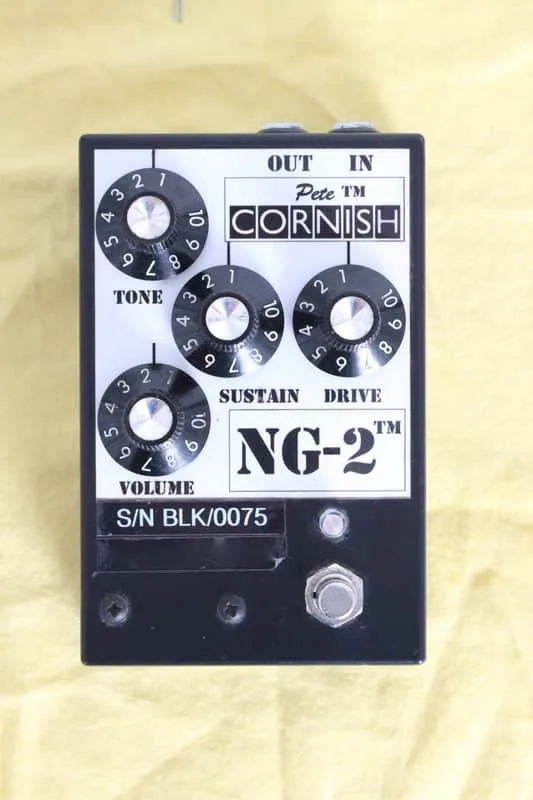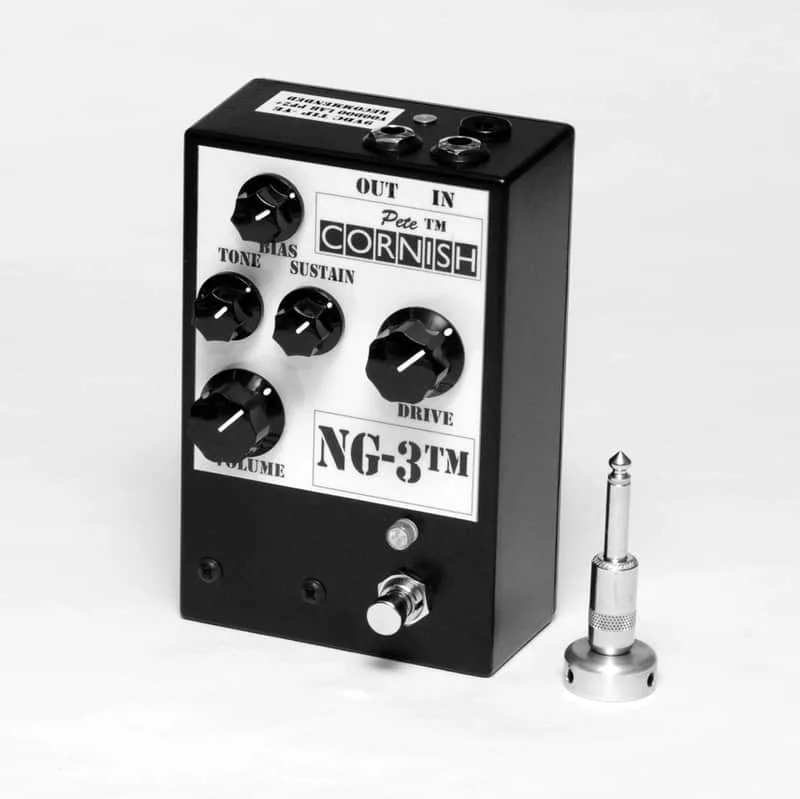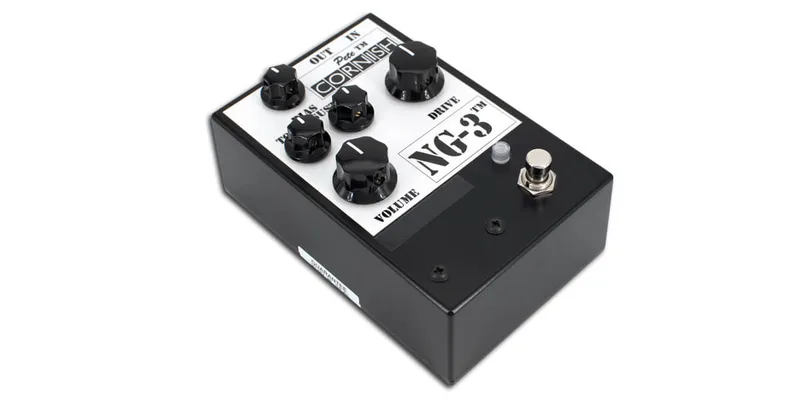


The Pete Cornish Deluxe NG-3 is a fuzz box from British builder Pete Cornish, and it is built around one idea: simulating what Cornish calls "Imminent Amp Death" (I.A.D.), the sound of a tube amp right at the edge of failure1. Where most fuzz pedals aim for a smooth or singing sustain, this one aims for the ragged, collapsing character of an amp with a blown power tube or a failing output transformer. In Cornish's own framing of where it sits among fuzz boxes, "In the range of generally available fuzz boxes covering a scale from 1 through 10, this one goes to 15 !"1.
The circuit works in three stages rather than one clipping stage, and the Deluxe version adds a 9V battery drawer and a larger enclosure alongside the standard NG-3, which was released in 20102. Both versions are custom-built units ordered directly from the maker by email3.
Imminent Amp Death in three stages
The Deluxe NG-3's signal path is a chain of three distinct stages, each doing a different job1.
| Stage | What it is | What it does |
|---|---|---|
| 1 | Linear DRIVE | Up to +26dB of gain feeding the second stage1 |
| 2 | Stabilised discrete preamp | Overloads smoothly when overdriven45 |
| 3 | Vari-Class amplifier stage | Simulates a failing tube amp1 |
The third stage is where the pedal's name concept lives: it simulates a tube amp that has been under biased or has suffered serious tube or output transformer failure1. The SUSTAIN control adjusts the signal level into this third section, and Cornish labels its range in deliberately descriptive terms, from "Tired Output Tubes" at the low end to "Melted Tubes and Shorted Output Transformer" at the top1.
Aion FX, which traced the NG-3 circuit, describes the design intent in plain terms2:
"It was designed to emulate 'imminent amp death', the sound of a blown power tube or output transformer right before it all goes up in smoke."2
The trace also gives a picture of how each stage is built. Stage 1 is an op-amp gain stage very similar to the second op-amp stage of the Cornish SS-3 that drives the hard clipping. Stage 2 is a more basic transistor gain stage with an emitter bypass capacitor and a 1nF capacitor from base to emitter. Stage 3 is a single-transistor stage set for much higher gain, with its base bias set by a 5V precision zener diode and a potentiometer, and a single diode going to ground that clips half of the waveform above 0.7V2. That half-wave clipping in the final stage is a large part of why the pedal sounds like an amp coming apart rather than a conventional fuzz.
The NG-3 also carries an external, user-adjustable Bias control, and its origin is documented: it was added at Lou Reed's request, after the NG-2 had used an internal bias trimmer. As Aion FX recounts, "Lou asked if this could be made external so that he could adjust it to find other possibilities"2.
Power: 9V, 20mA
The Deluxe NG-3 runs on a 9V DC adapter that Cornish specifies must be noise free and fully stabilised, capable of supplying 20mA. The coax connector is 5.5/2.1mm with the center pin negative1.
The battery switches on when you insert a plug into the "IN/PWR ON" jack, so the pedal draws power whenever a cable is connected1.
The standard NG-3 page carries the same adapter requirements, 9V DC, stabilised, noise free, 20mA, 5.5/2.1mm center negative41, and Pete Cornish has also offered a battery-free NG-3 built to order3. The Deluxe version's battery provision is the practical difference: a 9V cell of the preferred MN1604 type, replaced through a removable drawer in the enclosure rather than by opening the box1.
Enclosure, footswitch and buffer
The Deluxe NG-3 is housed in a rugged die-cast box with lined control knobs1. It measures 171 x 121 x 55 mm, or 6.75 x 4.75 x 2.2 inches1. The standard NG-3 page lists a smaller enclosure, 145 x 95 x 49 mm3; the two versions differ in size as well as in battery provision, and the maker's own pages give both figures without reconciling them.
Switching is by a heavy duty custom made all-metal footswitch with a large cap and protection ring, plus a Hi-Brite LED so the effect state is visible on a dark stage1.
The pedal also includes an RFI rejecting input and bypass buffer1. Aion FX's trace confirms the NG-3 uses the standard Cornish buffers2, the same buffering approach found across the maker's line. For a player, that means the pedal presents a consistent load to the guitar and drives long cable runs without the treble loss an unbuffered true-bypass fuzz can suffer.
Warranty and ordering
The Deluxe NG-3 is covered for twelve months from date of purchase: any original manufacturing fault is repaired under guarantee, with the unit returned post paid to the maker. The guarantee is voided if the guarantee labels are damaged or removed, and normal wear, misuse, unauthorised modifications or accidental damage are excepted1. The standard NG-3 page states a two-year warranty on the same terms4, so the coverage differs between versions.
Units are custom built and ordered by email, advising the maker of your delivery location3.
Videos
shnobel
Diego Aditya
Drums FX Pedals
Questions
What does Imminent Amp Death mean on the Pete Cornish NG-3?
It is the sound the pedal is built to simulate: a tube amp that has been under biased or has suffered serious tube or output transformer failure. The SUSTAIN control sets how far gone the simulated amp is, from Tired Output Tubes at one end to Melted Tubes and Shorted Output Transformer at the other.
Does the NG-3 run on a battery?
The Deluxe NG-3 takes a 9V battery, preferred type MN1604, replaced through a removable drawer in the enclosure. The battery switches on when you insert a plug into the IN/PWR ON jack. Pete Cornish has also offered a battery-free version of the NG-3.
What polarity does the NG-3 power supply need?
A 9V DC adapter, fully stabilised and noise free, feeding a 5.5/2.1mm coax connector with the centre pin negative. The adapter must be capable of supplying 20mA.
How much gain does the NG-3 drive stage have?
The first stage is a Linear DRIVE with up to +26dB of gain, feeding the second stage, a stabilised discrete preamp that overloads smoothly when overdriven. A third Vari-Class stage then simulates the failing tube amp.
How long is the Pete Cornish warranty?
The Deluxe NG-3 carries a twelve-month warranty from date of purchase covering repairs of any original manufacturing fault, returned post paid. The guarantee is voided if the guarantee labels are damaged or removed, and normal wear, misuse, unauthorised modifications or accidental damage are excepted.
What size is the NG-3 enclosure?
The Deluxe NG-3 measures 171 x 121 x 55 mm, or 6.75 x 4.75 x 2.2 inches. The standard NG-3 page lists a smaller 145 x 95 x 49 mm enclosure, so the two versions differ in size as well as in battery provision.
Sources (5)
- PETE CORNISH Deluxe NG-3, Pete Cornish, 2025
- Tracing Journal: Cornish NG-3, Aion FX, 2023-10-06
- PETE CORNISH NG-3, Pete Cornish, 2025
- PETE CORNISH NG-3, Pete Cornish, 2025
- Pete Cornish NG-3 Fuzz, Delicious Audio, 2017-06-13