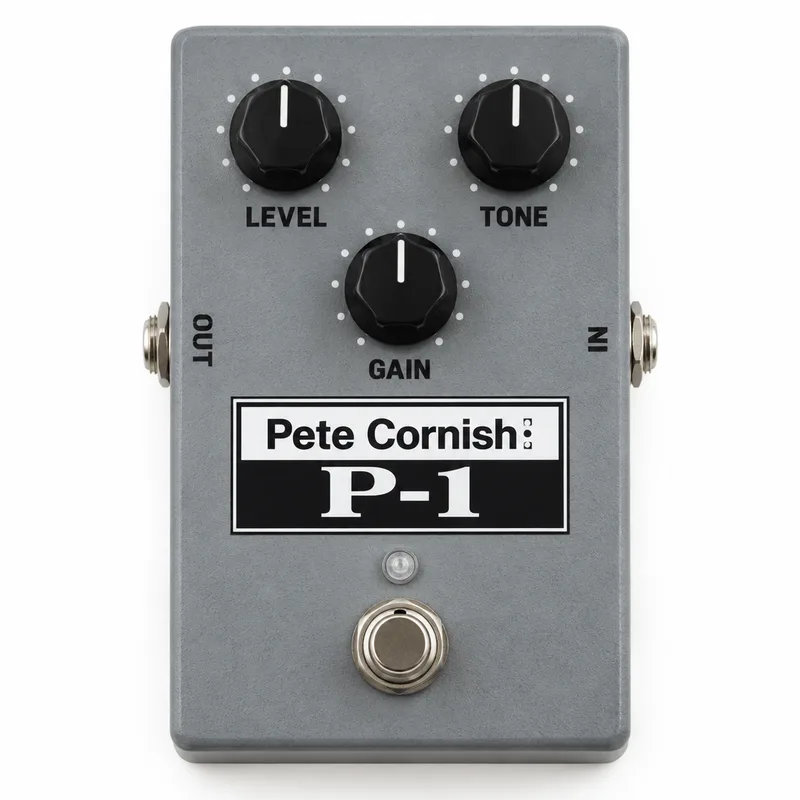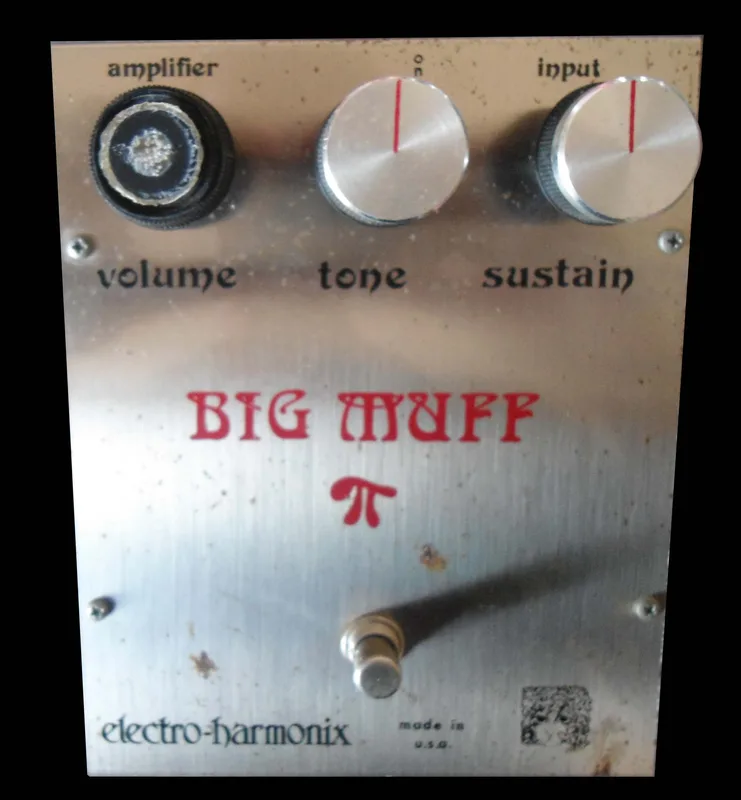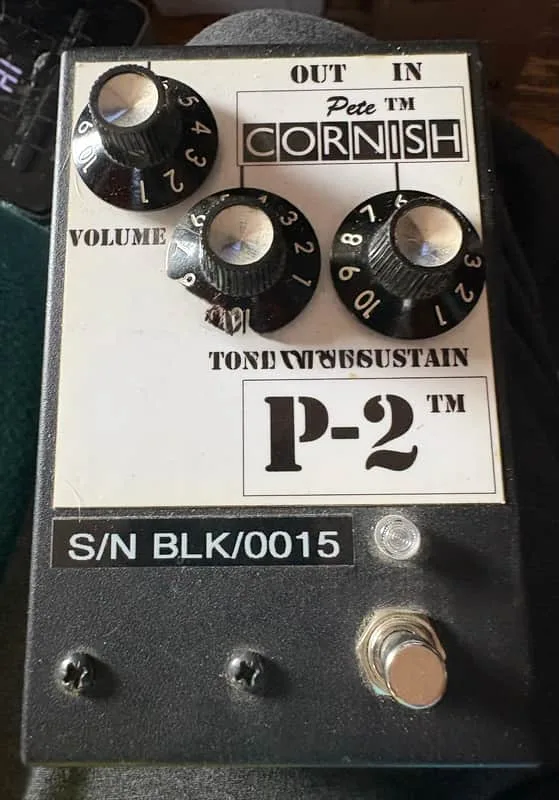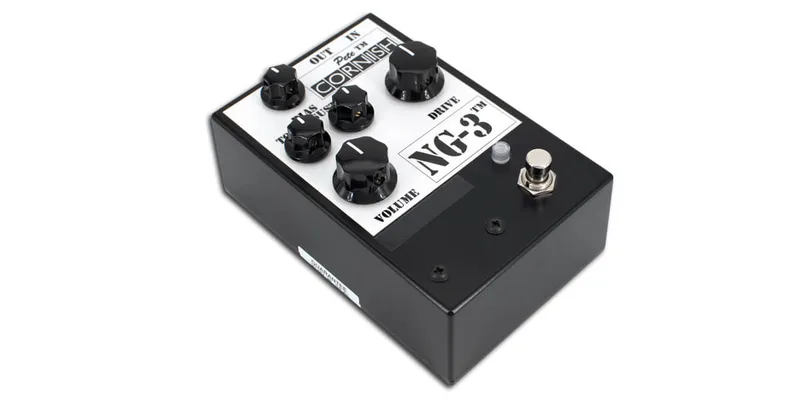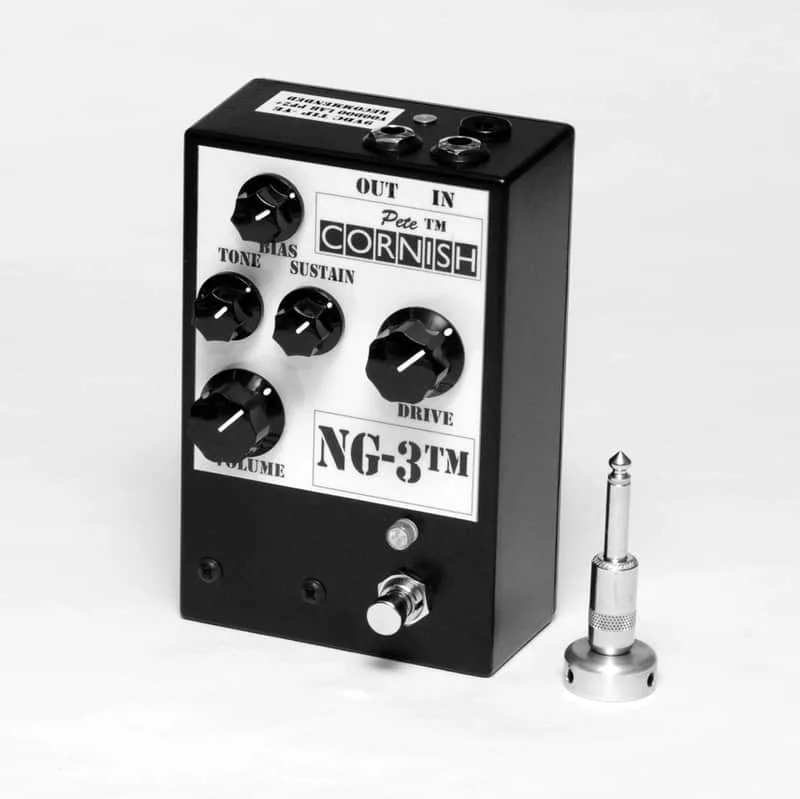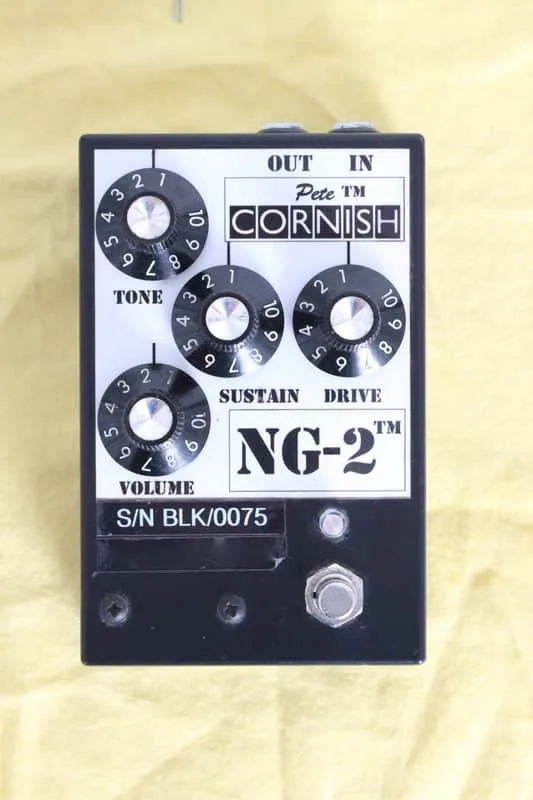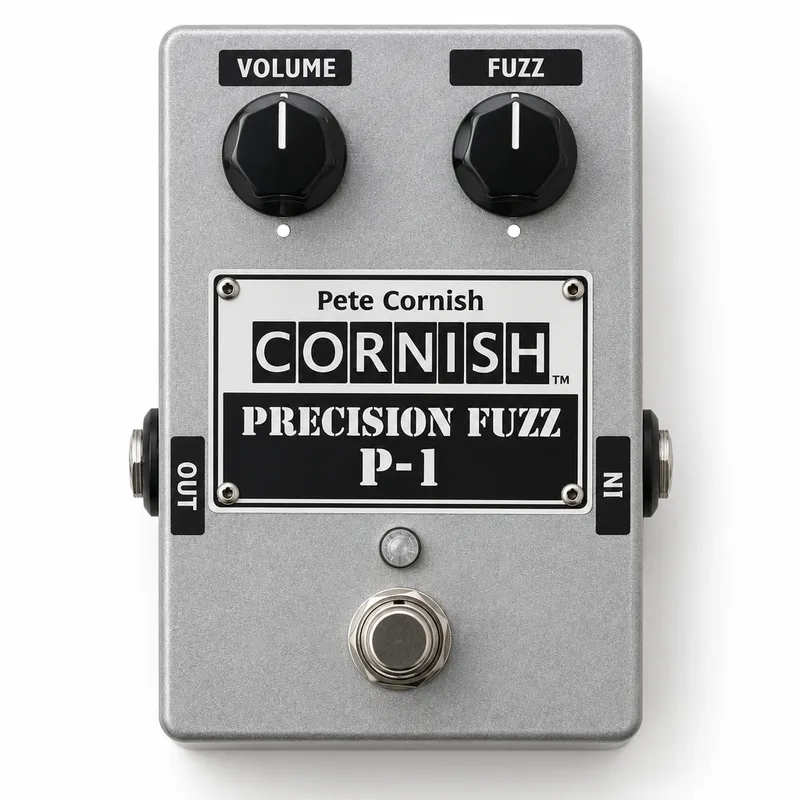


The Pete Cornish Precision Fuzz P-1 is a hand-built fuzz pedal from Pete Cornish, built around a mid 1970s Ram's Head Big Muff circuit with Cornish's own refinements. It began life as a circuit called the Custom Fuzz, designed for David Gilmour in 1976 as part of his integrated pedalboard, and it stayed in his rig in one form or another for decades. Pete Cornish describes the pedal sold today as "the Worlds first DOUBLE ISOLATED fuzz or distortion pedal"12.
A Big Muff circuit with Cornish's refinements
At its core the P-1 is a Ram's Head Big Muff. Aion FX describes it as "an adaptation of the EHX Big Muff Pi V2 (Ram's Head) with two transistor buffers added to the front of the circuit to reduce noise and improve the signal isolation"4. In 2024, Aion FX traced the P-1 circuit and determined it matched one of the Ram's Head Big Muff schematics published on Kit Rae's website, the only difference being Pete Cornish's buffer1. Kit Rae, who has documented Gilmour's gear for years, puts it plainly: "They were all essentially custom made versions of Big Muff circuits with Pete's improvements"1.
The Gilmour connection runs deep. Kit Rae reports that a schematic of the P-1 circuit shown at the Pete Cornish shop in 2016 had "David's favorite Muff" written on it1. Cornish was one of the first people known to have been making modified versions of the Big Muff circuit, going as far back as the late 1970s with the first custom Big Muff pedal for David Gilmour of Pink Floyd, and later with his P-2 and G-2 variations in the 1990s5.
The improvements Cornish made to the stock circuit were practical ones, requested as1:
- power supply de-coupling
- RF filtering
- unity gain buffers in the circuit and bypass, to maintain a constant high signal level
- improved reliability
- reduced PCB size1
The buffers are the heart of the design. Two transistor buffers sit in front of the fuzz circuit to reduce noise and improve signal isolation4, which is what Cornish means by "double isolated" on his product pages4.
Is the P-1 a Big Muff clone?
Close enough that the question is fair, but not a straight copy. Kit Rae calls the P-1 "very much an exact clone of a mid 1970s Big Muff circuit, and a very good one"1. Aion FX's trace backs that up: the P-1 was essentially a straight clone of David Gilmour's favorite Big Muff, a Ram's Head V2, with Pete's namesake buffers added6.
On tone, Kit Rae's verdict is strong: "I have found it to be one of the best Ram's Head Big Muff clones out there. It is remarkably similar in tone to some of the original 1973-76 era Ram's Head Big Muffs," with significantly more gain on tap than most originals1.
From Custom Fuzz to P-1
The pedal's naming history is a little tangled, and worth untangling:
- The circuit was designed for David Gilmour in 1976 as part of his integrated pedalboard, where it was known as the Custom Fuzz4.
- The first public version was called the Precision Fuzz and was unbuffered. The current P-1 is a buffered version of that original Precision Fuzz1.
- The first pedal version of the Custom Fuzz was built in 2006 and offered for sale to the public later that year, labeled "Custom Design"1. Another short run was made in 2008, when it was renamed the P-11.
- A 2013 version was added to the regular Cornish pedal line, with a high quality double buffer and a much sturdier enclosure than the stock Electro-Harmonix Big Muffs1.
The P-1 and the P-2 are closely related: the P-2 is a Big Muff design reached by way of the P-1, and Pete Cornish considered the P-2 an improvement over his original 1976 Custom Fuzz1. The public P-2 versions include a built-in double buffer and a larger enclosure1.
David Gilmour and the P-1
The P-1's history with David Gilmour spans most of its life:
- Designed for Gilmour in 1976 as part of his integrated pedalboard4.
- Built into his 1976 pedalboard, and used briefly for the 2006 On An Island tour, sometimes for a few songs such as Comfortably Numb1.
- Kit Rae also notes the P-1 was used on the original Wall tour as well as the On An Island tour7.
- At the 1990 Knebworth show, Gilmour blended the Precision Fuzz with the drive from a Mesa/Boogie Studio Preamp used as an overdrive in his signal chain1.
Videos
shnobel
shnobel
Questions
Is the Pete Cornish P-1 a Big Muff clone?
Essentially yes, with additions. Kit Rae's history article calls the P-1 an exact clone of a mid 1970s Big Muff circuit, and when Aion FX traced the circuit in 2024 it matched a Ram's Head Big Muff schematic, the only difference being Pete Cornish's buffer. Cornish added two transistor buffers to the front of the circuit to reduce noise and improve signal isolation, so it is a Big Muff with Cornish's refinements rather than a straight copy.
What is the difference between the original Precision Fuzz and the buffered P-1?
The first version, called the Precision Fuzz, was unbuffered. The current P-1 is a buffered version of that original circuit, including a high quality double buffer, and it is built in a much sturdier enclosure than the stock Electro-Harmonix Big Muffs. The circuit was known as the Custom Fuzz until 2006, when it was renamed the P-1 to better indicate its relationship to the P-2.
Did David Gilmour use the Pete Cornish P-1?
Yes. The circuit was designed for David Gilmour in 1976 as part of his integrated pedalboard, and Kit Rae documents that Gilmour used a Cornish P-1 briefly for his 2006 On An Island tour, sometimes for a few songs such as Comfortably Numb. Kit Rae also notes the P-1 was used on the original Wall tour.
Which Big Muff era does the P-1 match?
The P-1 matches the Ram's Head era of the Big Muff, the V2 circuit from the mid 1970s. Aion FX's trace identified it as a clone of a Ram's Head V2, the Big Muff Aion FX describes as David Gilmour's favorite, and Kit Rae found it remarkably similar in tone to original 1973 to 1976 era Ram's Head Big Muffs.
What improvements did Pete Cornish make to the circuit?
The improvements requested were power supply de-coupling, RF filtering, unity gain buffers in the circuit and bypass to maintain a constant high signal level, improved reliability, and a reduced PCB size. The buffers are the most audible part of the design: two transistor buffers added to the front of the circuit to reduce noise and improve signal isolation.
Who traced the P-1 circuit?
Aion FX traced the P-1 circuit in 2024 and determined it matched one of the Ram's Head Big Muff schematics published on Kit Rae's website, with Pete Cornish's buffer as the only difference. Aion FX had previously published the first known trace of the related Cornish P-2 in October 2023.
Sources (7)
- The Big Muffs of David Gilmour of Pink Floyd, Kit Rae, 2024-07
- Pete Cornish Deluxe P-1, Pete Cornish, 2025
- Pete Cornish P-1, Pete Cornish, 2025
- Halo Deluxe Distortion/Sustainer, Aion FX, 2024-04-19
- The Big Muff History of All Versions 3, kitrae.net, 2017-03
- Tracing Journal: Cornish P-2, Aion FX, 2023-10-06
- David Gilmour Tone Building, Kit Rae (kitrae.net), 2022-05