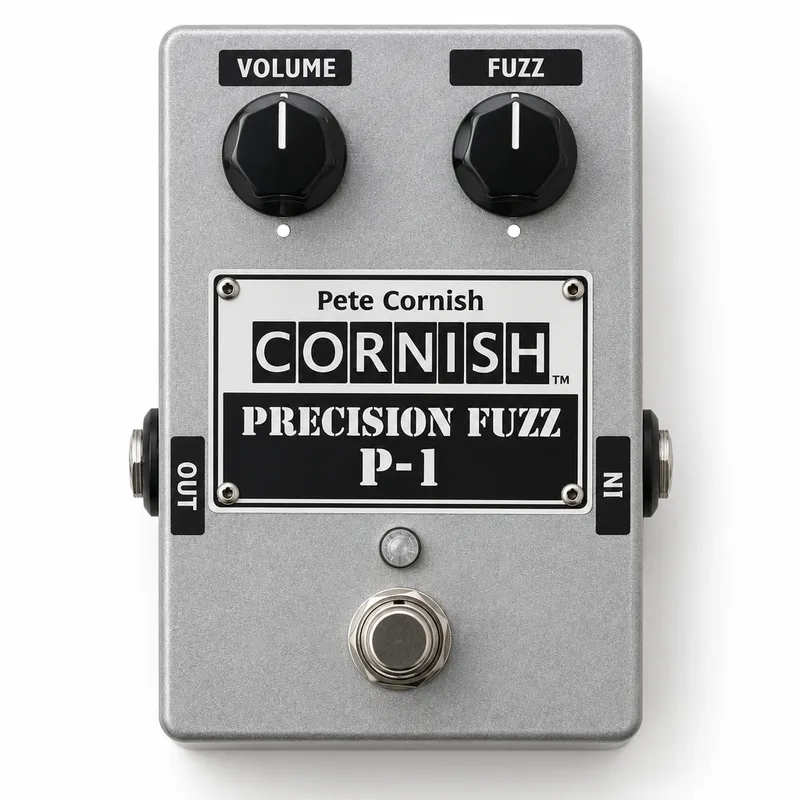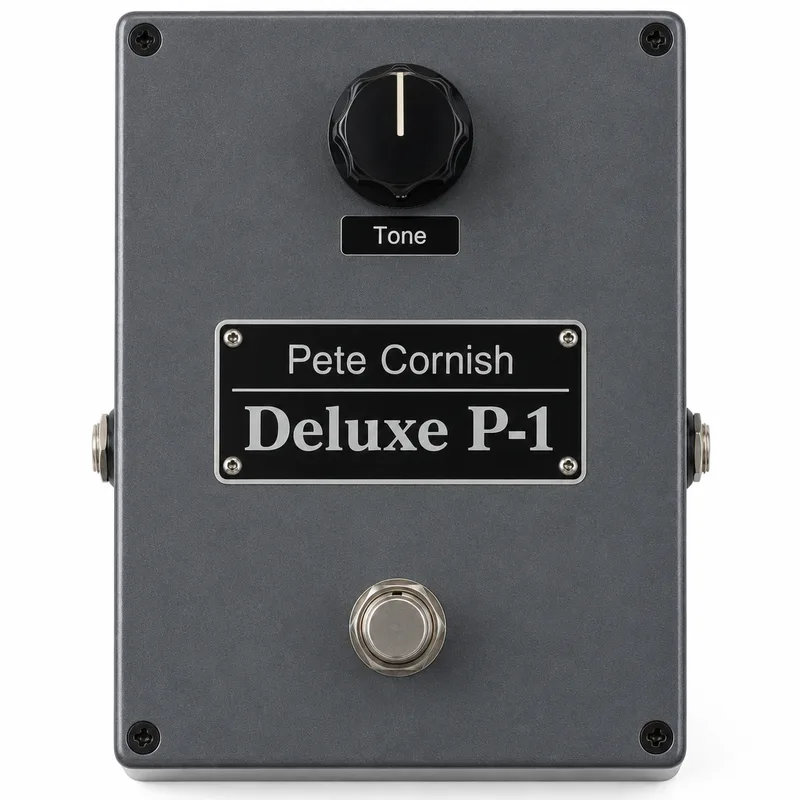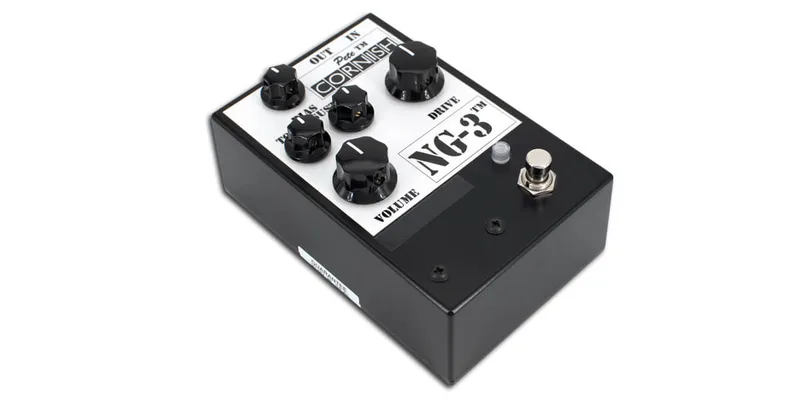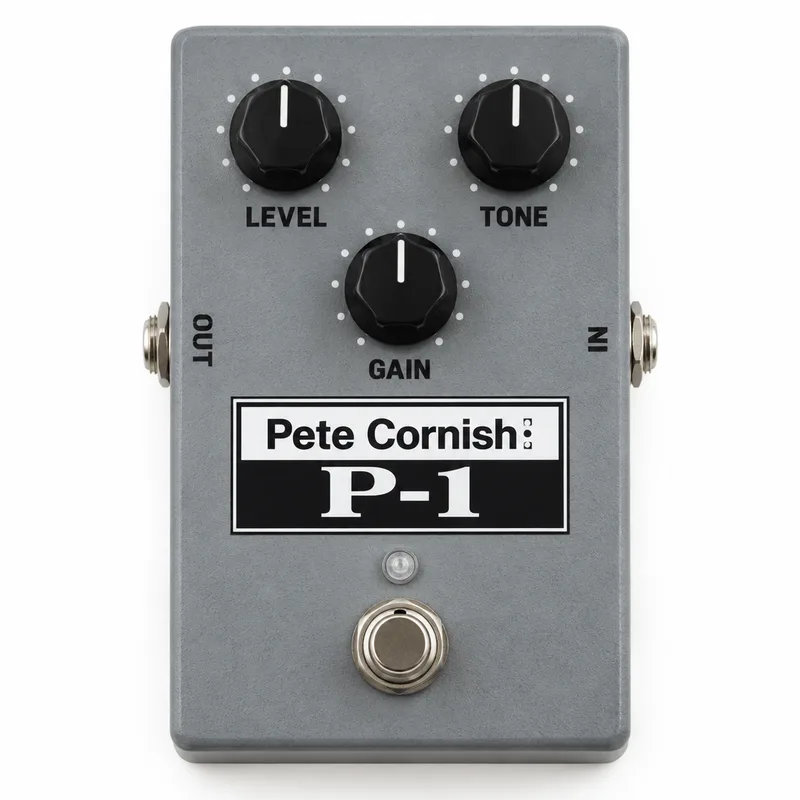


The Pete Cornish P-1 is a hand-built fuzz pedal from the English maker Pete Cornish, described by the maker as the world's first double isolated fuzz or distortion pedal1. It began life in 1976 as a circuit called the Custom Fuzz, designed for David Gilmour as part of his integrated pedalboard2, and it remains in production today as a custom-order pedal: Kit Rae notes that Pete Cornish has been selling these by custom order since 20053. The maker recommends it for a fat, high gain, searing lead sound, suited to solos and heavy rock rhythm work1.
The controls and buffer
The P-1's front panel is simple: a fuzz/distortion circuit and a tone control. Pete Cornish designed the tone facility to give treble boost when set clockwise and bass boost when set counterclockwise, with the settings in between providing varying amounts of high and low frequency boosting1. The Deluxe P-1 works the same way, with treble boost clockwise and bass boost anti-clockwise from 12 o'clock4.
What sets the P-1 apart from a stock Big Muff is what sits in front of the fuzz. The input is the maker's high impedance, unity gain, Class A buffer preamp with RFI rejecting capability and a low impedance audio output1. When Gilmour commissioned the design, the requested improvements included power supply de-coupling, RF filtering, unity gain buffers in the circuit and bypass to maintain a constant high signal level, and improved reliability6. Those buffers are why the maker calls the pedal double isolated, and why players often reach for Cornish pedals to solve signal-loss and noise problems on large boards. If you are curious about that side of the design, see Buffer Pedals.
What circuit is it based on?
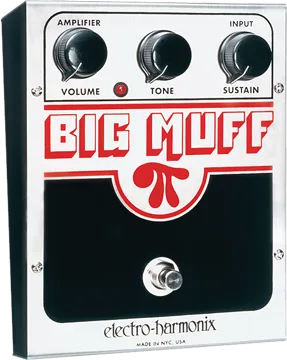
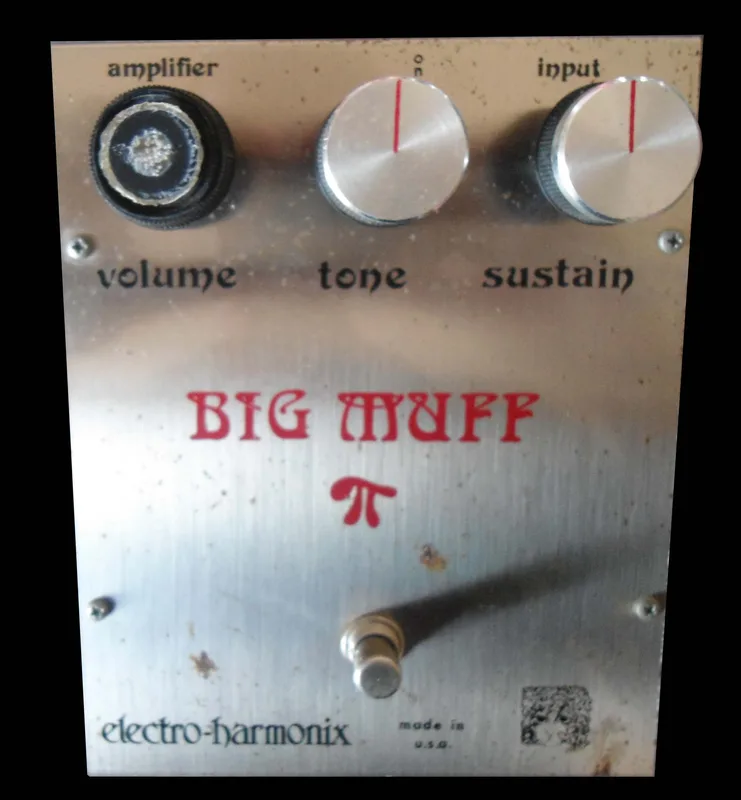
The P-1 is an adaptation of the Electro-Harmonix Big Muff Pi V2, the Ram's Head version, with two transistor buffers added to the front of the circuit to reduce noise and improve signal isolation2. Aion FX's technical analysis puts it the same way: the P-1 was essentially a straight clone of David Gilmour's favorite Big Muff, a Ram's Head V2, with Pete's namesake buffers added7.
Kit Rae, who has documented Gilmour's gear in depth, describes the P-1 as very much an exact clone of a mid-1970s Big Muff circuit, and a very good one6. He also recounts a detail from a 2016 visit to the Cornish shop: the schematic he was shown of the P-1 circuit even has "David's favorite Muff" written on it6. In 2024, Aion FX traced the P-1 circuit and determined it matched one of the Ram's Head Big Muff schematics traced on Kit Rae's website, the only difference being Pete's Cornish buffer6.
"the P-1 is very much an exact clone of a mid 1970s Big Muff circuit, and a very good one"
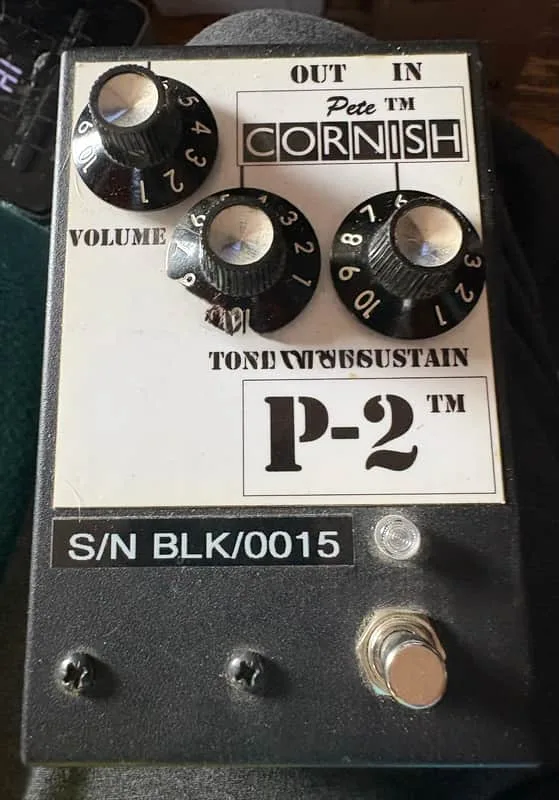
For players comparing Cornish fuzzes, the P-1 sits alongside the Pete Cornish Precision Fuzz P-1 and Pete Cornish Precision Fuzz P-2 in the maker's line, and the broader field is covered on Fuzz Pedals.
History: from Custom Fuzz to catalog pedal
The circuit started as the Custom Fuzz, designed for David Gilmour in 1976 as part of his integrated pedalboard2. Kit Rae dates the first pedal version, labeled Custom Design, to 2006, offered for sale to the public later that year, and the P-1 was added to the regular Cornish pedal line in 20136. The maker says the pedal is used prominently by David Gilmour in the All Tube Effects Stage System custom designed and built by Pete Cornish1, and Rae reports that Gilmour also used a Cornish P-1 briefly for his 2006 On An Island tour6.
Power: battery-free by design, or the Deluxe
The standard P-1 is a battery-free design; the maker's order link is addressed to a Battery Free P-1 Pedal Order1, consistent with the maker's published battery-free design policy5. Players who want battery power are pointed at the Deluxe P-1, which offers easy battery replacement via a removable drawer; the battery is switched on when you insert the IN/PWR ON jack, and the maker's preferred battery type is the MN16044.
The two versions differ in more than size. The standard P-1 is battery free, while the Deluxe P-1 adds the battery drawer and MN1604 battery operation. Check which version a listing refers to before ordering.
Where it is made and what it costs
Each unit is hand built, wired and tested by Pete, Lynda and Mingus Cornish14. The pedals are sold by custom order rather than off the shelf. The maker's UK listing prices the P-1 at 540.58 GBP ex VAT as of 2026-03-31; the same listing also gives 648.70 GBP including VAT, so the two figures reflect the VAT difference rather than a disagreement5. The warranty runs two years from date of purchase, covering repairs of any original manufacturing fault, with normal wear, misuse, unauthorized modifications or accidental damage excepted; it is voided if the guarantee labels are damaged or removed, and it is not transferable1.
Videos
shnobel
shnobel
Questions
Does the Pete Cornish P-1 take a battery?
The standard P-1 is a battery-free design; Pete Cornish's product page directs orders for a Battery Free P-1 Pedal, and the maker sells a separate battery-free design philosophy. The Deluxe P-1 is the version with battery power: it has a removable drawer for battery replacement, the battery switches on when you insert the IN/PWR ON jack, and the maker's preferred battery type is the MN1604.
What circuit is the P-1 based on?
The P-1 is an adaptation of the Electro-Harmonix Big Muff Pi V2, the Ram's Head version, with two transistor buffers added at the front of the circuit to reduce noise and improve signal isolation. Kit Rae calls it an exact clone of a mid-1970s Big Muff circuit, and Aion FX's 2024 trace found it matched a Ram's Head schematic, the only difference being the Cornish buffer.
Did David Gilmour use the Pete Cornish P-1?
Yes. Pete Cornish designed the circuit, then called the Custom Fuzz, for David Gilmour in 1976 as part of his integrated pedalboard, and the maker says the pedal is used prominently by Gilmour in the All Tube Effects Stage System Cornish built for him. Kit Rae reports Gilmour also used a P-1 briefly on his 2006 On An Island tour.
Where are Pete Cornish pedals made?
In England. According to the maker's product pages, each unit is hand built, wired and tested by Pete, Lynda and Mingus Cornish. The pedals are sold by custom order rather than through normal retail stock.
How big is the Pete Cornish P-1?
The standard P-1 measures 145 x 95 x 49 mm. The Deluxe P-1 is larger at 171 x 121 x 55 mm, which is 6.75 x 4.75 x 2.2 inches, the difference reflecting the Deluxe's extra features and battery drawer.
Sources (7)
- Pete Cornish P-1, Pete Cornish, 2025
- Halo Deluxe Distortion/Sustainer, Aion FX, 2024-04-19
- David Gilmour Tone Building, Kit Rae (kitrae.net), 2005
- Pete Cornish Deluxe P-1, Pete Cornish, 2025
- Battery Free Effects Pedals, petecornish.co.uk, 2026-03-31
- The Big Muffs of David Gilmour of Pink Floyd, Kit Rae, 2024-07
- Tracing Journal: Cornish P-2, Aion FX, 2023-10-06
 David Gilmour