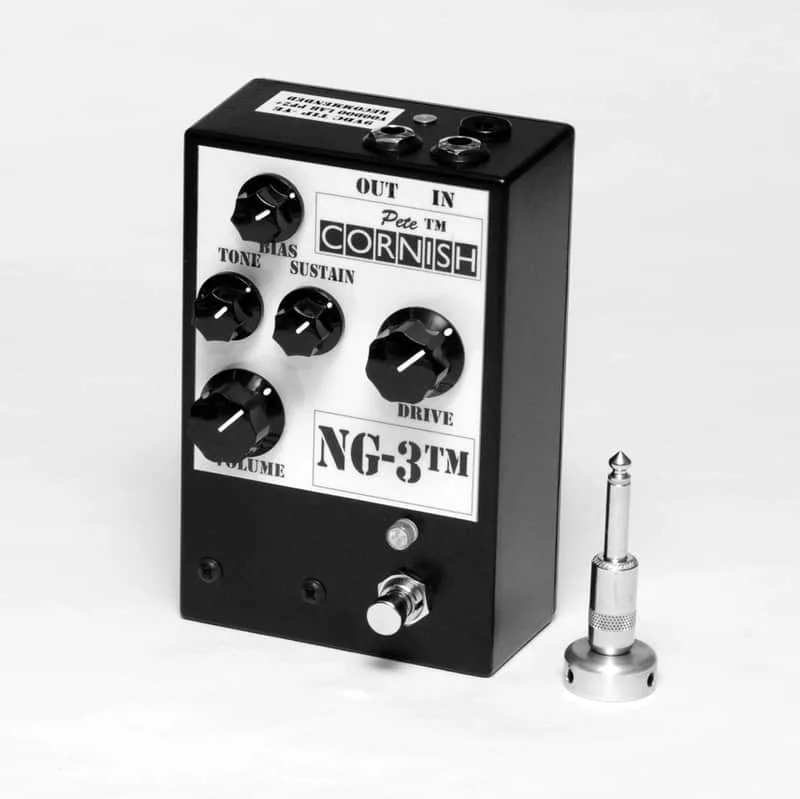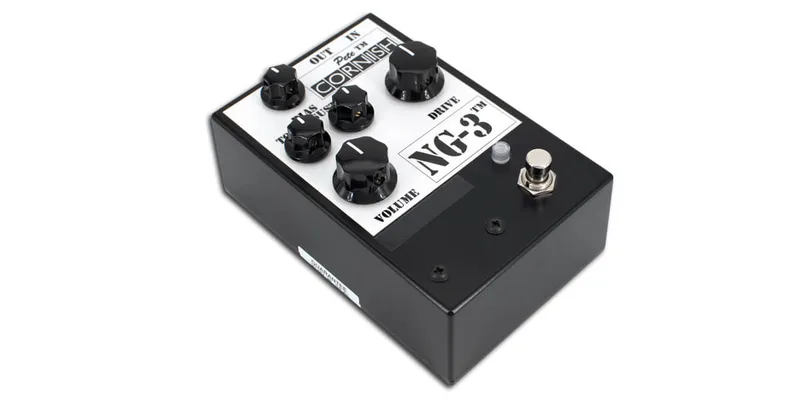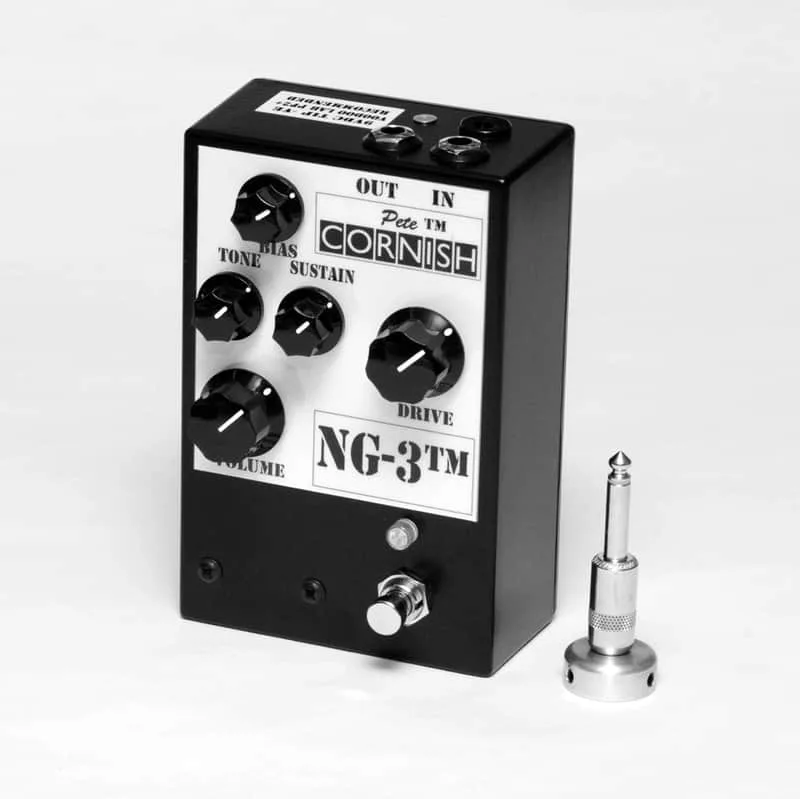


The Pete Cornish NG-3 is a hand-built fuzz pedal from British maker Pete Cornish, a builder with a reputation for no-frills, solidly engineered effects1. Where most fuzzes aim for warmth or sustain, the NG-3 was, in the maker's own words, "Specifically designed to simulate 'Imminent Amp Death'"2. Aion FX puts the design intent in plainer terms: it emulates "the sound of a blown power tube or output transformer right before it all goes up in smoke"3. Pete Cornish's product page frames its intensity with a wink: "In the range of generally available fuzz boxes covering a scale from 1 through 10, this one goes to 15!"2
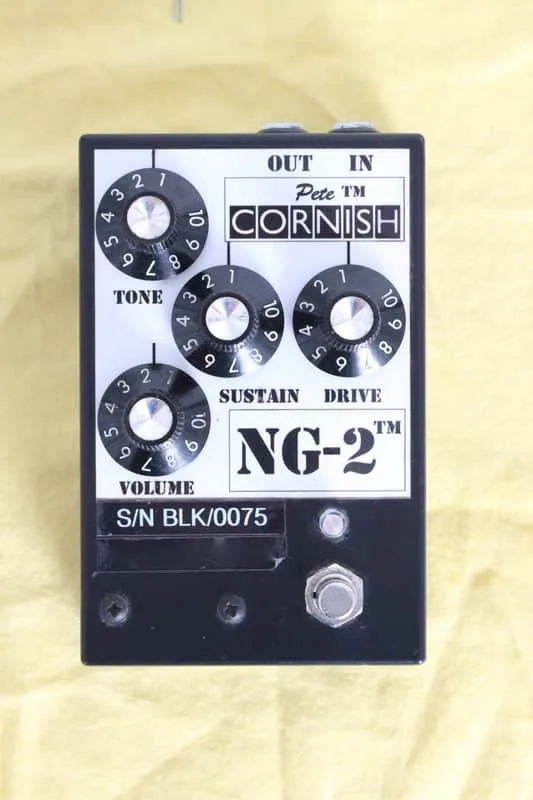
Released in 2010 as the successor to the NG-2 and the N.G. Fuzz4, the NG-3 is a custom-built unit with several separate stages, so the player can tune it to their own degree of amp failure2.
What it does to your sound
The NG-3's character comes from its third stage, which simulates a tube amp that has been over or under biased, or has suffered serious tube or output transformer failure1. The SUSTAIN control adjusts the signal level driving that stage, and Pete Cornish labels its range in amp-failure terms: from "Tired Output Tubes" to "Melted Tubes and Shorted Output Transformer"2.
Aion FX's testing found the Bias knob is the heart of the pedal's range4:
- Bias fully up: fairly traditional fuzz sounds4
- Bias dialed down: the tone turns into what Aion FX calls a glitchy mess, with gating, sag, feedback, velcro and instability4
That external Bias knob is the NG-3's defining difference from the NG-2. On the NG-2 the bias control was internal, and Aion FX's account of the lineage records that it was moved to the front panel at Lou Reed's request: "Lou asked if this could be made external so that he could adjust it to find other possibilities"7.
The controls
| Control | What it does |
|---|---|
| DRIVE | Linear first stage with up to +26dB of gain feeding the second stage2 |
| SUSTAIN | Sets the signal level into the third section, from "Tired Output Tubes" to "Melted Tubes and Shorted Output Transformer"2 |
| BIAS | Sets the operating class of the third stage: Class A fully clockwise, Class B around 12 o'clock, Class C fully counterclockwise2 |
| TONE | Bass/treble balance, matched to your bypassed signal level2 |
| VOLUME | Output level, matched to your bypassed signal level2 |
The BIAS settings map directly onto amplifier bias classes, which is what makes the "failing amp" framing literal rather than figurative2:
- Class A (fully clockwise): the stage conducts over the whole input cycle and produces the lowest distortion.
- Class B (about 12 o'clock): the stage amplifies 50% of the input signal, creating more distortion than Class A.
- Class C (fully counterclockwise): the stage conducts less than 50% of the signal, so only the peaks pass on to the next stage.
Aion FX notes the TONE control is a full bass/treble balance control, the same topology as a Big Muff tone control but tuned for different frequencies3.
Inside the circuit: three gain stages
Pete Cornish describes the signal path as three sections: a linear DRIVE stage with up to +26dB of gain, feeding a stabilized discrete preamp that overloads smoothly when overdriven, then a "Vari-Class" amplifier stage simulating a failing tube amp2. Aion FX's circuit trace fills in the detail3:
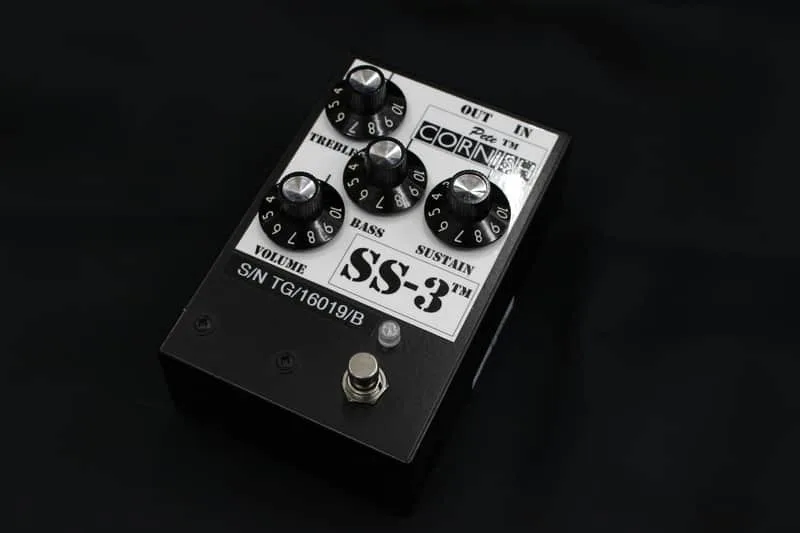
- Stage 1: an op-amp gain stage, very similar to the second op-amp stage of the Cornish SS-3, which drives the hard clipping.
- Stage 2: a more basic transistor gain stage with an emitter bypass capacitor and a 1nF capacitor from base to emitter.
- Stage 3: a single-transistor stage set for much higher gain, with base bias set by a 5V precision zener diode and a potentiometer, and a single diode to ground that clips half the waveform above 0.7V.
The NG-3 carries the standard Cornish buffers at its input and output3, a contrast with the NG-2, which Aion FX traced as unbuffered with a different topology altogether: a transistor boost, a Big Muff-style clipping stage with germanium diodes, a silicon Fuzz Face stage and a simple treble-cut tone control3.
Silicon, not germanium
Aion FX classifies the NG-3 as a variable-bias silicon fuzz3. Relative to the NG-2, the germanium transistor pair was replaced with a single silicon transistor, and the clipping stage uses silicon transistors4. The trace photos also show an op-amp and an LM4040 zener reference inside, which Aion FX flagged as a sign the circuit holds surprises compared with the earlier pedal3.
Power and ordering
The NG-3 is battery free by design2. It needs a 9V DC adapter that is noise free and fully stabilized, capable of supplying 20mA, with a 5.5/2.1mm coax connector and a negative center pin2.
No battery option means the NG-3 must live on a pedalboard with a proper 9V DC supply. Pete Cornish's emphasis on a noise-free, fully stabilized adapter points toward an isolated supply rather than a daisy chain shared with other pedals.
The pedal is a custom-built unit: to place an order you email Pete Cornish advising your delivery location5. Each unit is hand built, wired and tested by Pete, Lynda and Mingus Cornish8. The warranty runs two years from date of purchase, covering repairs of any original manufacturing fault; it is voided if the guarantee labels are damaged or removed, and it is not transferable2.
The Deluxe NG-3
A Deluxe NG-3 variant adds a 9V battery (preferred type MN1604) in a removable drawer, switched on when the "IN/PWR ON" jack is inserted8. It shares the same three-stage topology and the "goes to 15" description, but its warranty is twelve months rather than the standard NG-3's two years8.
Videos
shnobel
Diego Aditya
Drums FX Pedals
Questions
Does the Pete Cornish NG-3 take a battery?
No. The NG-3 is a battery-free design, built to run from a 9V DC adapter only. Pete Cornish specifies a noise-free, fully stabilized 9V DC supply whose adapter is capable of supplying 20mA, connected through a 5.5/2.1mm coax plug with a negative center pin.
What does the Bias knob on the NG-3 do?
It sets the operating class of the third gain stage. Fully clockwise is Class A, the lowest distortion setting; around 12 o'clock is Class B, which amplifies only half the input signal; fully counterclockwise is Class C, where only the signal peaks pass on. Aion FX found that turning it down from full produces gating, sag, velcro and instability.
How do you order a Pete Cornish NG-3?
The NG-3 is a custom-built unit ordered directly from Pete Cornish by email, advising your delivery location. Each pedal is hand built, wired and tested by Pete, Lynda and Mingus Cornish, so units are made to order rather than stocked in shops.
Is the NG-3 a silicon fuzz?
Yes. Aion FX describes it as a variable-bias silicon fuzz. Compared with the NG-2, the germanium transistor pair was replaced with a single silicon transistor, and the clipping stage uses silicon transistors.
What is the warranty on Pete Cornish pedals?
The NG-3 carries a two-year guarantee from date of purchase covering repairs of any original manufacturing fault. The guarantee is voided if the guarantee labels are damaged or removed, and it is not transferable. The Deluxe NG-3 instead carries a twelve-month warranty.
Sources (8)
- Pete Cornish NG-3 Fuzz, Delicious Audio, 2017-06-13
- PETE CORNISH NG-3, Pete Cornish, 2025
- Tracing Journal: Cornish NG-3, Aion FX, 2023-10-06
- Nysiad Silicon Fuzz / Cornish NG-3, Aion FX, 2023-10-06
- PETE CORNISH NG-3, Pete Cornish, 2025
- Grey Series Effects Pedals, petecornish.co.uk, 2026-03-31
- Tracing Journal: Cornish NG-2, Aion FX, 2024-11-29
- PETE CORNISH Deluxe NG-3, Pete Cornish, 2025