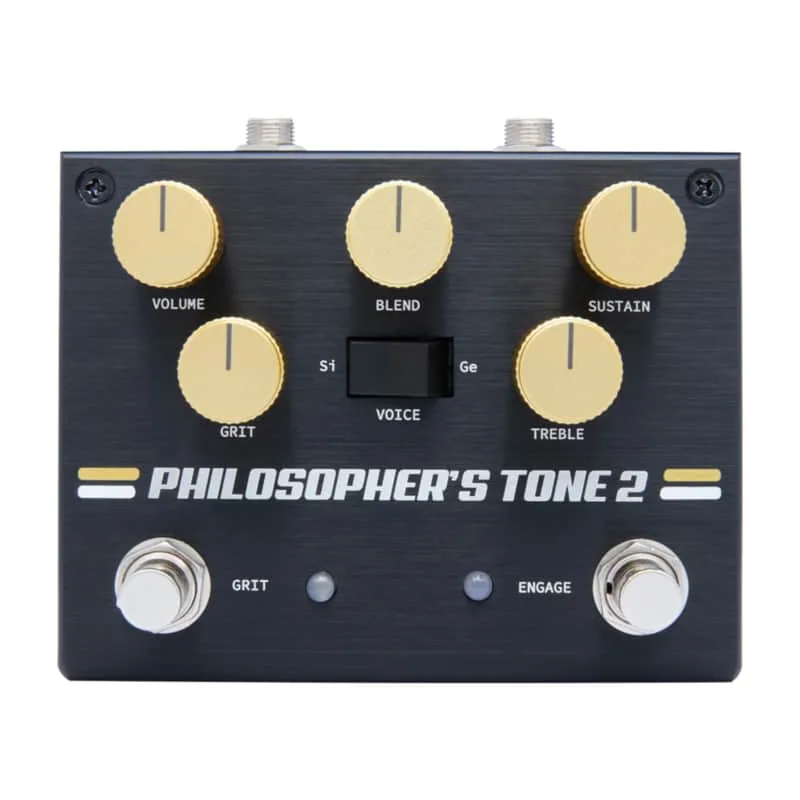


The Pigtronix Philosopher's Tone 2 is a second-generation version of the brand's optical compressor pedal, announced at NAMM in January 2024 and available then for $1991. It is a compressor and sustainer with a footswitchable Grit overdrive stage, so you can run clean optical compression on its own and stomp in distortion on top without changing pedals2.
The Grit circuit is a refined implementation of the overdrive first heard in the limited-edition Gold version of the Philosopher's Tone, and it offers two clipping voices selected by a front-panel switch: silicon for more bite, germanium for a smoother tone231. The pedal runs from an 18V supply with internal 18V power rails, which Pigtronix says gives maximum clean headroom for hot pickups, active bass, synthesizers and other line-level sources12.
An optical compressor with a switchable Grit overdrive
The Philosopher's Tone 2 elevates the optical compression of the original Pigtronix Philosopher's Tone, released in 2009 and designed by Howard Davis, to a second generation with an expanded feature set14. The compressor side is a vactrol-based design, the same approach as the original, while the Grit stage adds nonlinear diode-clipping that can range from subtle overdrive to overflowing distortion without unwanted feedback24.
MusicRadar's Jonathan Horsley described the Grit stage as producing "overdriven tones from the edge-of-breakup to the 'overflowing'"1. The germanium mode in particular delivers what Pigtronix describes as smooth top end and rich midrange response, tailored to match the characteristics of the optical sustainer21.
Pedal of the Day (www.pedal-of-the-day.com) describes the Philosopher's Tone 2 as "a world-class compressor/sustainer with footswitchable Grit"2. The Grit circuit is a refined implementation of the overdrive circuit first heard in the limited-edition Gold version of the Philosopher's Tone1.
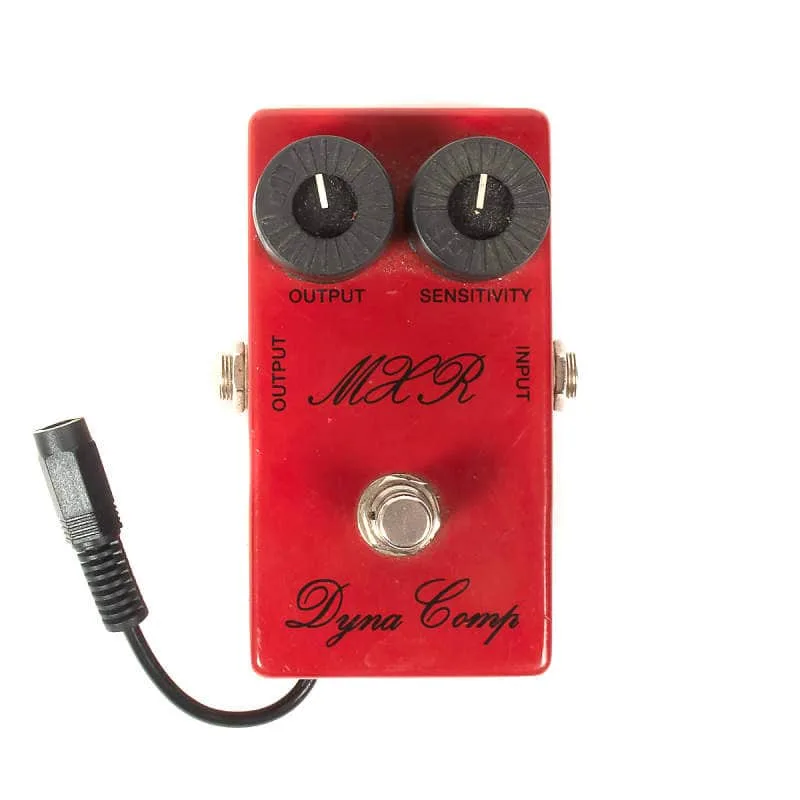
The pedal ships with a quick-start guide that includes an "Open Americana" preset: unity gain, everything at noon, mild compression. Horsley noted that while the circuit might seem a world away from the classic Dyna Comp paradigm, Pigtronix's guide promises old-school Nashville Telecaster tones from that setting1.
The controls
The Philosopher's Tone 2 keeps the control set familiar from the Philosopher's Tone family and adds the Voice switch for the Grit circuit15.
| Control | What it does |
|---|---|
| Volume | Sets overall output1 |
| Grit | Dials in the overdrive amount1 |
| Blend | Mixes uncompressed signal with compressed signal; only active when the Grit stage is disengaged1 |
| Voice switch | Selects silicon or germanium clipping mode for Grit; silicon for more bite, germanium for a smoother tone15 |
The Blend knob is the one control with a catch: it is a parallel clean blend that lets you mix your instrument's original tone with the compressed sound, but only when Grit is bypassed21. Switch the Grit stage on and the blend drops out of the circuit1.
The enclosure itself is part of the update. Guitar World reported that the Philosopher's Tone 2 moves to an enlarged double pedal format with full-size knobs and a new paint job, giving a little more real estate between the controls so the layout is clearer and easier to operate5.
Power: 18V, 100mA
The Philosopher's Tone 2 runs at 18V from a pedalboard power supply and draws 100mA1. MusicRadar noted that at 18V the pedal has no shortage of headroom, which is the point of the internal 18V power rails: they keep the compressor clean even with hot input signals12.
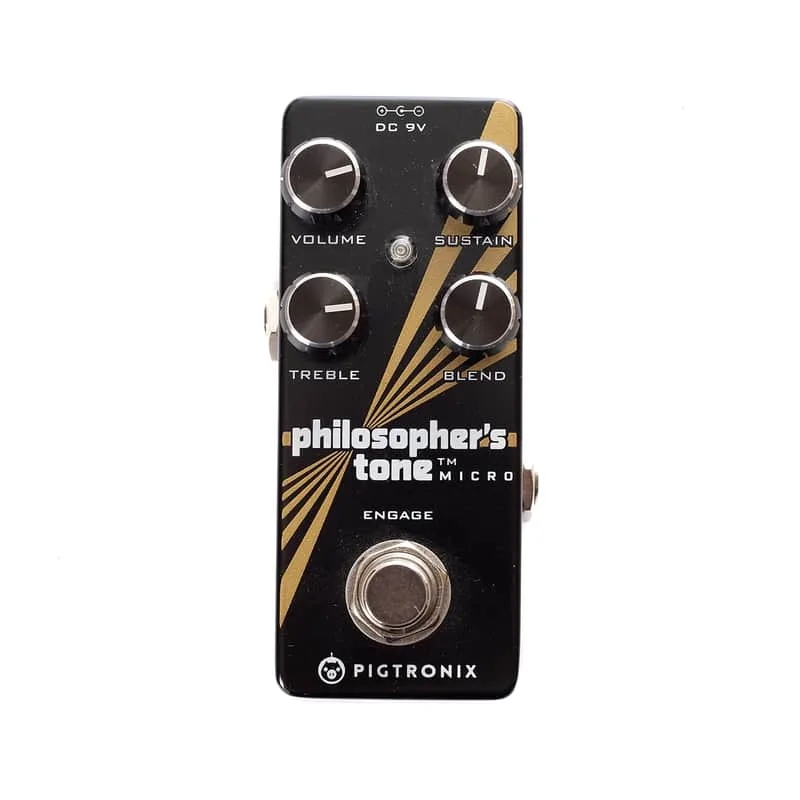
The 18V requirement and 100mA draw mean the Philosopher's Tone 2 needs its own power supply output, not a shared 9V daisy chain. The smaller Philosopher's Tone Micro, by contrast, runs on a standard 9V adapter because it uses internal charge pumps to double the voltage67.
History and versions
The original Philosopher's Tone was a vactrol-based compressor and overdrive first released in 2009, designed by Howard Davis4. It was described by Premier Guitar in 2018 as an award-winning and top-selling compressor, and it went through several revisions and editions over the years84:
- Philosopher's Rock: a version that emphasized the overdrive component and replaced the original4
- Philosopher's Bass: tuned for bass frequencies4
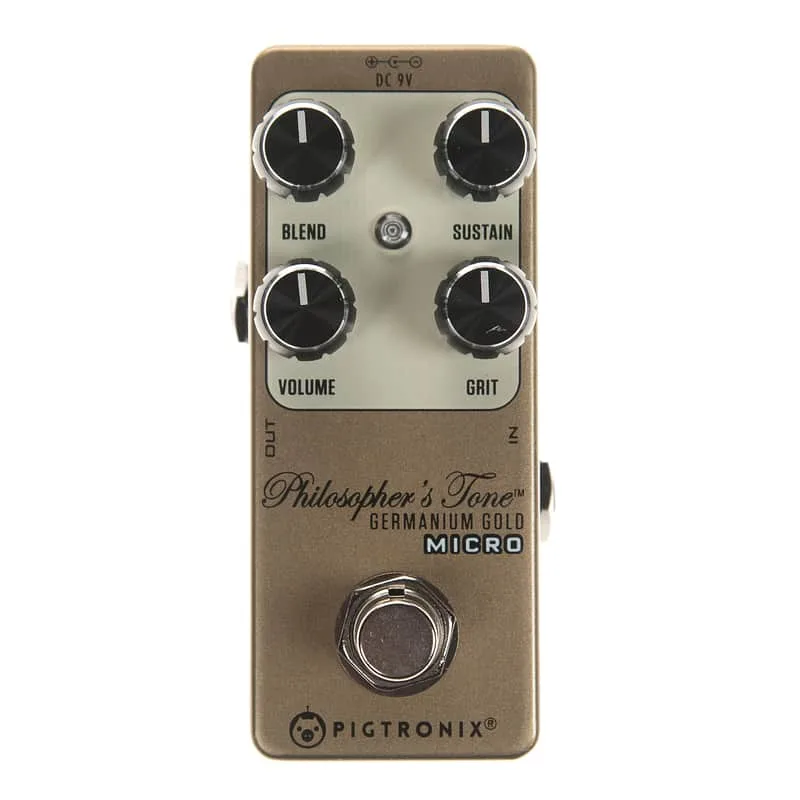
- Germanium Gold edition: a gold-enclosure limited edition with a single germanium diode in place of one of the silicon diodes in the clipping section4
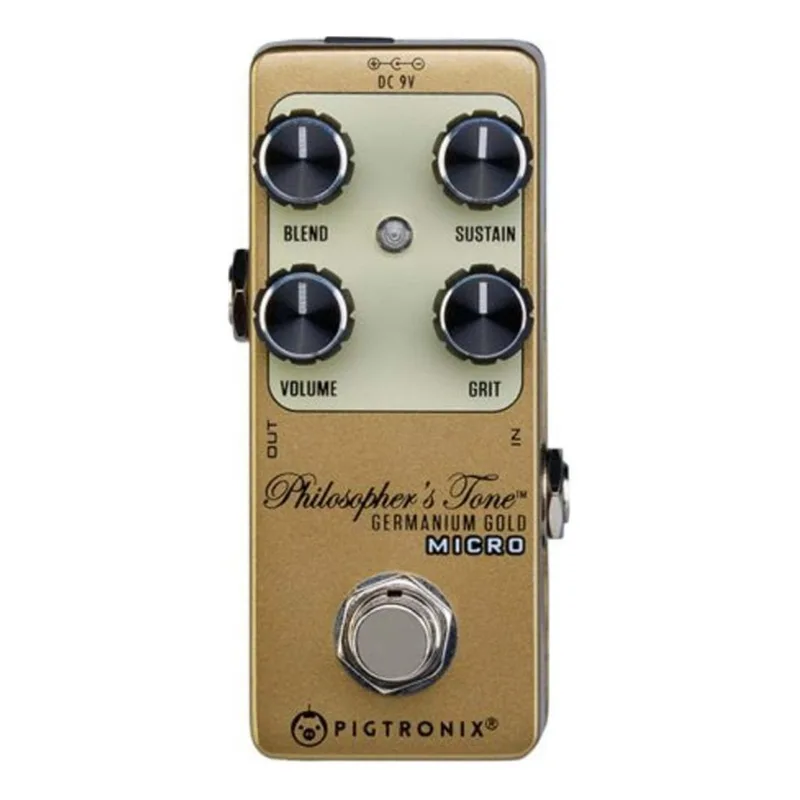
- Philosopher's Tone Micro: a 1590A-sized miniature released August 1, 2016, pretty well identical to the original circuit but with an onboard charge pump voltage doubler so it no longer needed its own 15V or 18V adapter497
- Philosopher's Tone Germanium Gold Micro: a 2018 micro version adding germanium diodes to the original circuit10
- Philosopher's Tone 2: the 2024 second generation with the footswitchable Grit stage1
Aion FX notes that as of its project page's release in 2026, the miniature version was the only one currently manufactured, while the Philosopher's Tone 2 was reported available now at $199 in January 202441. The Grit circuit in the Tone 2 comes from that limited-edition Gold version, refined by Pigtronix23.
What reviewers said
Pedal of the Day reviewed the Philosopher's Tone 2 and came away positive about the combination of effects, saying "I've always love the combination of these two effects genres, and this beauty from Pigtronix really provides a wide rang[e]"2.
"I've always love the combination of these two effects genres, and this beauty from Pigtronix really provides a wide range from which to explore and create"
The same review highlighted the true-bypass switching and the internal 18V power rails as features that suit the pedal to hot pickups, active bass, synthesizers and other line-level sources2.
Earlier Philosopher's Tone family reviews give context for the circuit. MusicRadar wrote in 2016 that "the original Philospoher's Tone is a pedal we like, a lot," and its review of the Micro found the treble control and Blend knob made it "a great utility pedal for more than just compression"711. On the Germanium Gold Micro, MusicRadar listed the Blend knob as a reason to buy, noting it lets you set a mix of dry and compressed sound12.
Videos
Pigtronix
Pigtronix
Pigtronix
Questions
Is the Philosopher's Tone 2 true bypass?
Yes. The Philosopher's Tone 2 uses true-bypass switching, so with both the compressor and the Grit stage disengaged your signal passes through without the pedal's circuitry coloring it. The earlier Philosopher's Tone Micro and the Philosopher's Rock also used true bypass.
Does the Philosopher's Tone 2 work on bass?
Pigtronix built the pedal with internal 18V power rails for maximum clean headroom, which the company says makes it ideal for hot pickups, active bass, synthesizers and other line-level sources. Players wanting a compressor tuned specifically for bass frequencies can look at the Philosopher's Bass line.
What is the difference between the Germanium and Silicon modes on the Philosopher's Tone 2?
The Voice switch on the front of the enclosure selects the clipping mode for the Grit circuit. Silicon gives more bite, while germanium delivers what Pigtronix describes as smooth top end and rich midrange response. Both are nonlinear diode-clipping modes ranging from subtle overdrive to overflowing distortion.
Does the Blend knob work when Grit is on?
No. The Blend knob mixes your uncompressed signal with the compressed signal, but it is only active when the Grit stage is disengaged. With Grit switched on, the parallel clean blend is out of the circuit, so the compressed and overdriven signal is what you hear.
How is the Philosopher's Tone 2 different from the Philosopher's Tone Micro?
The Micro is a 1590A-sized miniature that packs the original Philosopher's Tone circuit into a much smaller box and runs on a standard 9V adapter, using internal charge pumps to double the voltage. The Philosopher's Tone 2 is an enlarged double pedal with full-size knobs, a footswitchable Grit stage, a Voice switch and 18V operation drawing 100mA.
Sources (12)
- NAMM 2024: Pigtronix unveils the revamped the Philosopher's Tone 2, an optical compressor with a switchable Si/Ge drive and blend control to take you to “a new plane of tonal enlightenment”, MusicRadar, 2024-01-30
- Pigtronix Philosopher's Tone 2 Optical Compressor & Overdrive, Pedal of the Day (www.pedal-of-the-day.com), 2024-07-02
- Pigtronix Philosopher's Tone 2 Compressor with added Grit, gearnews.com, 2024-01-30
- Polyphemus Optical Compressor / Pigtronix Philosopher’s Tone, Aion FX, 2023-07-03
- NAMM 2024: “This pedal facilitates an alchemical dance”: Pigtronix's Philosopher's Tone 2 is the sequel that looks set to top the original, Guitar World, 2024-01-30
- Tracing Journal: Pigtronix Philosopher’s Tone Micro, Aion FX, 2025-03-28
- Summer NAMM 2016: Pigtronix Philosopher's Tone Micro promises miniaturised compression alchemy, MusicRadar, 2016-06-30
- Philosopher’s Tone Germanium Gold Micro by Pigtronix, Premier Guitar, 2018-04-23
- Pigtronix Unveils the Philosopher's Tone Micro, Premier Guitar, 2016-06-25
- Pigtronix Philosopher’s Tone Germanium Gold Micro compressor pedal, gearnews.com, 2018-06-08
- Pigtronix Philosopher's Tone Micro review, MusicRadar, 2017-05-23
- Pigtronix Philosopher's Tone Germanium Gold Micro review, MusicRadar, 2018-08-03