
The Poison Noises Glut Cheeks Fuzz V2 is a fuzz pedal released in 2022 as part of a overhaul that saw new versions of the maker's entire pedal lineup1. It is a vintage recipe pedal: Pedal of the Day describes it as "made using the same recipe as your favorite 60's fuzzes," built to conjure "your favorite Fuzz Face and Tone Bender tones in seconds"1.
The secret ingredients, in the reviewer's words, are "the legendary BC108 transistors"1. That makes it a silicon fuzz, the same transistor family used in the later classic Fuzz Face circuits, rather than the germanium parts of the earliest versions.
A Fuzz Face and Tone Bender recipe in one pedal
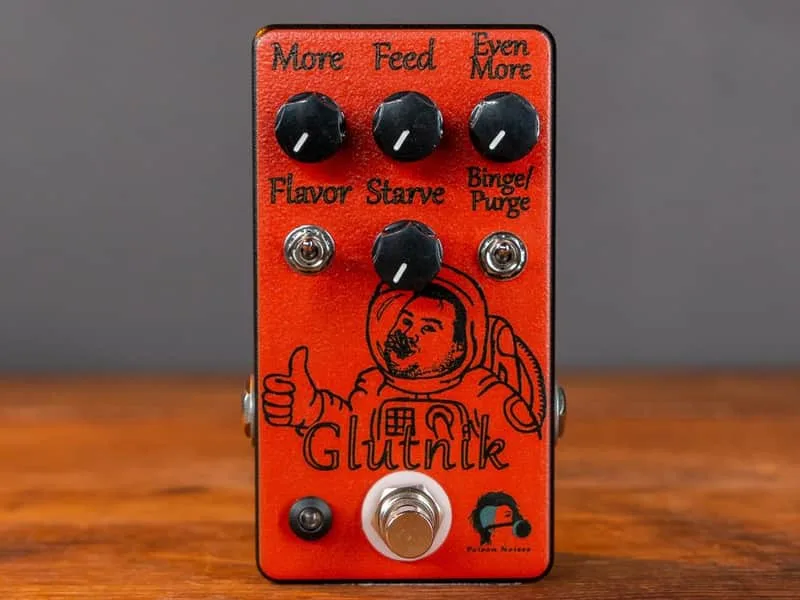
The Glut Cheeks V2 sits in the vintage fuzz camp rather than the big Muff camp. Where Poison Noises' own Glutnik Fuzz V2 is described as "our take on a Russian Muff style [fuzz]," the Glut Cheeks draws on the two transistor and three transistor circuits of the 60s21. Pedal of the Day's take on what it delivers:
"Conjuring up your favorite Fuzz Face and Tone Bender tones in seconds"
The two or three transistor switch is the heart of that dual lineage: two transistors points the circuit toward the simpler Fuzz Face style, three toward the Tone Bender style, and the pedal lets you move between them1.
The controls
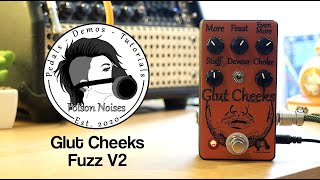
The V2's control set is small but each knob does something specific to the circuit rather than being a generic gain or tone control1.
| Control | What it does |
|---|---|
| Choke | Sets how much voltage is being fed into the last transistor1 |
| Stuff | Adjusts how much resistance is at the front of the circuit1 |
| Even More | A high pass filter tone control, new and improved on the V21 |
| Devour switch | Chooses between a two or three transistor configuration, creating new ways to dish out the amount of gain in your signal1 |
For a player, Stuff behaves like an input conditioning control, changing how hard the guitar drives the front of the circuit, while Choke starves or feeds the output transistor, which changes the character and saturation of the fuzz. Even More, as a high pass filter, trims low end so the fuzz can sit in a mix without mud, and the Devour switch is effectively two fuzzes in one enclosure1.
History and versions: V2 and V3
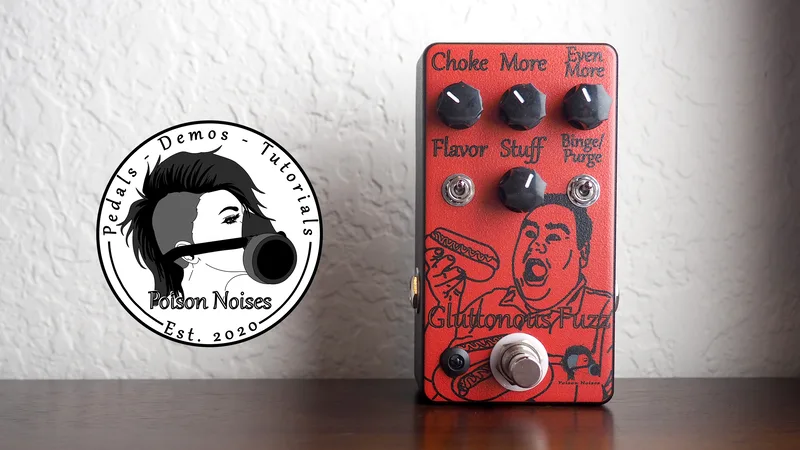
Poison Noises released new versions of its entire lineup of effects pedals, including the Glut Cheeks Fuzz V21. The lineup has since moved on to a Glut Cheeks Fuzz V334, and the Gluttonous Fuzz V3 brings back parameters from all the original incarnations of that fuzz3.
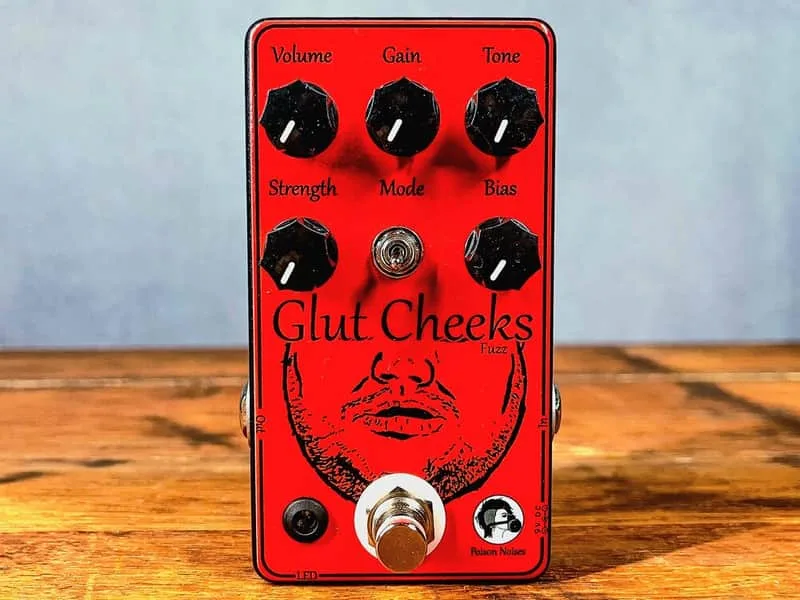
The Glut Cheeks itself moved to a V3, reviewed by Pedal of the Day in June 20234. The V3 keeps the core recipe: BC108 transistors, described as "carefully selected, organically sourced, grass fed," and a switch, now called Mode, that still "allows you to choose between a two or three transistor configuration"4.
What the V3 adds is a Strength control, which "allows you to pull back the intensity of the input signal in a way similar to rolling the volume back" on the guitar, for a cleaned up sound4. That is the classic fuzz trick of rolling down the guitar's volume knob to clean up, built into the pedal itself.
| Glut Cheeks V2 | Glut Cheeks V3 | |
|---|---|---|
| Transistors | BC1081 | BC108, organically sourced4 |
| Two or three transistor switch | Devour switch1 | Mode switch4 |
| Input intensity control | Not part of the V2 control set4 | Strength control4 |
| HPF tone control | Even More1 | Carried over in the recipe1 |
Pedal of the Day's verdict on the V3 was positive on the direction of the line: "Each new iteration of all the Poison Noises pedals showcase how they get better and better, and this fuzz continues that" streak4.
Videos
Poison Noises
Pedal of the Day
Questions
Is the Poison Noises Glut Cheeks Fuzz V2 a germanium or silicon fuzz?
It is a silicon fuzz. The Glut Cheeks Fuzz V2 uses BC108 transistors, the same silicon type found in many classic late 60s fuzz circuits. The V3 also uses BC108 transistors, described by the maker's press coverage as carefully selected and organically sourced.
What does the Devour switch do on the Glut Cheeks Fuzz?
The Devour switch lets you choose between a two or three transistor configuration, which changes how much gain is dished out in your signal. On the V3 the same function is handled by a switch called Mode.
What is the difference between the Glut Cheeks Fuzz V2 and V3?
Both use BC108 transistors and offer a two or three transistor switch, but the V3 renames the Devour switch as Mode and adds a Strength control, which pulls back the intensity of the input signal for a cleaned up sound, similar to rolling back your guitar's volume knob.
Which classic fuzzes is the Glut Cheeks Fuzz based on?
Pedal of the Day describes the Glut Cheeks V2 as conjuring up Fuzz Face and Tone Bender tones, made using the same recipe as favorite 60s fuzzes. It is a vintage style circuit rather than a big Muff style fuzz.
What does the Even More control do on the Glut Cheeks Fuzz V2?
Even More is a high pass filter tone control, new and improved on the V2. It shapes the EQ by trimming low frequency content, which lets you thin the fuzz out so it sits better in a mix or cleans up mud.
Does the Glut Cheeks Fuzz V3 have a Strength control?
Yes. The V3 adds a Strength control that pulls back the intensity of the input signal in a way similar to rolling back your guitar's volume, giving a cleaned up sound at lower settings.
Sources (4)
- Poison Noises Glut Cheeks Fuzz V2, Pedal of the Day, 2022-09-03
- Poison Noises Glutnik Fuzz V2, Pedal of the Day, 2022-09-23
- Poison Noises Gluttonous Fuzz V3, Pedal of the Day, 2022-08-06
- Poison Noises Glut Cheeks Fuzz V3, Pedal of the Day, 2023-06-16