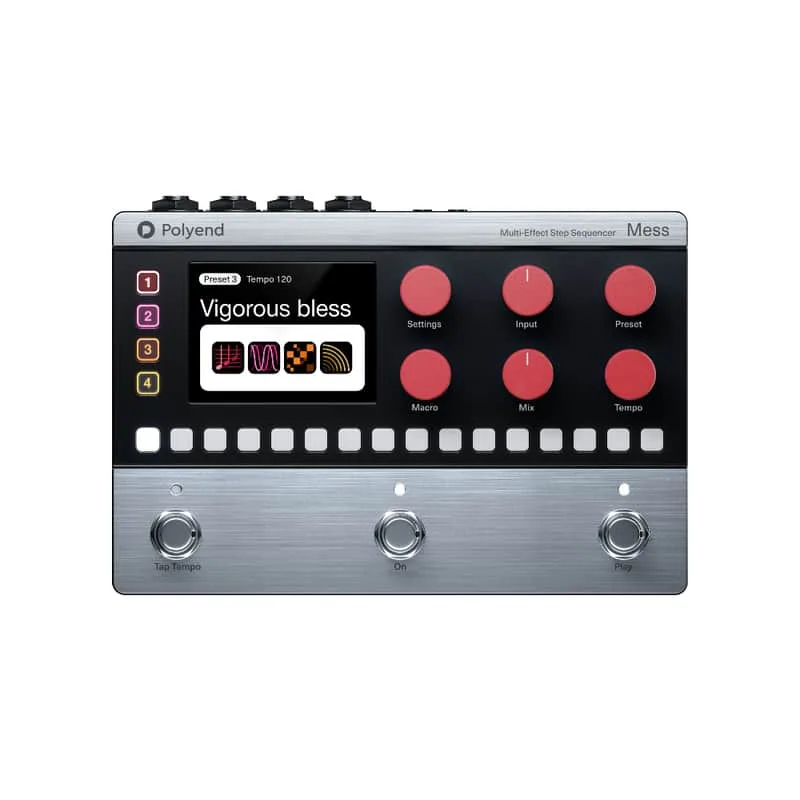


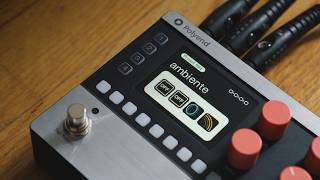
The Polyend MESS is a multi-effect step sequencer: a floor-based unit that combines a multi-effects processor with a 16-step sequencer that drives the effects themselves1. Where a conventional multi-effects pedal gives you one static sound at a time, the MESS uses its 16-step grid to move, pulse and reshape effects over time. As the Pedal of the Day reviewer put it, "Sequencing makes effects come alive. Instead of one static sound, you get movement, rhythm, and textures that keep evolving"1.
Polyend announced the MESS as a floor-based multi-effects unit in the same format as its Step drum machine, and opened it for pre-order at $5992. Polyend was until recently primarily a synth manufacturer, and the MESS reflects that background: MusicRadar observed that although the box is floor-based, it is clearly aimed as much at the desks of synthesists as at guitar pedalboards3.
What the MESS does: effects driven by a step sequencer
The name is the description: MESS stands for Multi-Effect Step Sequencer3. The unit is a multi-effects pedal with four independent tracks, and a 16-step sequencer that, in Delicious Audio's words, "turns static processing into something alive"4. Sequences are built across 16 step pads on the unit's surface5, and one knob per function keeps the interface simple, with the 16-step grid letting you build sequences fast1.
The practical difference from an ordinary multi-effects unit is rhythm. Instead of dialing in a delay or filter and leaving it, you program changes across the 16-step grid so the effect parameters move in time. Pedal of the Day's reviewer found that "MESS turns a simple guitar line into something bigger. Atmospheres, pulses, textures you didn't expect"1.
The effects library covers 125 algorithms, freely assignable to each of the four effect lanes, with over 120 stereo effects in total4. Delicious Audio broke that down further: realistically it is 11 core types with deep sub-modes, including 25 reverb variations alone4. That puts the usual pedalboard staples in reach, from delay, reverb and chorus territory to filters, tremolo and pitch-based effects, all as algorithms the sequencer can drive.
Four effect tracks and routing
The MESS gives you four independent effect tracks, and each track runs independently, with its own speed, length, and step probability4. That last part matters: because each track can run at its own rate and length, the four sequences drift in and out of alignment with each other, which is where much of the evolving, generative character comes from.
The four tracks can be routed three ways4:
| Routing mode | What it means |
|---|---|
| Series | The four effect tracks run one into the next, in a chain |
| Parallel | The tracks process the signal side by side and are mixed |
| Dual parallel | Two pairs of tracks, each pair in series, the pairs in parallel |
MusicRadar confirms the same three options, describing the tracks as configurable for serial, parallel or dual parallel configurations3. For a player, the choice is the same one as on any effects rig: series chains stack effects so each processes the output of the last, while parallel routing keeps each track clean and combines them at the end, useful for mixing, say, a long reverb with a rhythmic filter without the reverb washing over the filter's movement.
Controls, presets and connections
The front panel follows a one-knob-per-function layout, with the 16 step pads used to build sequences1. Storage is generous: the MESS ships with 150 presets, plus room for 1,000 of your own1, and there is a microSD slot for storage as well4.
Connections include an expression input, MIDI over TRS Type B, USB-C and the microSD slot4. The audio path is stereo, with a stereo/mono 6.3 mm input jack and separate L-Out/Mono and R-Out 6.3 mm output jacks3. Delicious Audio's reviewer flagged the single stereo input jack as "another odd choice for a pedal this ambitious"4, since it means the input wiring differs from the two separate mono jacks most stereo pedals use.
No power supply is included4. The MESS needs 9 to 18 V DC at a minimum of 500 mA, and any polarity and voltage in that range will work3. The 500 mA minimum draw rules out a standard 9V battery-style supply, and it is enough that a small daisy chain intended for ordinary analog pedals may not keep up.
What reviewers said
Published reviewers have been broadly positive, with some reservations. Pedal of the Day's reviewer, demoing a unit provided by Polyend, concluded that with the MESS "you've got a machine that will encourage completely new ways of approaching music and songwriting alike"1. MusicRadar's coverage at launch called it "an FX sequencing powerhouse"5.
On the critical side, Delicious Audio noted that some users report the reverbs feel a bit digital4, and the same review took issue with the absence of a power adapter at the $599 price, calling it stingy4. The $599 price was the pre-order figure in May 20252; the pre-order listing also quoted £5992.
Polyend was until recently primarily a synth manufacturer, and the MESS is one of its entries in the guitar-effects market6.
Videos
Polyend
Polyend
Polyend
Questions
Does the Polyend MESS come with a power supply?
No. Both MusicRadar and Delicious Audio note that a power adapter is not included, which Delicious Audio called stingy at the price. It runs on 9 to 18 V DC at a minimum of 500 mA, and any polarity and voltage in that range will work, so you need to supply your own adapter34.
Does the Polyend MESS have MIDI?
Yes. The MESS has MIDI over TRS Type B, along with an expression input, USB-C and a microSD slot4. That makes it usable as part of a larger synced rig, not just as a standalone floor unit.
How many presets does the Polyend MESS hold?
It ships with 150 presets, plus space for 1,000 of your own1. Presets and other data can also be stored on the microSD slot4.
Is the Polyend MESS stereo?
Yes. It has stereo inputs and outputs: a stereo/mono 6.3 mm input jack, and separate L-Out/Mono and R-Out 6.3 mm output jacks3. Delicious Audio noted the single stereo input jack as an odd choice for a pedal this ambitious4.
Sources (6)
- Polyend MESS Multi-Effect Step Sequencer, Pedal of the Day, 2026-07-20
- Guitar Pedal X, Guitar Pedal X, 2025-05-09
- “A sturdy, interesting and decent-sounding effects unit with tempo syncing and sequencing capabilities”: Polyend Mess review, MusicRadar, 2026-02-01
- Polyend Mess Multi-FX With Sequencer, Delicious Audio, 2026-04-09
- “Not another multi-effect for your dentist,” but Polyend's Mess looks like an FX sequencing powerhouse that you can really get your teeth into, MusicRadar, 2025-05-07
- The 7 Best MultiFX Pedals For Synths | Delicious Audio, Delicious Audio, 2025-08-22