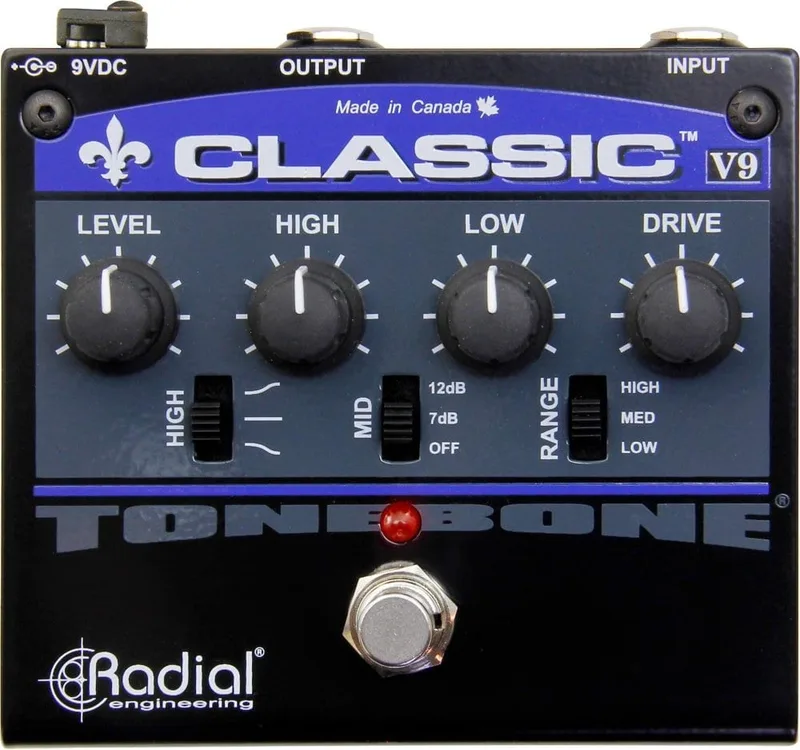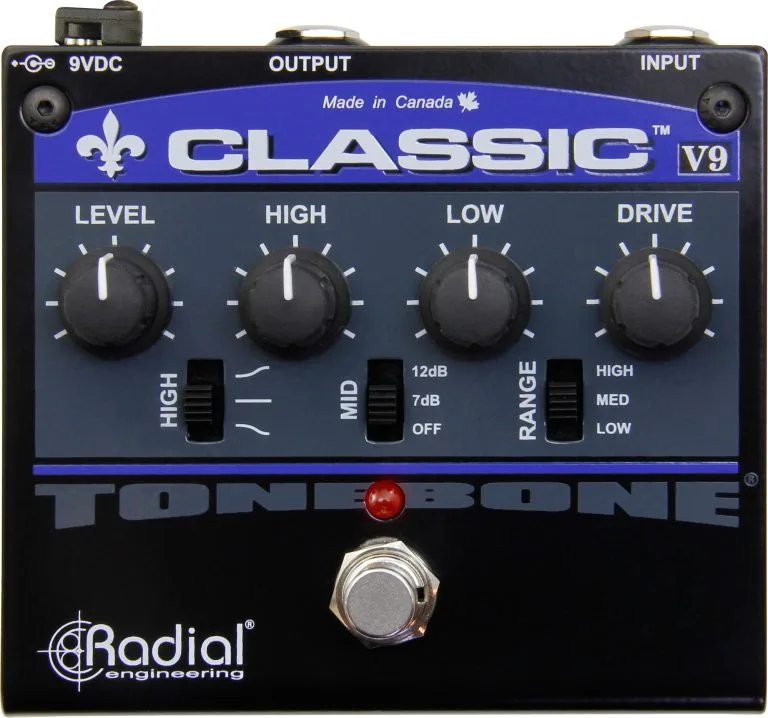


The Radial Classic-V9 is a distortion pedal from Radial Engineering12. Radial says the pedal "cleans up like a tube amp and captures the feel and dynamics of your playing," suiting blues, country or rock1. A dual band post-distortion EQ sets the distortion tone3, and a class-A buffer works to reject noise and drive multiple pedals4.
The pedal measures 4.25" x 4" x 2" (L x W x D) and weighs 1.35lb2. It ships in a box measuring 6.5" x 4.13" x 2.5" (L x W x D) at a shipping weight of 1.65lb2. Radial covers it with a 3-year transferable warranty2.
The controls
The Classic-V9 keeps the control set of a straightforward distortion pedal, with one twist: the EQ sits after the distortion stage rather than before it, so it shapes the distorted tone itself rather than the signal feeding the clipper4.
| Control | What it does |
|---|---|
| Drive | Fine tunes the drive to suit your playing style4 |
| Level | Sets the overall output level4 |
| EQ | Dual band post-distortion EQ, used to set the distortion tone4 |
| High | Compensates the top end for overly bright or dark amps4 |
| Range | 3-position switch that sets the gain stage4 |
The Range switch is the coarse gain selector, and Drive then trims within whichever range you pick. The High control is a practical touch for anyone moving the pedal between amps with very different top ends, letting you pull back brightness on a harsh amp or add it on a dark one4.
Power and connections
The Classic-V9 runs on a standard 9V power supply with a standard style power supply connection, drawing 200 milliamps14. That draw is on the heavy side for a compact analog pedal, so it is worth planning for on a pedalboard power budget. The original Tonebone Classic needed more than a 9V supply; the V9's move to 9V was one of the headline changes at launch5.
Connections are simple: a standard 1/4" jack for your guitar, and a 1/4" output jack to feed your amp or other pedals4.
The Classic-V9 is buffered, not true bypass. Radial says its class-A buffering circuit "gives you the feel of a true-bypass pedal" with greater noise rejection and lower impedance, and that the class-A buffer rejects noise and drives multiple pedals1. Players who want a true-bypass pedal should know this before buying used.
Specifications
| Specification | Value |
|---|---|
| Gain | 0dB to +48dB2 |
| Output impedance | 12kΩ2 |
| Noise floor | -78dBu2 |
| Frequency response | Shaped for guitar use2 |
| Audio circuit | Classic Class FET buffer and classic audio grade ICs2 |
| Size (L x W x D) | 4.25" x 4" x 2"2 |
| Weight | 1.35lb2 |
| Construction | 14-gauge steel2 |
| Warranty | Radial 3-year, transferable2 |
| Operating conditions | Dry locations only, between 5°C and 40°C2 |
Where it came from
Radial positions the Classic-V9 as a distortion pedal for players who want tube-amp feel without a tube inside: the company says it "cleans up like a tube amp and captures the feel and dynamics of your playing"51. Tone shaping comes from a dual band post-distortion EQ, which Radial describes as very powerful and used to set the distortion tone3. A class-A buffer is built in to reject noise and drive multiple pedals down the chain1.
In use, the Classic-V9 suits blues, country or rock, cleaning up like a tube amp and capturing the feel and dynamics of your playing, in Radial's words1. The dual band post-distortion EQ shapes the distortion tone after the drive stage3, and the class-A buffer lets the pedal reject noise while driving multiple pedals4.
Videos
Abel Franco
Abel Franco
Questions
Is the Radial Classic-V9 true bypass?
No. It uses a buffered bypass built around Radial's class-A buffer. Radial describes it as giving the feel of a true-bypass pedal while adding greater noise rejection and lower impedance, which also lets the buffer drive multiple pedals down the chain.
Does the Radial Classic-V9 have a tube inside?
No. The 12AX7 tube of the original Tonebone Classic was removed and replaced with a new tube-emulating tone circuit. Radial says the pedal still cleans up like a tube amp and captures the feel and dynamics of your playing.
Is the Radial Classic-V9 discontinued?
Yes. Radial states that the Classic-V9 has been discontinued and is no longer shipping. It was announced in October 2016 at $169.99 and sold for several years before being retired.
How much current does the Radial Classic-V9 draw?
It draws 200 milliamps from a standard 9V DC power supply connection. That is well above the roughly 50 to 100mA many compact analog pedals draw, so it needs a power supply with headroom rather than a small daisy-chain tap.
What is the difference between the Tonebone Classic and the Classic-V9?
The Classic-V9 is the next generation, solid-state version of the Tonebone Classic tube distortion. It is more compact, runs on 9V instead of the original's higher-voltage supply, and replaces the tube with a tube-emulating tone circuit. It also drops the original's filter knob.
Sources (5)
- Classic-V9, Radial Engineering, 2021-03-17
- Classic-V9 Specifications, Radial Engineering, 2018-04-10
- Radial releases "next-generation" Tonebone distortion pedal, the Classic V9, musicradar.com, 2016-10-12
- Classic-V9 Features, Radial Engineering, 2018-06-19
- Classic-V9 FAQ, Radial Engineering, 2018-06-11