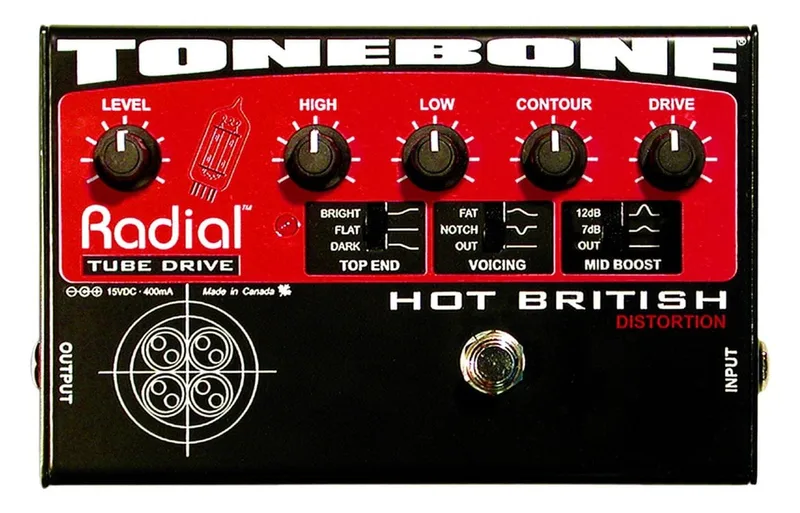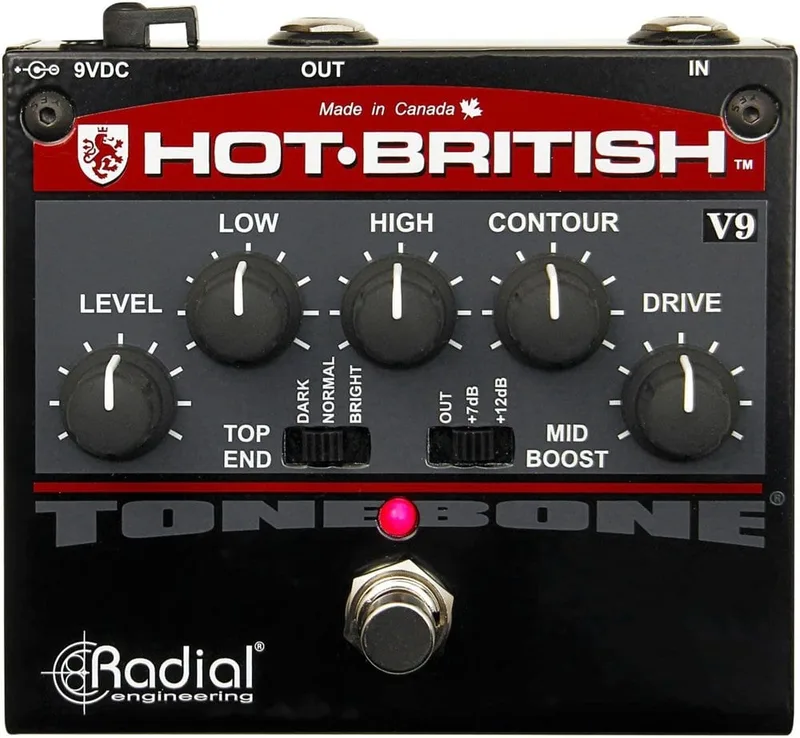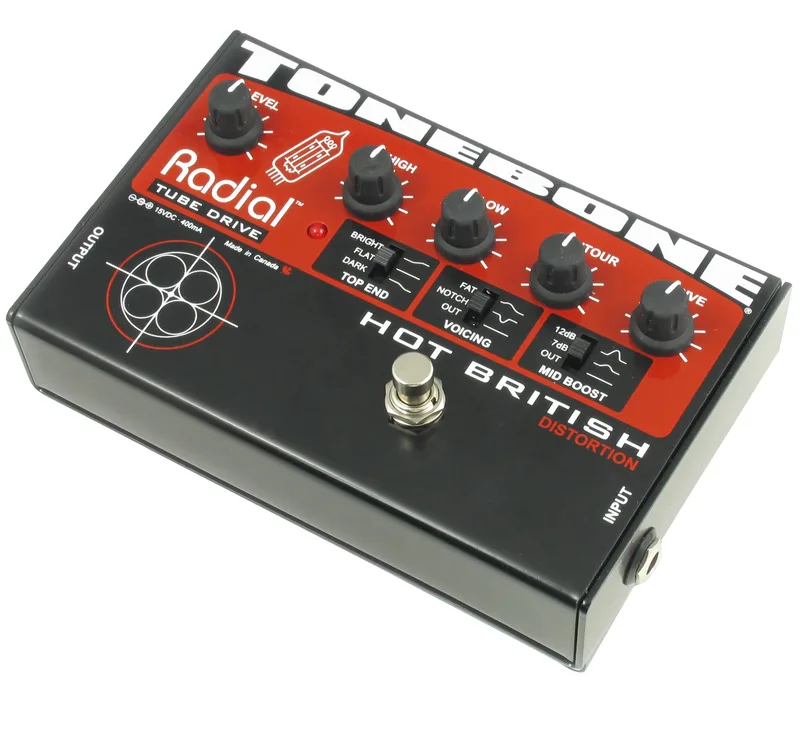



The Radial Hot British is a distortion pedal from Radial Engineering, part of the company's Tonebone line. Radial fashioned its voicing after a modified Marshall double-stack Plexi, and describes the result as delivering "ultra-rich harmonic textures and full-on saturated tube settings without the mud or noise," with each note keeping its distinctiveness and clarity1.
The original Hot British is discontinued: Radial states it "has been discontinued and is no longer shipping," though it keeps a legacy product page and the pedal remains well worn and loved by professional and semi-professional musicians12. Its successor, the Hot-British V9, arrived in 2017 in a smaller chassis, on standard 9V power, and without the tube.
What it does to your sound
The Hot British sits in the British-voiced corner of the distortion world, aimed at players chasing Plexi-style grind. Radial's design begins with a triple gain stage that combines the control and dynamics of solid-state circuitry with the warmth of a 12AX7 tube1. Switching on the Contour engages the passive-interactive EQ, which Radial credits with "huge, musically rich" tones1.
Vintage Guitar magazine reviewed the pedal alongside its Tonebone siblings in 2004 and was direct about where it lands:
"If you want to capture that famous 'British tone,' you'll not find a better pedal!"
Vintage Guitar magazine2
The controls
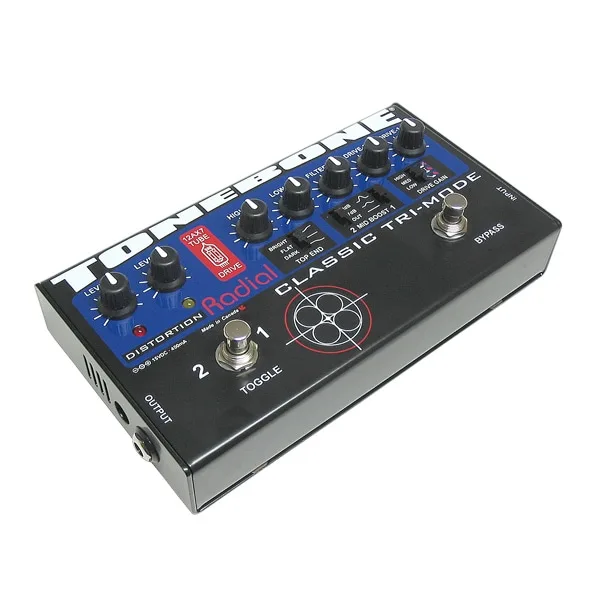
The Hot British front panel combines knobs and voicing switches. Vintage Guitar's review lists pots for Level, High, Low, Contour, and Drive, with the Contour adjusting the balance of low and high frequencies in the notch and fat voicing modes2. RockBoard's Tonebone reference adds the gain-stage switches: top-end, mid boost and drive gain switches alongside the control pots for high, low, filter and drive3.
| Control | What it does |
|---|---|
| Level | Sets the output volume |
| Drive | Sets the amount of distortion |
| High | Shapes the high frequencies |
| Low | Shapes the low frequencies |
| Contour | Adjustes the balance of low and high frequencies in the notch and fat voicing modes2 |
| Filter | Shapes the tone alongside the high and low pots3 |
| Top-End switch | Selects the top-end voicing4 |
| Mid Boost switch | Selects the midrange voicing4 |
| Drive Gain switch | Selects the drive character3 |
The V9 reworks this layout rather than copying it, with its own control set described below.
Power and connections
The original Hot British ran on 15V DC, center negative3, an unusual requirement among pedals, and previous versions of the Hot British line used that 15V supply together with the 12AX7 tube5. That made it awkward on a pedalboard built around standard 9V supplies, and it is one of the practical differences the V9 was designed to fix. Bypass is true bypass, on a stomp switch with an LED indicator2.
The V9 changes the power story completely. It runs on 9V DC, center pin negative, drawing a minimum of 40mA, and can be powered by a standard 9V power supply or a multi-pedal power brick67. Radial's FAQ gives a range of 9 to 12V with a minimum of 40mA of current7. There is no battery option: Radial says the Class-A circuitry is power hungry and would drain a battery in no time7. The power input is regulated, and the pedal can be left on with very little current draw7.
Connections on the V9 are a standard ¼" instrument input for the guitar and a ¼" output for the amplifier, with a latching bypass footswitch4.
The original Hot British's 15V DC, center negative supply is not compatible with standard 9V pedalboard outputs, and the V9 cannot run on a battery. Plan power accordingly if you find either version used.
From tube pedal to the tubeless V9
In February 2017 Radial announced the Hot-British V9, a smaller, tubeless version of the pedal, available at $169.995. Guitar Interactive Magazine reported it shipping in March 2017, built in Canada8. Delicious Audio described it as "the updated plexi-style V9 Hot British unit," packed into a pedalboard-friendly compact chassis9.
The V9 keeps the Hot British's tonal aim but changes the circuit. In Radial's words, "The tube has been surgically removed and replaced with a new tube-emulating tone circuit"7. The solid-state, Class-A discrete design includes Radial's Class-A buffering circuit, which Radial says provides the same feel as true bypass while allowing long cables and pedal chains6. Once engaged, three tone-shaping stages provide control from subtle tube saturation textures to high-gain, over-the-top distortion6. Radial states the V9 retains the tonal characteristics of the original7.
The V9's controls differ from the original's:
| Control | What it does |
|---|---|
| Level | Sets the output volume of the pedal4 |
| Drive | Sets the overall distortion amount and input level6 |
| Contour | Alters the character of the distortion: clockwise for more high frequencies, counter-clockwise for a warmer tone4 |
| Low | Post-distortion EQ control for high frequencies4 |
| Top-End switch | 3-position switch controlling the high frequency response4 |
| Mid-Boost switch | 3-position switch controlling the midrange response4 |
Delicious Audio noted that the V9 features multiple tone shaping stages for total control over your sound, and that its Class-A buffering circuit gives the feel of a true-bypass pedal with greater noise rejection and lower impedance9.
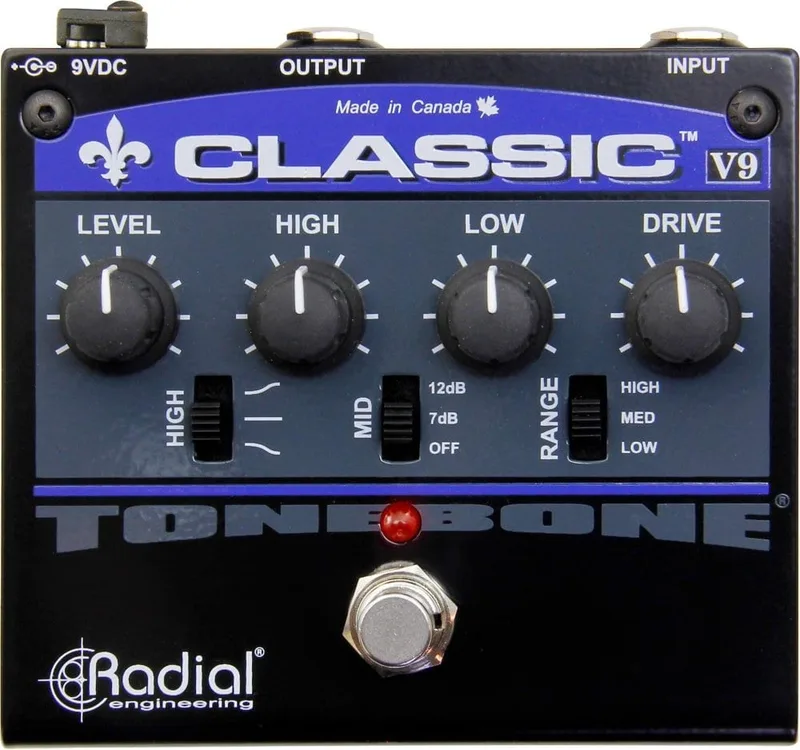
The V9 follows the pattern Radial set with the Tonebone Classic V9, announced in October 2016 as a compact, 9V-powered version of the tube-powered Tonebone Classic5. MusicRadar's reviewer Trevor Curwen found that pedal "very responsive" and sympathetic to playing dynamics, cleaning up nicely with guitar volume roll-back10, which points to what players can expect from the shared Class-A approach, though the Hot-British V9 itself was not the subject of that review.
Hot-British V9 specifications
| Specification | Value |
|---|---|
| Circuit | Class-A discrete, solid-state6 |
| Gain | +5dBu6 |
| Maximum input | +15dBu6 |
| Input impedance | 200kΩ6 |
| Output impedance | 1kΩ6 |
| Noise floor | -87dBu6 |
| Frequency response | Shaped for guitar use6 |
| Power | 40mA, 9V DC, center pin negative6 |
| Chassis | 14-gauge steel6 |
| Size (L x W x D) | 4.25" x 4.06" x 2" (108mm x 103mm x 50mm)6 |
| Weight | 1.45lb (0.66kg)6 |
| Warranty | Radial 3-year, transferable6 |
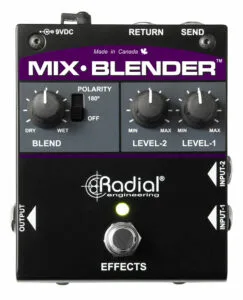
Radial also notes the V9 can be used with bass, though running it in parallel is typically preferred to retain full low-end frequencies, and the Radial Mix-Blender lets you mix in the desired amount of distortion alongside the original bass tone7.
Related Radial pedals
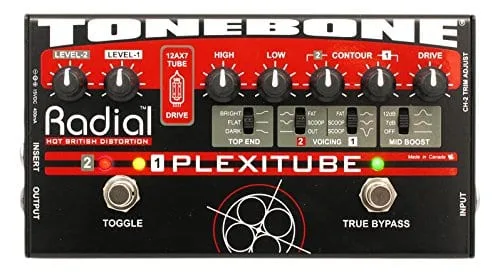
The Hot British sits in a family of Radial British-voiced distortions. The tube-driven Plexitube offers a more feature-laden British-style take on the format, while the compact, tubeless line includes the Bones London Distortion and Bones Hollywood Distortion.
Videos
ProGuitarShopDemos
Сергей Табачников
theperfectguitar
Questions
Does the original Radial Hot British have a tube?
Yes. The original Hot British is a 12AX7 tube distortion pedal built around a triple gain stage that combines solid-state control and dynamics with a real 12AX7 tube for what Radial describes as warm, natural tone. The later Hot-British V9 removes the tube and replaces it with a tube-emulating tone circuit.
Is the Hot-British V9 true bypass?
No. The Hot-British V9 uses a buffered bypass built on Radial's Class-A buffer rather than true bypass. Radial says the buffer provides the same feel as true bypass while allowing long cable runs and large pedal chains, with greater noise rejection and lower impedance.
Can the Hot-British V9 run on a battery?
No. Radial states that the Class-A circuitry of the Hot-British V9 is power hungry and would drain a battery quickly, so it runs from a standard 9V power supply or a multi-pedal power brick instead.
What power supply did the original Hot British need?
The original Tonebone Hot British ran on 15V DC with a center negative plug, an unusual requirement among pedals, and it used a 12AX7 tube. The V9 replaced this with standard 9V DC, center pin negative, needing at least 40mA of current.
Is the Radial Hot British discontinued?
Yes. Radial states that the original Hot British has been discontinued and is no longer shipping, though it retains a legacy product page and remains well used by professional and semi-professional players. The Hot-British V9, announced in 2017, is its successor.
Sources (10)
- Hot British, Radial Engineering, 2021-03-17
- Radial Engineering Tonebone Classic, Hot British, and Switchbone, Vintage Guitar magazine, 2006-02-23
- Tonebone Hot British by Radial Engineering, RockBoard (www.rockboard.de), 2026
- Hot-British V9 Features, Radial Engineering, 2018-06-19
- Radial cooks up Hot-British V9 distortion pedal, MusicRadar, 2017-02-28
- Hot-British V9 Specifications, Radial Engineering, 2018-04-10
- Hot-British V9 FAQ, Radial Engineering, 2018-06-11
- Radial Update Hot-British V9 Tube Distortion Pedal, Guitar Interactive Magazine, 2017-03-20
- Radial ToneBone Hot-British V9 Distortion, Delicious Audio, 2017-12-20
- Radial Engineering Tonebone Classic V9 review, MusicRadar, 2017-05-27