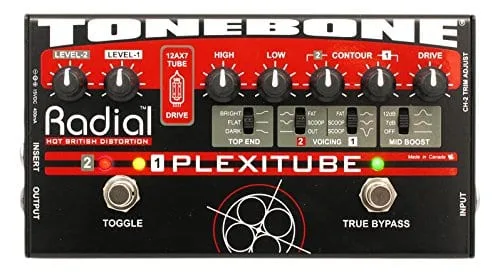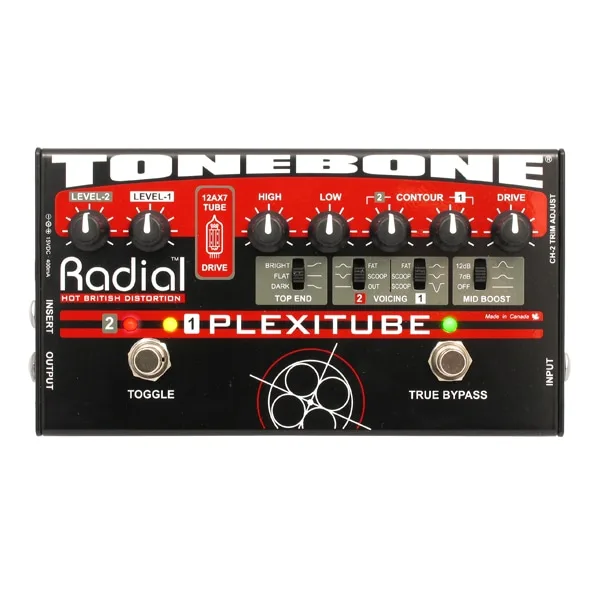


The Radial Plexitube is a true-bypass, dual-channel tube distortion pedal from Radial Engineering, built around a 12AX7 preamp tube and voiced for high-gain, low-noise Plexi-style distortion1. Its two channels are set up for on-the-fly switching between rhythm and lead settings: channel 1 is optimized for rhythm, with chunky tones and scooped mids for a wall of sound, while channel 2 is the higher-gain lead channel, voiced for razor-sharp solo cut and sustaining mids23. Radial describes the tube's role as generating harmonics and warming the signal path, combined with three gain stages to create the distortion4.
Radial states the Plexitube has been discontinued and is no longer shipping1. It is available only on the used market.
Two channels, one Plexi voice
The two channels are the pedal's core idea. Channel 1 carries the rhythm voicing, with scooped-out mids and what Radial calls chunk rhythm tones for a thunderous wall of sound; channel 2 is the lead channel with higher gain, built for razor-sharp cut and smooth sustaining mids36. A single foot stomp on the toggle switch moves between the two2.
Guitar World reviewed the pedal in May 2007, testing it with a Burstbucker-loaded Les Paul into a Fender Vibro-King, and summed it up this way6:
"The Plexitube provides everything you need to generate layers of searing Brit-style preamp-derived gain"6
Guitar World, May 20076
The review also placed the pedal in its family context: it recreates the sound of Radial's original Hot British pedal while adding the second high-gain channel, more distortion control, voicing options and an effects loop insert on channel 26.
The controls
Radial gives each channel its own settings while sharing some controls globally. The picture from the maker's feature page and Guitar World's review26:
| Control | What it does |
|---|---|
| Drive | Master drive control sets overall distortion; a drive knob for each channel26 |
| Level | Independent output level controls for each channel6 |
| EQ | Two-band passive-interactive equalizer for tone shaping while retaining natural sound2 |
| High/Low | Global high- and low-frequency controls6 |
| Contour | Independent contour knobs for each channel's midrange6 |
| Top End | 3-position switch, dark/flat/bright, to compensate for humbuckers or single coils2 |
| Voicing | 3-position switch for each channel, with ultra scoop on rhythm2 |
| Mid Boost | 3-position switch to increase midrange on either channel for added cut when soloing2 |
| Toggle | Switches between channel 1 and channel 2 with a single foot stomp2 |
| Insert jack | Standard 1/4" TRS insert for effects on channel 2, so a delay can come on automatically when you toggle to the solo channel2 |
The insert jack is worth noting for lead players: plug a delay into channel 2's loop and switching to that channel brings the delay in with it2.
Power and the tube
The Plexitube runs on a 15V DC, 400mA power adaptor, which Radial supplies with the pedal34. The power supply input is internally regulated to properly heat up the tube and power the rest of the circuit2. Radial notes the Cioks DC10 power brick has a 15V outlet suitable for Tonebone pedals4.
Radial says the tube inside the Plexitube can last upwards of 10 years, and that complete instructions with pictures for changing it are provided in the user guide. For powering, the Cioks DC10 power brick has a 15V outlet for Tonebone pedals4.
The 12AX7 tube can last upwards of 10 years, and Radial suggests changing it only if the tone is lacking or the output is down from when the pedal was first plugged in; changing the tube affects the sound only slightly. Complete instructions with pictures are in the Plexitube user guide4. A vent on the enclosure provides air ventilation to keep the tube running cool2.
History and the Tonebone line
Construction is built like the rest of the Tonebone line: a 14-gauge steel enclosure with a baked enamel finish, components soldered to a double-sided circuit board with a full-surface ground plane, and a hybrid tube / proprietary audio circuit5. The pedal is rated for use in dry locations between 5°C and 40°C5.
Videos
ProGuitarShopDemos
G-System Videos
POLAR - Integrated Solutions & Pro Audio
Questions
Can the Radial Plexitube run on 18V?
Radial says it can be run from an 18V power brick, but warns this may shorten the lifespan of the internal voltage regulators. If you do use 18V, make sure the polarity is correct and the supply can deliver sufficient current. The pedal normally runs on the supplied 15V DC 400mA adaptor.
Is the Radial Plexitube discontinued?
Yes. Radial's product page states the Plexitube has been discontinued and is no longer shipping. It was released in May 2007 as part of the Tonebone line, so it remains available only on the used market.
Does the Plexitube work with bass?
Yes, Radial confirms it can be used with bass. They note that with bass it is typically preferred to run a distortion pedal in parallel to retain full low-end frequencies, mixing the distortion with the original bass tone, for example using Radial's Mix-Blender.
How do I fix signal loss on channel 2 of the Plexitube?
Channel 2 is normalled through the insert jack on the pedal. If the insert jack is typically unused, exercising it by plugging in a guitar plug a handful of times should restore the signal. This is Radial's own recommended fix for channel 2 signal loss.
Is the Radial Plexitube true bypass?
Yes. Radial describes the Plexitube as a true-bypass dual-channel tube distortion pedal with true-bypass switching to retain your tone, and Guitar World's 2007 review confirmed true-bypass operation when the pedal is turned off.
Sources (6)
- Plexitube, Radial Engineering, 2024-01-30
- Plexitube Features, Radial Engineering, 2018-04-18
- Plexitube by Radial Engineering, RockBoard PedalPedia, 2026
- Plexitube FAQ, Radial Engineering, 2018-11-27
- Plexitube Specifications, Radial Engineering, 2018-04-18
- Radial Engineering Tonebone Plexitube distortion, Guitar World, 2007-05-14