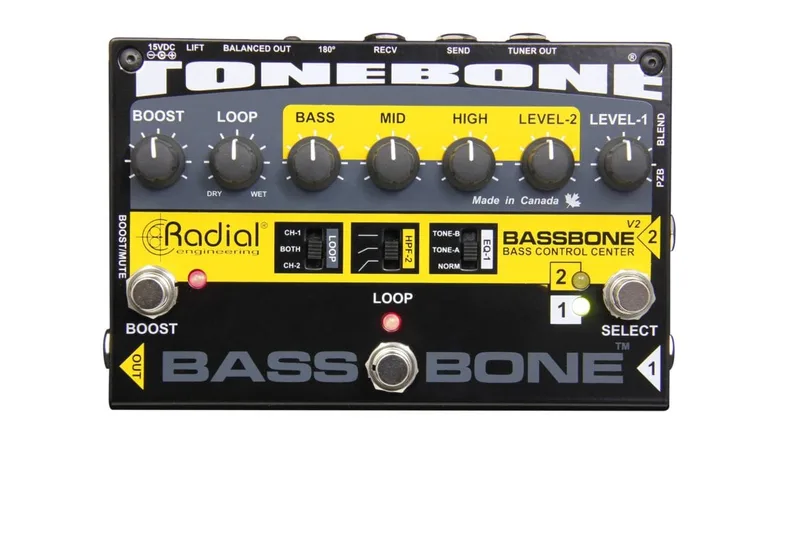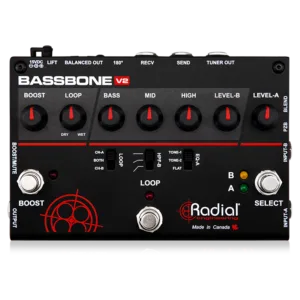


The Radial Bassbone V2 is a two-channel bass preamp, EQ, booster and DI box from Radial Engineering, built as a compact floor unit for players who carry more than one instrument or want a full tone-shaping and direct-out station at their feet. Radial describes it as "a power-packed bass preamp that combines on-stage efficiency, amazing tonal control and superb audio performance in a compact box"1. It is a buffered preamp rather than a true-bypass effect: Radial says specially designed buffers drive the two preamp channels, the EQ, the power booster, the tuner out and the effects loop with no signal level loss2.
The core idea is simple. One bass goes into input 1 and a second into input 2, and the Select footswitch moves between them, each with its own level and tone settings. With a single bass, the same switch moves between two voiced channels. Radial positions it as a "bass command center" that switches between any two basses, including active, passive magnetic and piezo-equipped uprights3. Guitar World's 2026 guide to bass preamp pedals highlighted it for touring players and anyone switching between multiple instruments4.
What it does to your sound
The two channels are voiced differently. Channel 1 keeps things simple: a three-position EQ-1 switch selects between flat and two preset EQ contour curves, and Radial notes that setting it to Flat bypasses the EQ so the instrument's original tone passes unaltered72. Channel 2 carries a full 3-band active EQ that Radial says lets you carve your tone to suit any playing style or instrument, plus a high-pass filter switch with 60Hz, 80Hz and off positions to roll off excessive low-frequency resonance7.
Bass Gear Magazine's Tom Bowlus, reviewing the V2, found the EQ musical rather than surgical. "Cutting the Mids resulted in a very pleasing tone that didn't lose all of the power behind the notes," he wrote of channel 25. His summary of the sonic profile: lows offer great control via EQ or high-pass filtering, mids are solid and clear with good control, and highs show no high-end loss, with the ability to emulate a passive tone cut5.
The magazine's Amp Lab bench review by Dan Kropp measured the channel 1 contour settings. The Tone-B setting showed a tighter mid scoop than Tone-A, shifted down to about 350Hz, with slightly attenuated but extended bass and a treble bump centered around 8kHz8. He also noted that channel 2 appears to have a bit more gain, and thus a bit less headroom, than channel 18.
The controls and footswitches
There are three footswitches and a set of knobs and recessed switches:
| Control | What it does |
|---|---|
| Level-1 and Level-2 knobs | Adjust instrument level for each channel7 |
| EQ-1 switch | Three positions: flat or two preset EQ contour curves on channel 17 |
| 3-band EQ | Active EQ on channel 27 |
| HPF-2 switch | High-pass filter on channel 2: 60Hz, 80Hz or off7 |
| Boost knob | Sets boost from unity gain to +8dB7 |
| Loop Wet/Dry knob | Mixes the dry bass sound with the wet effects loop7 |
| Select footswitch | Switches channels with one bass, or instruments with two7 |
| Loop footswitch | Turns the effects loop on and off7 |
| Boost footswitch | Activates the power booster or the mute function, with a large LED indicator7 |
| Boost/Mute switch | Recessed switch assigning the Boost footswitch to boost or mute7 |
| Ground Lift switch | Recessed switch disconnecting pin-1 on the XLR to fight ground-loop hum7 |
Two details are worth knowing. The Boost level and Loop Wet/Dry knobs apply to both channels, as Bass Gear Magazine noted5. And when the recessed Blend switch is engaged, the Select footswitch is disengaged and channels 1 and 2 are blended together, a mode Dan Kropp documented in the Amp Lab review8. The tuner out is always on for tuning on the fly, or can be used with the mute function for silent tuning7.
Inputs, outputs and the XLR direct out
The rear panel carries two 1/4" instrument inputs. Input 1 is the primary; when nothing is plugged into input 2, its signal is automatically sent to channel 2 as well. Input 2 is for a second bass7. Input impedance is 220K ohms on input A and 220K/10M ohms on input B, the 10 meg-ohm setting being the one that suits piezo pickups6.
Outputs are a 1/4" instrument jack for your bass amp, a balanced XLR direct out, and a tuner out, with 1/4" send and receive jacks for the effects loop on the top edge75. The XLR sends the post-EQ Bassbone sound to the PA or recording console7. Radial says the DI output is active and similar to the Radial J48 direct box2. The ground lift and phase-shift buttons affect only the balanced XLR output5.
Measured performance from Radial's spec sheet6:
| Specification | Value |
|---|---|
| Frequency response | 20Hz to 18kHz |
| Dynamic range | 85dB |
| Noise floor | -100dB |
| Equivalent input noise | -92dBu at XLR |
| Total harmonic distortion | 0.05% at -15dBu |
| Intermodulation distortion | 0.2% at -20dBu |
| Maximum input | +7dBu |
| Gain | Unity gain device |
| Output impedance | 300 ohms at XLR |
Power: 15V, 400mA
The Bassbone V2 runs on a Radial 15V DC, 400mA power supply, which is included, with a cable clamp on the unit that locks down the adapter cable to prevent accidental power disconnection7. The connector is center negative6. Radial explains the reasoning behind the higher voltage on the related Bassbone OD: "By using a 15V - 400 mA power supply, we can increase the headroom and reduce distortion for a more natural bass tone"9.
The Bassbone V2 runs on 15V DC, center negative, and cannot be powered by 48V phantom power from the console. It is protected against phantom power by blocking capacitors on the XLR, but those only prevent damage; they do not power the unit2. Radial warns that a third-party 15V supply with incorrect polarity can damage the unit2.
History: from the original Tonebone Bassbone
The original Tonebone Bassbone was introduced in 20035. The Bassbone V2 followed in 2015 as its replacement, made by Radial Engineering5. Radial says the V2 uses the same audio circuit as the original Bassbone, with new features added2.
Radial artist Martin Isenberg, a double bassist, uses the V2 as his preamp and to switch between channels for his P Bass and his upright1. The unit is built in a 14 gauge steel enclosure, carries Radial's transferable 3-year warranty, and is rated for dry locations between 5°C and 40°C6.
Bassbone V2 versus Bassbone OD
Both are two-channel bass preamps, but they aim at different players. The V2 is billed by Radial as a bass preamp and boost1: its tone tools include a channel 1 contour switch, where the Flat setting bypasses the EQ so the instrument's original tone passes through unaltered172, and a boost knob that controls the amount of signal boost from unity-gain to +8dB172. It is not true bypass; specially designed buffers manage the audio signal to drive two preamp channels, EQ, power booster, tuner and effects loop with no signal level loss2. The Bassbone OD adds overdrive in the same box, where the V2 covers clean switching, EQ and boost.
Videos
Sweetwater
Radial Engineering
Deadbeat Studios
Questions
Can the Bassbone V2 run on 9V?
No. The Bassbone V2 runs on a 15V DC, 400mA center-negative power supply, which Radial includes in the box. Radial chose 15V to increase headroom and reduce distortion. Radial warns that incorrect polarity on a third-party supply can damage the unit.
Can I use the Bassbone V2 with an upright bass?
Yes. Radial says the Bassbone V2 works with guitar, mandolin, banjo, fiddle, dobro, cello and more, though it is optimized for bass. Input B offers a 10 meg-ohm impedance setting suited to piezo pickups, and Radial artist Martin Isenberg uses his to switch between a P Bass and an upright.
Why is my bass quieter through the Bassbone V2?
A slight volume drop compared with plugging straight into your amp is normal. The Bassbone V2 produces an instrument-level output between -30dB and -15dB, and Radial deliberately backed the output down to compensate for the power of the EQ at full settings. The difference can be made up at the amp's input.
Can the Bassbone V2 be powered by phantom power?
No. The Bassbone V2 cannot be powered by 48V phantom power. It is equipped with blocking capacitors on the XLR output that protect its circuitry from phantom power and other DC currents, so phantom on the console will not harm it, but it cannot run the unit.
What is the difference between the Bassbone V2 and the Bassbone OD?
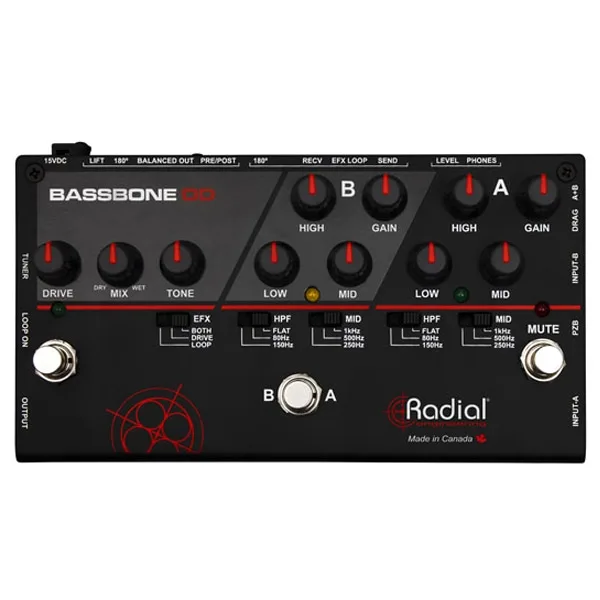
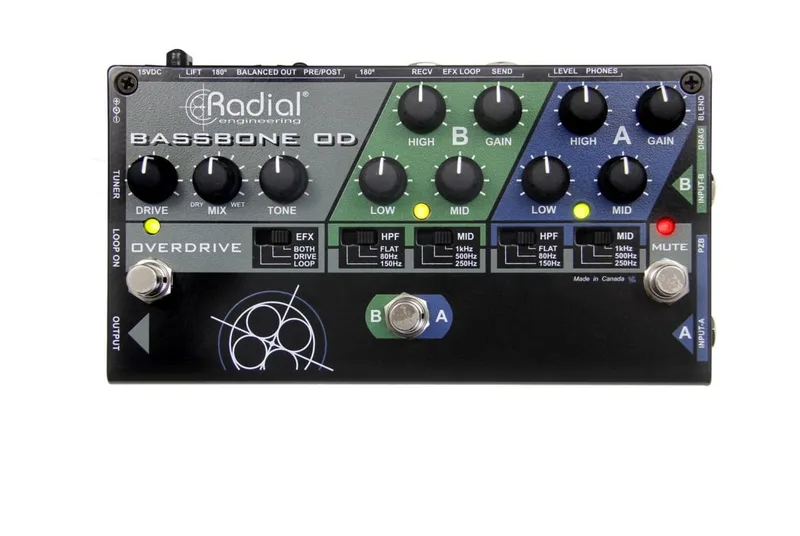
The Bassbone V2 is a two-channel preamp, EQ, booster and DI with an effects loop. The Bassbone OD is a bass preamp and overdrive: its overdrive circuit is derived from the Ibanez TS9, modified for bass, and it adds drag control load correction and a PZB piezo booster. Both have two channels and a built-in active DI.
Sources (9)
- Martin Isenberg, Radial Engineering
- Bassbone V2 FAQ, Radial Engineering, 2019-05-13
- Bassbone v2 by Radial Engineering, rockboard.de, 2026
- Best bass preamp pedals: consistently great tone, anywhere, Guitar World, 2023-05-23
- Radial Tonebone Bassbone V2 Pedal, Bass Gear Magazine, 2021-03-24
- Bassbone V2 Specifications, Radial Engineering, 2022-03-16
- Bassbone V2 Features, Radial Engineering, 2026-04-09
- AMP Lab - Radial Tonebone Bassbone V2 | Bass Gear Magazine, Bass Gear Magazine, 2021-04-02
- Bassbone OD FAQ, Radial Engineering, 2021-09-27