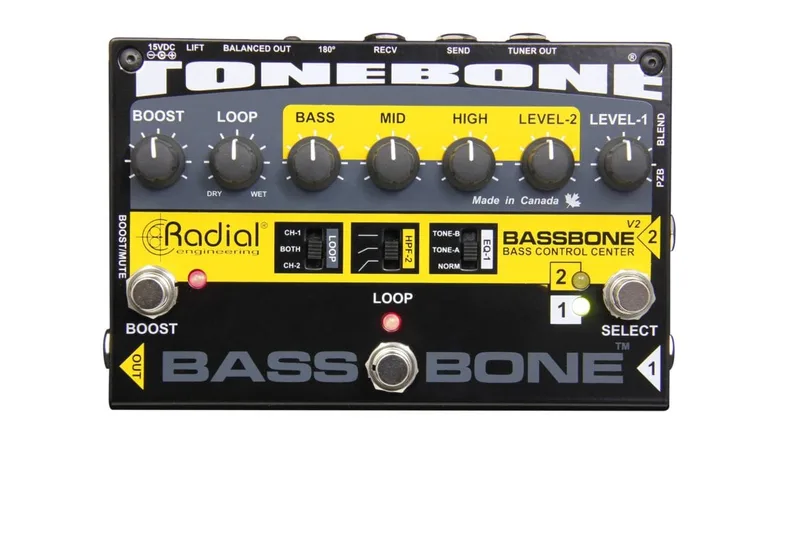


The Radial Bassbone V2 is a two-channel bass preamp pedal from Radial Engineering that combines a preamp, EQ, DI and power booster in one box. Radial describes it as "a power-packed bass preamp that combines on-stage efficiency, amazing tonal control and superb audio performance in a compact box"1. Its core job is letting a player run two instruments, such as an electric bass and a piezo-equipped upright, through one rig and switch between them with a footswitch, while sending a balanced post-EQ signal to the PA or a recording console23.
Bass Gear Magazine described the Bassbone V2 as "the latest iteration of the now-classic Bassbone" in the preamp category, noting that it replaces the venerable original45.
What it does
The Bassbone V2 is built around two independent preamp channels. Channel 1 has a three-position EQ-1 contour switch that selects between flat and two preset EQ curves; set to flat, it passes the instrument's tone unaltered29. Channel 2 has a full three-band active EQ (bass, mid, high) plus a three-position high-pass filter switch, so you can carve a very different tone for a second instrument28. Each channel has its own level knob2.
Radial positions the V2 as a "bass command center" that lets you switch between any two basses, including active, passive magnetic and piezo upright basses6. Bassist Martin Isenberg, featured on Radial's artist pages, uses it exactly that way: "I use the V2 as my preamp and to switch between channels for my P Bass and my upright"1.
Beyond the preamp, the V2 carries:
- A power booster, adjustable from unity gain to +8dB2
- A parallel effects loop with a wet/dry mix knob24
- An active balanced XLR DI output, post-EQ, which Radial says is similar to its J48 direct box9
- An always-on tuner out, usable with the mute function for silent tuning2
- A 180-degree polarity reverse and a ground lift on the XLR output23
The controls and footswitches
The front panel is organized around three footswitches and a set of knobs and recessed switches4.
| Control | What it does |
|---|---|
| Level-1 and Level-2 knobs | Adjusts instrument level for each channel2 |
| EQ-1 switch | Three-position switch: flat or two preset EQ contour curves on channel 12 |
| Bass, Mid, High (channel 2) | Active three-band EQ on channel 228 |
| HPF-2 switch | High-pass filter on channel 2 at 60Hz, 80Hz or off, to roll off excessive low resonance2 |
| Boost knob | Sets boost amount from unity gain to +8dB2 |
| Loop Wet/Dry knob | Mixes the dry bass sound with the wet effects loop2 |
| Boost/Mute switch | Recessed switch assigning the Boost footswitch to the power booster or to mute2 |
| 180° (XLR) switch | Recessed switch reversing pins 2 and 3 at the XLR out for phase alignment or feedback reduction2 |
| Ground Lift switch | Recessed switch disconnecting pin 1 on the XLR out to fight ground-loop hum2 |
The three footswitches:
- Select: switches between channels with one bass, or between instruments with two basses2.
- Loop: turns the effects loop on and off2.
- Boost: activates the power booster or the mute function, with a large, easy-to-see LED indicator2.
Bass Gear Magazine's reviewer noted that the Boost level knob and the wet/dry Loop knob apply to both channels, and that the recessed Boost/Mute button lets the third footswitch work as a mute instead of a boost4. The parallel effects loop, dialed in "a little or a lot" via the Loop knob, replaced the original Bassbone's serial TRS loop4.
Power and connections
The Bassbone V2 runs on 15V DC, center negative, from the included Radial 15VDC/400mA supply2. Radial says the higher-voltage supply increases headroom and reduces distortion for a more natural bass tone10. A cable clamp locks the adapter cable in place to prevent accidental power disconnection2.
The Bassbone V2 cannot be phantom powered. It does have blocking capacitors on the XLR output that protect it from 48V phantom and other DC currents, so connecting it to a console with phantom engaged is safe9. If you use a third-party 15V supply, Radial warns to check the polarity carefully to avoid damaging the unit9.
Connections on the rear panel23:
- Input-1: primary 1/4" instrument input; the signal automatically feeds channel 2 when nothing is plugged into Input-2
- Input-2: 1/4" input for a second bass
- Out: 1/4" instrument output to your bass amplifier
- Send and Receive: 1/4" jacks for the effects loop
- Tuner out: always on for tuning on the fly
- Balanced Out: XLR DI output, post-EQ, to the PA or recording console
Measured specifications from Radial's spec sheet3:
| Specification | Value |
|---|---|
| Frequency response | 20Hz to 18kHz |
| Dynamic range | 85dB |
| Total harmonic distortion | 0.05% at -15dBu |
| Intermodulation distortion | 0.2% at -20dBu |
| Input impedance | 220K ohms (input A), 220K/10M ohms (input B) |
| Output impedance | 300 ohms at XLR |
| Equivalent input noise | -92dBu at XLR |
| Maximum input | +7 dBu |
| Construction | 14 gauge steel |
Buffered, not true bypass
The Bassbone V2 is not true bypass. Radial's own answer on the question is direct: "No, the Bassbone V2 is a preamp. Specially designed buffers are used to manage the audio signal"9. Those buffers drive the two preamp channels, the EQ, the power booster, the tuner out and the effects loop with no signal level loss9.
One consequence players notice: the V2 can sound slightly quieter than plugging a bass straight into the amp. Radial says this is normal, because the output was deliberately backed down to compensate for the power of the EQ at full settings; the unit produces an instrument level output between -30dB and -15dB depending on the instrument's own output9. The V2 is a unity gain device overall3.
From the original Bassbone to the V2
The original Bassbone was Radial's earlier two-channel bass preamp, and the Bassbone V2 replaces it. Radial says it faithfully reproduced the same award-winning tone while adding features by incorporating new internal design, and the V2 is slightly smaller than the original, with an overall size that is very similar49. Bass Gear Magazine reviewed the V2 in 2015, the year of its origin8.
The V2 is slightly smaller than the original overall, though the size is very similar4. The 2022 refresh was purely cosmetic: Bass Musician Magazine reported that Radial refreshed the artwork of the Bassbone V2 and HotShot DM-1 "to complement modern pedalboards," with features and operation unchanged and nothing touched internally11.
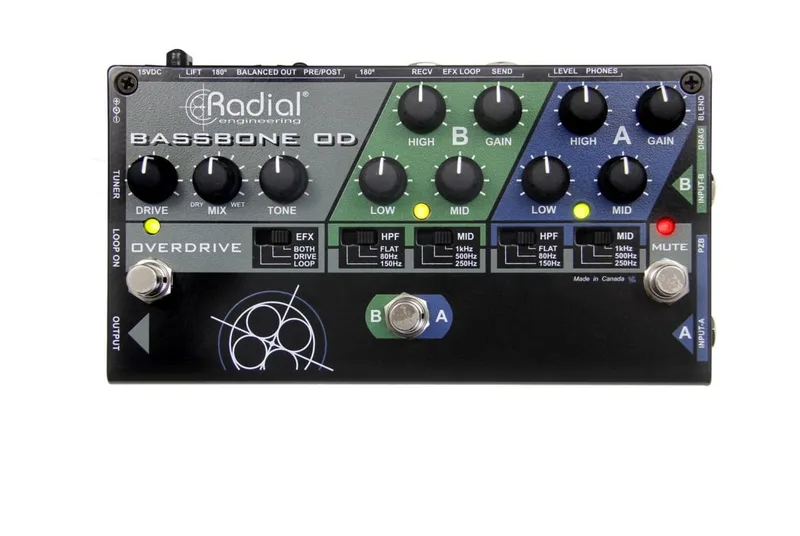
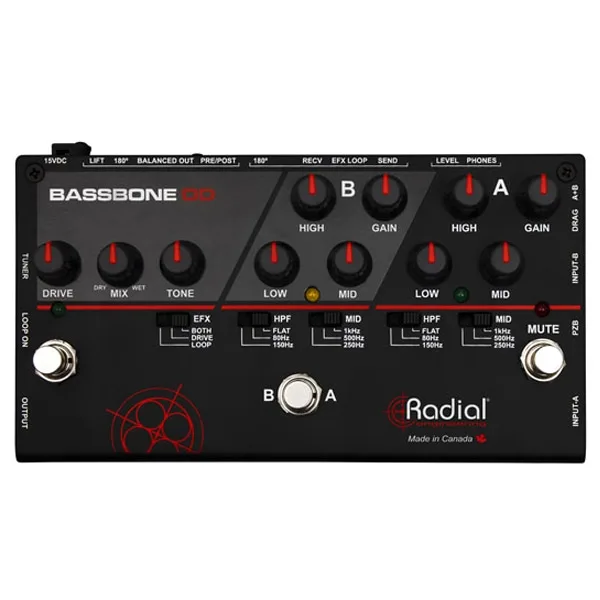
Radial also makes the Bassbone OD, a bass preamp and overdrive built on the same basic circuit as the original Bassbone but with more headroom and an overdrive circuit added10. The V2 and the OD are distinct products: the V2 is the preamp, EQ, DI and boost version without overdrive.
What reviewers said
Guitar World's July 2026 guide to the best bass preamp pedals named the Bassbone V2 its choice for touring and multiple instruments, citing its 15V DC power and two-channel design5.
Videos
Sweetwater
Radial Engineering
Deadbeat Studios
Questions
Can the Radial Bassbone V2 run on 9V?
No. The Bassbone V2 runs on a 15V DC, center negative supply rated at 400mA, and Radial includes the proper adapter in the box. Radial chose the higher voltage to increase headroom and reduce distortion for a more natural bass tone, so a standard 9V pedal supply will not run it.
Is the Bassbone V2 true bypass?
No. The Bassbone V2 is a preamp, and Radial uses specially designed buffers to manage the audio signal. Those buffers drive the two preamp channels, the EQ, the power booster, the tuner out and the effects loop with no signal level loss.
Can I use two basses with the Bassbone V2?
Yes. Input-1 is the primary instrument input and Input-2 takes a second bass. The Select footswitch then switches between the two instruments, and each channel has its own level and EQ setup. With one bass, the same footswitch switches between Channel 1 and Channel 2.
Can the Bassbone V2 be phantom powered?
No. The Bassbone V2 cannot be powered by 48V phantom power. It does have blocking capacitors on the XLR output that protect the unit from 48V phantom and other DC currents, so it is safe to connect to a phantom-powered console.
Why is the Bassbone V2 slightly quieter than plugging straight into the amp?
That is normal. Radial backed down the output level to compensate for the power of the EQ at full settings. The Bassbone V2 produces an instrument level output between -30dB and -15dB depending on the output of your instrument.
Does the Bassbone V2 work with an upright bass piezo?
Yes. Radial designed the V2 to switch between active, passive magnetic and piezo-equipped upright basses. Bass Gear Magazine's reviewer found the PZB switch on Channel 2 makes a very audible difference in gain and fullness with piezo-equipped instruments.
Sources (11)
- Martin Isenberg, Radial Engineering
- Bassbone V2 Features, Radial Engineering, 2026-04-09
- Bassbone V2 Specifications, Radial Engineering, 2022-03-16
- Radial Tonebone Bassbone V2 Pedal, Bass Gear Magazine, 2021-03-24
- Best bass preamp pedals: consistently great tone, anywhere, Guitar World, 2023-05-23
- Bassbone v2 by Radial Engineering, Rockboard, 2026
- Bassbone V2, Radial Engineering, 2026-04-27
- AMP Lab - Radial Tonebone Bassbone V2 | Bass Gear Magazine, Bass Gear Magazine, 2021-04-02
- Bassbone V2 FAQ, Radial Engineering, 2019-05-13
- Bassbone OD FAQ, Radial Engineering, 2021-09-27
- New Look For the Radial Engineering Bassbone V2 and Hotshot DM1, Bass Musician Magazine, 2022-03-30