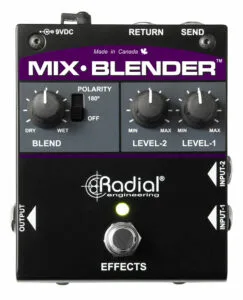

The Radial Mix-Blender is a parallel effects blender pedal from Radial Engineering, a stompbox that splits your signal so effects can run alongside a clean dry path instead of replacing it1. Its core job is the wet-dry blend: a Blend control lets you mix in as much of the effects as you like into the signal path2. For a bass player, that means adding distortion or fuzz while keeping the original low end intact, which Radial describes as mixing in the desired amount of distortion while maintaining the original bass tone3.
MusicRadar reported the pedal as the latest in Radial's Tonebone line when it launched, available for $169.994. Radial positions it for guitarists, bassists and keyboard players, and states the circuit is designed to work with electric guitars, basses and acoustics5.
What it does: blending effects in parallel with the dry signal
Most pedalboards run in series: every pedal sits in one line, so a heavy distortion pedal eats your clean tone along with everything else. The Mix-Blender takes a different route. Your instrument feeds the pedal, a Send jack carries your signal out to an effects chain, and a Return jack brings the pedals back in2. The Blend control then mixes the wet, processed signal with the dry, unprocessed one, so you set the balance yourself rather than choosing all or nothing2.
A heavy-duty footswitch activates and bypasses the effects loop, and a super bright full-size LED indicator shows its status on dark stages2. A cable clamp retains the power supply cable and eliminates accidental disconnects2.
The controls at a glance:
| Control | What it does |
|---|---|
| Blend | Wet-dry blend, sets how much of the effects is mixed into the signal path2 |
| Level 1 & 2 | Adjusts the relative levels between the two instruments2 |
| Polarity | Toggles the effects send's relative phase by 180 degrees2 |
| Effects footswitch | Activates the Mix-Blender's effects loop2 |
Why the polarity switch matters
When you run effects in parallel, the wet and dry signals get summed back together. Some pedals invert the phase of whatever passes through them, so the wet path can arrive at the summing point flipped relative to the dry path. When that happens, the two signals partially cancel, thinning or hollowing out the sound.
The Mix-Blender's answer is a 180 degree polarity reverse switch on the effects loop. Radial says it lets you compensate for pedals that are out of phase with the dry signal path5. If a parallel blend sounds weak or hollow, flipping the switch is the first thing to try.
Two inputs, and how to use them
The two standard ¼" guitar inputs accept two instruments or effects2, with Level 1 and Level 2 controls adjusting the relative levels between them2. That makes the pedal usable as a small two-input mixer, for example blending two instruments into one amp, or feeding a second source alongside your main one.
The Send jack can also feed a tuner instead of an effects chain2, which lets you tune silently without interrupting your signal.
Buffers and signal quality
Both inputs feature 100% discrete Class A buffers4. The main audio path is a discrete Class A circuit, with an audio grade IC handling the send-return loop1. Radial's published measurements for the pedal:
| Specification | Value |
|---|---|
| Frequency response | 20Hz to 20KHz, +0/-2dB1 |
| Dynamic range | 104dB1 |
| Gain | -30dB maximum (FX off), +2dB maximum (FX on)1 |
| Total harmonic distortion | 0.01%1 |
| Intermodulation distortion | 0.02%1 |
| Input impedance | -220k1 |
| Equivalent input noise | -97dBu1 |
| Maximum input | +10dBu1 |
Power and practical details
The Mix-Blender runs on a typical 9V power supply connection, powered from an optional supply or power brick, and the power supply is not included2. There is no battery option in the specifications.
Power supply is not included. You need your own 9V DC adapter or power brick, and the built-in cable clamp is there to keep that connection from being knocked loose on stage2.
The enclosure is a 14-gauge steel chassis and outer shell, measuring 4.62" x 3.5" x 2" (117.3 x 88.9 x 50.8mm) and weighing 1.35 lbs (0.61kg)1. Radial rates it for use in dry locations only, between 5°C and 40°C1, and covers it with a 3-year transferable warranty1.
Keyboards and hot signals
The pedal is not limited to guitar. Radial notes it can be used with keyboards, and that some keyboards, like digital pianos, can have very hot output signals, so distortion can occur; if it is heard, the keyboard's output is turned down5.
Videos
Sound On Sound magazine
Questions
Can I use the Radial Mix-Blender as a two-input mixer?
Yes. It has two standard quarter-inch guitar inputs with their own Level 1 and Level 2 controls, which Radial describes as being used to adjust the relative levels between the two instruments. You can plug in two instruments or use the second input for effects, and balance them against each other.
Why does the Mix-Blender have a polarity switch?
The polarity switch toggles the effects send's relative phase by 180 degrees. Some pedals flip the phase of the signal passing through them, so when the wet and dry paths are combined back together they can cancel each other out. Radial says the switch lets you compensate for pedals that are out of phase with the dry signal path.
Does the Radial Mix-Blender work with bass?
Yes. Radial states the Mix-Blender's circuit is designed to work with electric guitars, basses and acoustics. It is a common tool for bass players who want to blend in distortion while keeping their clean low end, which Radial describes as mixing in the desired amount of distortion while maintaining the original bass tone.
Can the Mix-Blender run on a battery?
No. The Mix-Blender is powered from a typical 9V DC power supply connection, and Radial notes the power supply is optional and not included, so you supply your own adapter or power brick. There is no battery compartment in the specifications.
Is the Radial Mix-Blender buffered?
Yes. Both inputs feature 100 percent discrete Class A buffers, according to MusicRadar's coverage of the pedal. The main audio path is a discrete Class A circuit, with an audio grade IC used for the send and return loop.
Sources (5)
- Mix-Blender Specifications, Radial Engineering, 2018-04-17
- Mix-Blender Features, Radial Engineering, 2022-09-15
- Plexitube FAQ, Radial Engineering, 2018-11-27
- Mix and blend guitars and effects with Radial's Mix-Blender pedal, MusicRadar, 2016-03-09
- Mix-Blender FAQ, Radial Engineering, 2019-05-13