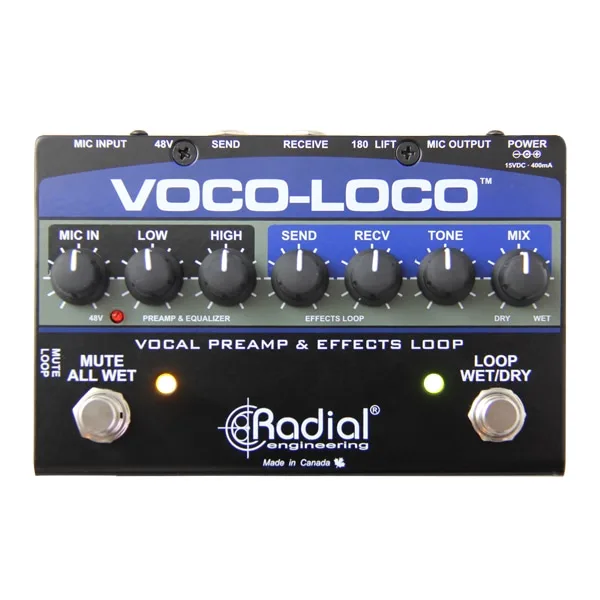


The Radial Voco-Loco Mk2 is a vocal effects interface from Radial Engineering: a microphone preamp in a floor-pedal enclosure with an effects loop made of ordinary unbalanced 1/4 inch jacks. You plug your mic into it, send the signal out to your guitar pedals, bring it back, and feed the result to the PA. Radial pitches it at singers who want echo, reverb or distortion on their voice using the pedals they already own1.
Radial describes the unit as a studio quality preamp in pedal clothing, and the Mk2 is an updated version of the original Voco-Loco21. It works with dynamic and condenser microphones, generates its own phantom power, and can now run on 9V to 18V pedalboard power supplies instead of only its bundled supply31.
What the Voco-Loco Mk2 does
The idea is simple: guitar pedals expect an unbalanced, instrument-level signal on a 1/4 inch jack, and a PA expects a balanced mic or line signal on an XLR. The Voco-Loco Mk2 sits between the two. Its mic preamp sets the input level for your microphone, the signal goes out to your pedals on unbalanced 1/4 inch jacks, comes back in, and a male XLR output feeds the PA system3.
The dry microphone signal is kept separate from the wet effects signal, so the PA receives the unprocessed vocal cleanly while the pedals do their work on the loop5. That matters for a singer: your voice stays solid at the desk even when the loop is running delay, reverb or distortion.
Radial says the original Voco-Loco was tested with a wide range of popular stage and studio microphones, with excellent results in all cases5.
The controls
The Mk2 keeps the control set of the original and adds a 2-band EQ. Radial describes the EQ as carefully crafted and effortless to adjust4.
| Control or switch | What it does |
|---|---|
| Mic In | Sets the input level of the mic preamp section3 |
| 2-band EQ | Adjusts the tone of the signal4 |
| Tone control | Tames the effects signal once the loop returns4 |
| Dry-wet mix | Balances the unprocessed vocal against the effects loop4 |
| Loop Wet/Dry footswitch | Primary footswitch, toggles the effects loop on or off3 |
| Mute / All Wet footswitch | Activates the MUTE or ALL WET function (original Voco-Loco)6 |
| Mute Loop switch | Sets the left footswitch to Mute or All Wet (original Voco-Loco)6 |
The mix control is the heart of it for live use: you can set the wet/dry balance between your original vocal sound and the pedals, then kick the loop in and out with the footswitch without losing the dry signal6. The tone control on the loop return lets you shape the effects signal separately from the dry path4.
The original also carried utility switches that survive in the family: a 180 degree polarity reverse on the effects loop, so pedals stay in phase with the vocal mic, an input pad, and a ground lift that lifts pin 1 on the XLR to help eliminate ground loops65.
Power and connections
Connections are straightforward. The mic input on the Mk2 is a balanced locking XLR, a step up from the standard XLR female input of the original36. The output is a male XLR intended for the PA system or the line input of a mixing console36. The effects loop is a pair of unbalanced 1/4 inch jacks, send and return3.
The Mk2 draws 400mA at center positive polarity4. That is more current than many small pedalboard outputs provide, and the polarity is the opposite of the center negative standard on most guitar pedals, so it needs its own properly rated supply tap rather than a shared daisy chain.
The Mk2 accepts 9V to 18V pedalboard power supplies through its power connector and still ships with its own 15V PSU32. The original ran only on its external 400mA 15VDC supply6.
Why 40V phantom instead of 48V
The Voco-Loco generates 40 volts of phantom power, not the 48 volts of a standard console5. Radial explains the reasoning: the high 48V standard exists so a condenser mic can be positioned far from the mixing console, which short mic cables near a performer do not need. Radial chose 40 volts to avoid an extra power stage that could add noise45.
Specifications
| Specification | Value |
|---|---|
| Frequency response | 20Hz to 20kHz4 |
| Dynamic range | 100dB4 |
| Gain | 52dB4 |
| Clip level | +15dBu4 |
| Maximum input | +10dB4 |
| Equivalent input noise | -120dBu4 |
| Noise floor | -85dBu4 |
| Common mode rejection | -73dB @55Hz4 |
| Phase deviation | 8 degrees @50Hz4 |
| Input impedance | 10K-Ohms, 100K (FX loop)4 |
| Output impedance | 300 Ohms, 3000 Ohms (FX loop)4 |
| Construction | 14 gauge steel chassis and outer shell4 |
| Size (L x W x D) | 5.75 x 3.73 x 1.38 inches (146 x 95 x 35mm)4 |
| Conditions | Dry locations only, 5 to 40 degrees C4 |
From the original Voco-Loco to the Mk2
The original Voco-Loco is discontinued and no longer shipping; Radial's page for it now points readers to the Mk21. The Mk2 is an updated version2, and the visible changes are the 2-band EQ, the locking XLR mic input, and the wider 9V to 18V power supply compatibility342.
If you find an original Voco-Loco secondhand, note the differences: a standard rather than locking XLR input, no 2-band EQ, and power only from its bundled 15VDC supply rather than a pedalboard tap64.
Videos
Radial Engineering
Radial Engineering
Performer Magazine
Questions
Can I use my guitar pedals on vocals with the Voco-Loco?
Yes. The Voco-Loco Mk2 is a mic preamp with an effects loop built from unbalanced 1/4 inch send and return jacks, so you connect your pedals between them just as you would on a guitar amp's loop. A dry-wet mix control balances the unprocessed vocal against the effects, and a footswitch turns the loop on and off mid-song.
Does the Voco-Loco Mk2 work with condenser mics?
Yes. Radial states it works with dynamic and condenser microphones, and the unit generates phantom power for condensers. Radial says it tested a wide range of popular stage and studio microphones with excellent results in all cases.
Why does the Voco-Loco use 40V phantom power instead of 48V?
Radial explains that the high 48V standard exists so a condenser mic can sit very far from a mixing console, which short mic cables near a performer do not need. The Voco-Loco generates 40 volts instead, which Radial chose to avoid an extra power stage that could add noise.
Can the Voco-Loco Mk2 run on a 9V pedalboard power supply?
Yes. The Mk2 accepts 9V to 18V pedalboard power supplies through its power connector, though it still ships with its own 15V supply. It draws 400mA at center positive polarity, so check that your supply can deliver that current.
Is the original Voco-Loco still made?
No. Radial states the original Voco-Loco has been discontinued and is no longer shipping, and its product page points readers to the current Voco-Loco Mk2. The Mk2 is an updated version with a 2-band EQ and wider power supply compatibility.
Sources (6)
- Voco-Loco, Radial Engineering, 2026-02-11
- Voco-Loco Mk2, Radial Engineering, 2026-03-16
- Voco Loco Mk2 Features, Radial Engineering
- Voco Loco Mk2 Specifications, Radial Engineering, 2026-02-17
- Voco-Loco Specifications, Radial Engineering, 2022-11-08
- Voco-Loco Features, Radial Engineering, 2023-03-13