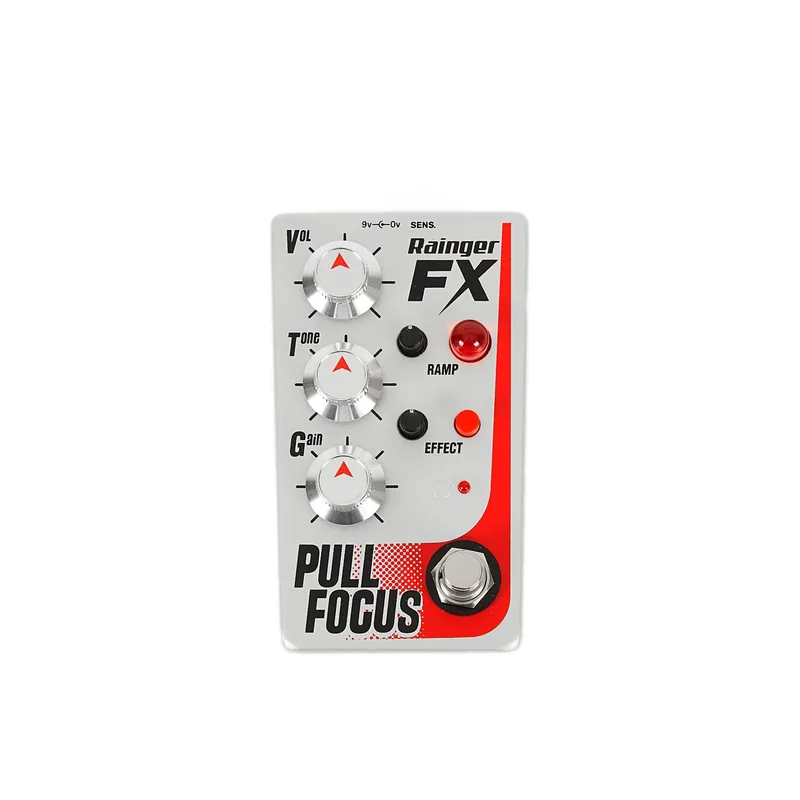


The Rainger FX Pull Focus is a high-gain distortion pedal with a twist: after you start playing, a second effect, either a chorus or a reverb, fades in on its own. Rainger FX describes it as "a multi-effects pedal, of a very particular kind", combining a distortion path with an automated fade-in effect and a noise gate that keeps the pedal silent when you are not playing1.
The distortion is all analog, while the reverb, chorus and the fade-in itself are digital1. Rainger FX describes the tone as full-range and not very scooped, with gain that runs from a loose mild overdrive up to what the maker calls "a massive chunky sound through to a tiny hint of sag"1. The pedal launched in September 2024, priced at $239 in the US, £239 in the UK and €289 in the EU, and is available from Rainger FX and international dealers2.
How the fade-in works
The core idea is the ramp. With the ramp knob fully counter-clockwise, the chorus or reverb effect is in all the time. As you turn it up, the effect takes a short while to arrive after you start playing, with the delay increasing to around four seconds at the maximum. Fully clockwise, the effect never comes in at all1.
A switch selects which effect fades in. By default you get the chorus; press the "effect" switch and the chorus is replaced by what Rainger FX calls "a spectacular digital reverb effect"1. Delicious Audio describes this second layer as "a second, faded-in digital effect, that can be either a chorus or a reverb"3.
The pedal also watches for your picking. A "sens." switch adjusts the sensitivity of the gate and pick detection circuits, lowering the noise gate threshold, which is what tells the pedal when to start and stop the fade-in and when to gate the noise1.
The controls
| Control | What it does |
|---|---|
| Volume | Sets the output level of the distortion1 |
| Tone | Shapes the distortion's frequency balance1 |
| Gain | Sets the distortion gain, from loose mild overdrive up to a massive chunky sound1 |
| Effect | Dual-purpose knob: adjusts chorus speed, and on the reverb setting adjusts both the length and the amount of reverb together1 |
| Ramp | Sets the fade-in delay for the chorus or reverb, from always-on (fully CCW) up to around four seconds, to never (fully CW)1 |
| Effect switch | Swaps the chorus for the digital reverb effect1 |
| Sens. switch | Adjusts sensitivity of the gate and pick detection circuits; lowers the noise gate threshold1 |
One thing players often ask: the chorus depth is fixed. Rainger FX is direct about it, saying "No it's not - it's set to be as noticeable as possible." The effect knob gives you speed, not depth1.
Built from the Break Box and Reverb-X
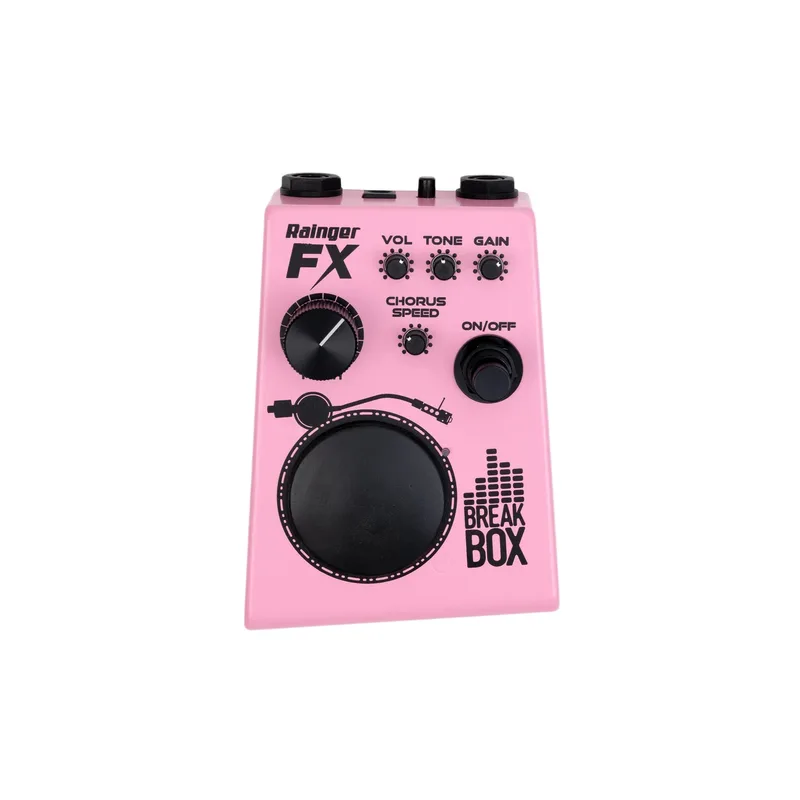
The Pull Focus is a development of earlier Rainger FX designs. Rainger FX says it "been developed from our Break Box pedal - but without the vinyl scratch, and with a reverb option"1. The Break Box, released in November 2022, combined the same distortion core with the chorus fade-in and a guitar-triggered record-scratch effect; the Pull Focus drops the scratch and adds the reverb choice.
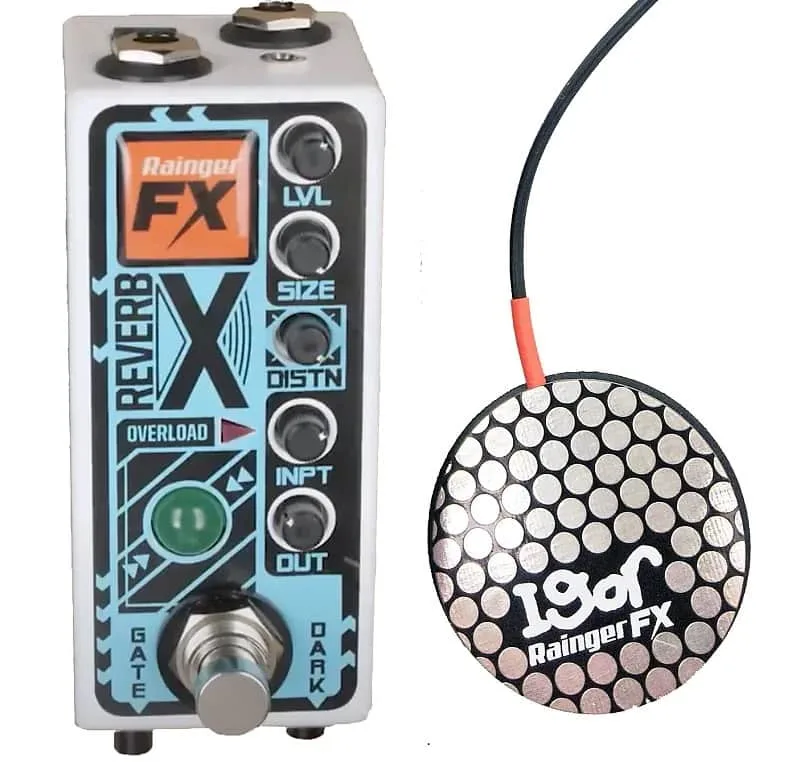
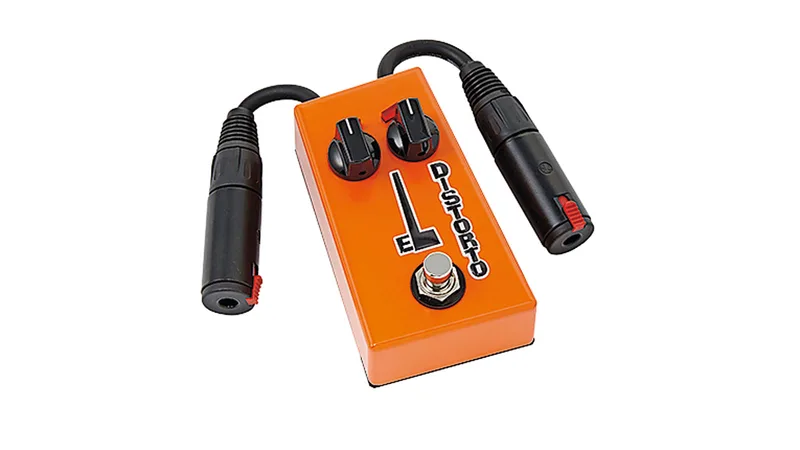
The distortion circuit itself has a longer lineage. Rainger FX describes it as the maker's favorite overdrive circuit, from the Reverb-X and El Distorto, going into the back end of the Tonebender circuit made for Colorsound1. Guitar Pedal X's reviewer, Stefan Karlsson, traced it similarly, calling it "a distortion and tone stack evolved from David's El Distorto (2011)"2. The Reverb-X, a UK-built mini pedal introduced at NAMM 2018 and based on the FV-1 reverb chip, contributes that overdrive circuit4.
Guitar Pedal X went on to name the Pull Focus among the best new distortion pedals of 2024, calling it:
"A real greatest hits of a Rainger FX pedal - featuring elements of the Freakenbender, El Distorto, Break Box, and Reverb-X."
Enclosure and practical details
The Pull Focus sits in a custom Rainger FX desk-style enclosure with a slight flare, symmetrical, with graphics by Rich Dimaio. Rainger FX notes the symmetry is "to help all our OCD musician friends"1. It is true bypass and draws about 60mA1.
Rainger FX's own listing prices the pedal at £199.00, with UK buyers paying £238.80 including VAT and entitled to free shipping but liable to that VAT1. Press listings at launch gave the price as $239 in the US, £239 in the UK and €289 in the EU2.
Videos
Rainger FX
SpiralCasterPlaysPedals
ambienttrash
News
Questions
Is the Rainger FX Pull Focus true bypass?
Yes. Rainger FX states the Pull Focus is true bypass, so with the pedal off your dry signal passes through without buffering or coloration. It also has custom-designed knobs and a built-in noise gate that keeps the pedal silent when you are not playing.
Is the Pull Focus analog or digital?
It is a hybrid. The distortion path is all analog, while the reverb, chorus and the fade-in ramp that brings them in are all digital. A switch on the pedal selects whether the faded-in effect is a chorus or a digital reverb.
Can you adjust the chorus depth on the Pull Focus?
No. Rainger FX says the chorus depth is not adjustable and is set to be as noticeable as possible. The effect knob adjusts chorus speed, and on the reverb setting it adjusts both the length and the amount of reverb together.
How much current does the Pull Focus draw?
Rainger FX lists the current draw as about 60mA. That is modest by digital-pedal standards, but it is more than a simple analog distortion box, so plan your power supply accordingly.
What is the difference between the Pull Focus and the Break Box?
The Pull Focus was developed from the Break Box but drops the guitar-triggered vinyl scratch effect and adds a reverb option alongside the chorus. Both share the same distortion core and the chorus fade-in concept, but the Pull Focus lets you choose chorus or reverb.
Sources (5)
- PULL FOCUS, Rainger FX
- Guitar Pedal X, Guitar Pedal X, 2024-09-17
- Rainger FX Pull Focus Distortion + Chorus/Reverb, Delicious Audio, 2024-11-08
- Rainger FX Introduces the Reverb-X, Premier Guitar, 2018-01-19
- Guitar Pedal X, Guitar Pedal X, 2024-12-17