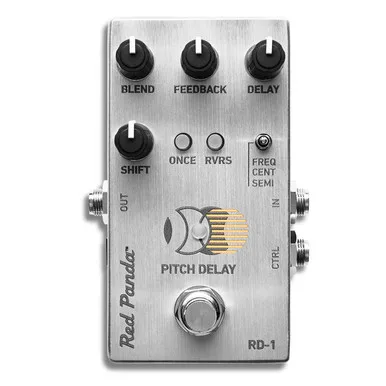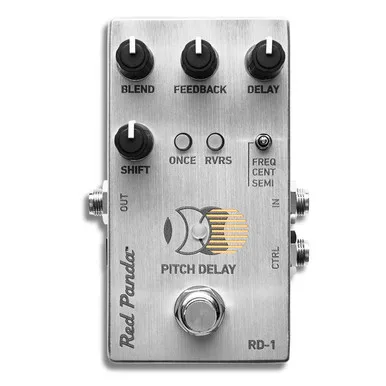


The Red Panda RD-1 Pitch Delay is a compact delay pedal that puts pitch shifting and frequency shifting inside a delay line. It is built on the same algorithm as Red Panda's Raster, but stripped of the menus and deep editing, so everything happens under your hands on the knobs123. It was introduced by Curt from Red Panda at their NAMM booth in January 2025 as a streamlined, pitch-shifting and frequency-shifting delay pedal, expected on shelves mid-year at a price point around $1991.
The core idea is a pitch shifter that operates either inside or outside the feedback loop, so repeats can shift continuously and evolve into textures, or shift once and hold. The pedal runs forward and reverse delay modes, switchable swiftly, with 1200 ms of forward delay time and 2400 ms in reverse for extended, atmospheric effects12.
Power and connections
The RD-1 runs on 9V DC and draws 150 mA. Its panel of ports covers everything a pedalboard needs: a CTRL / Tap Tempo jack, a TS input, USB-C, a TS output and the 9V DC power jack6.
The CTRL input is the pedal's expansion point. It takes an expression pedal or a tap tempo switch, so you can sweep parameters in real time or set delay time with your foot3. Guitar.com's review also notes a hidden tap-tempo option built into the pedal itself4.
The RD-1 is mono, with a single TS output, though it handles line-level signals6. Players running stereo rigs will not find a second output here; the Raster 2 is Red Panda's stereo delay with pitch shifter7.
Controls and modes
The control set is deliberately simple. You get standard controls for time, feedback and dry/wet blend, plus the pitch shifting controls, with a hidden tap-tempo option4. Red Panda designed the knobs for live, real-time tweaking: rubber knobs with raised pointers, so you can find and turn them without looking down1.
The pedal's three shift modes cover frequency shifting, detuning and chromatic transposing1, and it lets you swiftly switch between forward and reverse modes1. Delay time runs up to 1200 ms, doubled in reverse for extended, atmospheric effects2.
History: a simpler take on the Raster
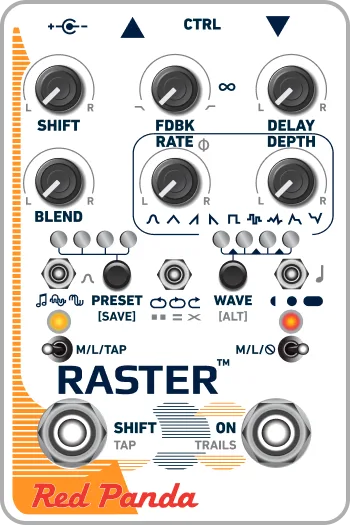
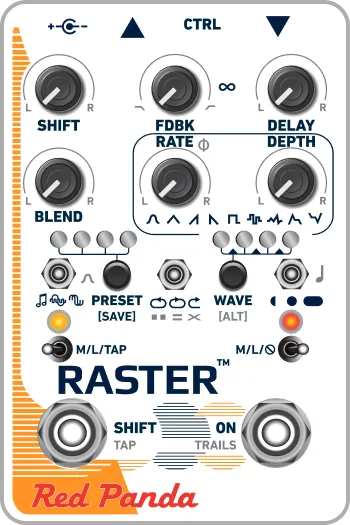
The RD-1 comes directly out of Red Panda's Raster line. The original Raster, described in Red Panda's own manual as "a digital delay with a pitch shifter integrated into the feedback loop," set the template: repeats that shift in pitch as they recycle86. Even in 2015, its launch press noted that the delay could be minimized to use the Raster as an old-school pitch shifter9. The Raster 2 later expanded the concept into a stereo delay with pitch shifter drawing 250 mA on 9V DC7.
The RD-1 reverses that direction. Where the Raster was Red Panda's deep-dive pitch delay, the RD-1 uses the same algorithm without the complexity13. Guitar.com's reviewer, Richard Purvis, describes it as designed "as an alternative to the Red Panda Raster 2 for more compact pedalboards"4. Curt from Red Panda put it plainly at NAMM: the RD-1 is a streamlined pitch-shifting and frequency-shifting delay pedal1.
What reviewers said
Published reviews agree on what the RD-1 is and who it is for:
- Guitar Pedal X (April 2026): coverage of the RD1 noted Red Panda's announcement that the pedal was expected to hit the shelves mid-year, at an accessible price point around $19961.
- Delicious Audio (June 2026): reported the pedal's core design, a pitch shifter that operates either inside or outside the feedback loop, enabling continuous or single repeat shifts for evolving textural repeats1.
- Pedal of the Day (July 2026): described the pitch shifter's placement inside or outside the feedback loop as the feature behind its evolving, textural repeats1.
- Guitar.com (August 2026): noted the RD1's announced mid-year arrival and its target price of around $1991.
"What you get is a pitch-shifting delay stripped down to essentials."
The trade-offs reviewers point to are consistent: no presets, no stereo output, no MIDI34. What you gain is a clean control topology and immediate access to the Raster's pitch-shifting delay sound in a smaller, more affordable box64.
RD-1 or Raster?
If you want the full pitch-delay experience with stereo output and deeper editing, the Raster 2 remains Red Panda's deep-dive pitch delay37. If you want that sound world at half the complexity, on a compact board, with knobs instead of menus, the RD-1 is the simpler, more affordable mono variant64.
Videos
Premier Guitar
Red Panda Lab
collector//emitter
Questions
What power supply does the Red Panda RD-1 need?
The RD-1 runs on 9V DC and draws 150 mA. It connects through a standard set of ports: a TS input, a TS output, a CTRL / Tap Tempo jack, a USB-C port and the 9V DC power jack. A typical isolated 9V pedalboard supply covers it.
Does the Red Panda RD-1 have tap tempo?
Yes. Tap tempo is available through the CTRL input, which also accepts an expression pedal. Guitar.com's review also notes a hidden tap-tempo option, so you can set delay time on the fly without touching the Time knob.
Is the Red Panda RD-1 stereo?
No. The RD-1 is configured for mono, with a single TS output, though it handles line-level signals. Players who need stereo delay would instead look at the Red Panda Raster 2, which is a stereo delay with a pitch shifter.
How long is the delay time on the RD-1?
Delay time runs up to 1200 ms in forward mode, and the reverse mode doubles that to 2400 ms for longer, more atmospheric repeats. The Time knob gives standard control over delay length.
What is the difference between the Red Panda RD-1 and the Raster?
The RD-1 uses the same algorithm as the Raster but without the complexity. It is a mono, knob-driven pedal with no menus, aimed at compact pedalboards and real-time tweaking, while the Raster 2 offers stereo output and a deeper feature set.
Does the Red Panda RD-1 have presets?
No. The RD-1 has no presets and no stereo output. It is designed around hands-on control, with rubber knobs and raised pointers for live tweaking rather than stored settings.
Sources (9)
- NAMM 2025: Red Panda RD1 Pitch Delayer, Sonic State, 2025-01-25
- Red Panda RD-1 Pitch Delay, Pedal of the Day, 2026-07-10
- Red Panda RD-1 Pitch Delay, Delicious Audio, 2026-06-23
- Red Panda RD-1 Pitch Delay review, guitar.com, 2026-08-17
- RD-1 Pitch Delay, Red Panda Lab
- Guitar Pedal X, Guitar Pedal X, 2026-04-02
- Raster 2 Owners Manual.pdf, Red Panda LLC, 2022-06
- raster_instructions.pdf, Red Panda Lab, 2017
- Stompbox Delivers Delay With Pitch Shifting, Sonic State, 2015-04-29