

The Roger Mayer Stone Fuzz is a two-control fuzz pedal from Roger Mayer, the designer best known for the fuzz and octave circuits he built and modified for Jimi Hendrix. Mayer describes it as "a modern evolution from the fuzz pedals I modified for Jimi", and as "a very heavy sounding fuzz with roots that go back to the early fuzzes Jimi used but is not a clone of the old Fuzz Face"1. It is aimed at players who want a heavy, high gain fuzz in that early lineage rather than a straight reproduction of a vintage unit.
What it does and where it came from
Mayer's own description, quoted when the circuit circulated among builders, says: "I have used the same basic transistor configuration but with several new innovations applied to the very basic circuit that was used then"1. He also describes the new Stone Fuzz as "a very Low Noise high gain design, stable, free from radio and other electronic interference"1. In other words, the goal was the spirit of the early fuzzes with modern noise and stability behavior, not a part-for-part copy.
Builders comparing the topology have placed it closer to a Tone Bender than a Fuzz Face. One commenter on the layout thread put it this way: "The design is not that far off a Vox tonebender overall which has a 1K fuzz pot then a series 820 ohm resistor in place of the 2K pot on this one"1. Another reader disputed the resistor reading, suggesting a 1K value would be more in keeping with this type of fuzz, so the exact component values as read from the circuit are not settled among builders1.
The controls
The Stone Fuzz keeps things simple, with two knobs:
That is the whole control set: no tone knob, no bias trim on the face of the unit. Players used to three-knob fuzzes will set the Drive to taste and balance the Output Level against their clean volume1.
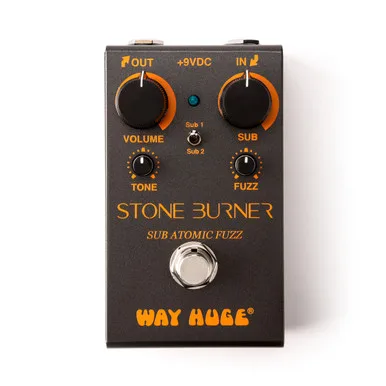
A related pedal with a similar name and purpose is the Way Huge Smalls Stone Burner Sub Atomic Fuzz, whose manual describes its VOLUME knob as adjusting the "level of fuzz effect"2. The two are different products from different makers, but both place a single level control against a fuzz drive control.
Power and bypass
The Stone Fuzz runs on an internal 9 Volt battery, and builders report the circuit will not run properly with power polarity reversed1. If you use a power supply rather than a battery, polarity matters here in a way it does not on pedals designed for reversed center-negative or center-positive operation.
The pedal features Hard Wire Bypass/True Bypass according to Mayer's description1, so when it is off, your guitar signal does not pass through the fuzz circuitry.
What builders and players found
The Stone Fuzz circuit circulated widely as a DIY stripboard project after a layout was posted on the Guitar FX Layouts blog in March 2014, and the comments there are the main published record of how the circuit behaves outside Mayer's own units1.
- On the genuine pedal, one commenter who had played an original unit said: "Nothing as revolutionary as the description suggests but a very good sounding one"1.
- On transistor choice, one builder concluded the circuit "works pretty well being PNP, but sucks when it's NPN"1. The same builder reported that BC307, BC309 and BC560C PNP transistors "all seem to work pretty well", while 2N2222A, 2N3904, BC548B and C, BC549B and C, and BC550B and C "all sound gated and splatty"1.
- Another builder who first tried an NPN version with BC550, BC549 and 2N3093 transistors said it "sounds awful and nothing like the original. it's a splatty, heavily gated mess", then reported that running it as PNP with BC560C transistors "sounds great"1.
- A different builder tried BC559, BC557 and BC560 PNP types and found they "all sound like a rough silicon fuzz, nowhere near the sound on the vids"1, so even among PNP builds opinions varied.
- One builder with a PNP BC559B build simply said "I like this fuzz sound"1.
For anyone building the circuit, the thread also records measured bias points: one PNP build with BC559B transistors measured Q1 at C -1.3, B -0.6, E 0v and Q2 at C -2.5, B -1.3, E -0.71, and an NPN breadboard with a BC549C at a battery reading of 8.88v and the Q1 collector trim set at 33k measured Q1 e 0v, b 0.56v, c 1.23 and Q2 e 0.59v, b 1.23v, c 2.39v1. One commenter who obtained an original unit reported it uses a 10nF capacitor in a spot builders had been guessing at1.
Videos
Ron Houben
Shari Pedals
Questions
Is the Roger Mayer Stone Fuzz true bypass?
Yes. Roger Mayer's description of the Stone Fuzz states that it features Hard Wire Bypass/True Bypass, so the pedal takes itself out of the signal path entirely when switched off. Builders discussing the circuit on the Guitar FX Layouts blog repeat the same bypass description, and it is one of the features Mayer lists alongside the pedal's low noise, high gain design.
Does the Roger Mayer Stone Fuzz use a battery?
Yes. According to Roger Mayer's description, the Stone Fuzz is powered by an internal 9 Volt battery with an operational life of over 150 hours, so changing a battery should not be a frequent chore. Builders also note that the circuit will not run properly with power polarity reversed, which matters if you plan to power it from a supply.
Is the Stone Fuzz a Fuzz Face clone?
No. Roger Mayer describes it as a very heavy sounding fuzz with roots that go back to the early fuzzes Jimi used, but says it is not a clone of the old Fuzz Face. He says he used the same basic transistor configuration with several new innovations applied to the very basic circuit that was used then.
Should the Stone Fuzz use PNP or NPN transistors?
Builders who have reproduced the circuit report that it works well with PNP transistors but poorly with NPN types. One builder tried BC307, BC309 and BC560C PNP transistors and found they all work pretty well, while a list of NPN types including 2N2222A, 2N3904 and BC548 to BC550 variants were reported to sound gated and splatty.
Does the Stone Fuzz work with reversed power polarity?
No. The Guitar FX Layouts post carrying the stripboard layout was edited to note that this circuit will not run properly with polarity reversed. Unlike many classic fuzz designs that tolerate or even expect a reversed supply, the Stone Fuzz needs its power the right way round.
Sources (2)
- Guitar FX Layouts: Roger Mayer Stone Fuzz, tagboardeffects.blogspot.com, 2025-02-10
- WM81.pdf, Jim Dunlop, 2023