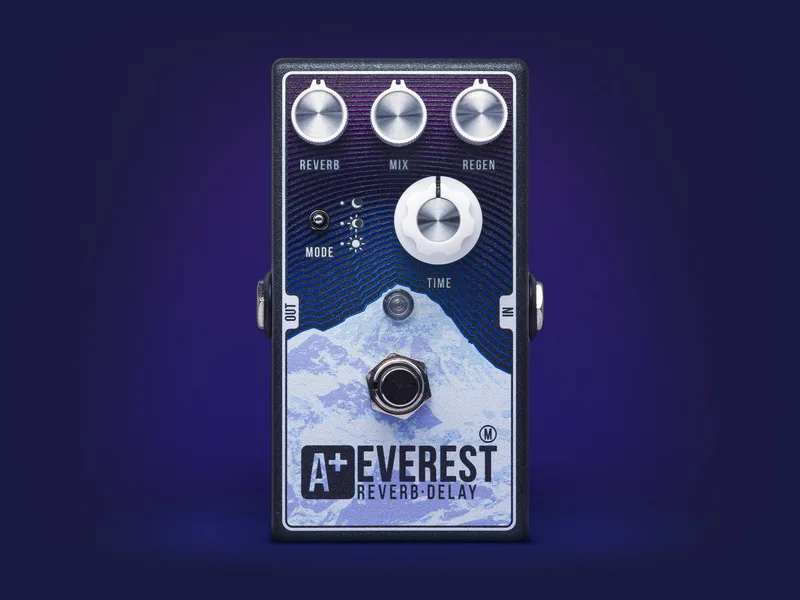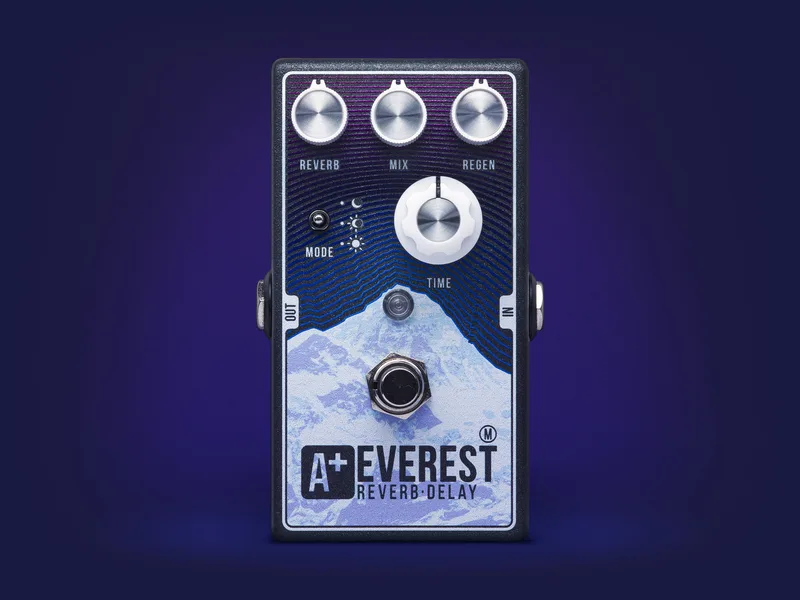


The Shift Line A+ Everest M is a compact reverb and delay pedal, a new revision of the maker's Everest reverb/delay pedal1. It offers six reverb and delay modes in two banks behind a simple knob-and-switch interface: three in Bank 1 on the MODE switch with a blue LED, and three more in Bank 2, reached by holding the BYPASS switch while selecting an algorithm, with a red LED1. Holding the BYPASS switch also puts the pedal into Infinity Mode, its infinite sustain mode1.
The controls
The Everest M keeps its surface simple: four knobs, one toggle and one footswitch. The REGEN knob simultaneously controls delay feedback and reverb decay, and the TIME knob controls delay time and affects reverb decay for effect sync, which is what lets the pedal stay this small1.
| Control | What it does |
|---|---|
| MODE switch | Selects one of the six reverb/delay algorithms1 |
| TIME knob | Sets delay time and affects reverb decay so the effects stay in sync; fully counterclockwise disengages the delay1 |
| REGEN knob | Simultaneously controls delay feedback and reverb decay1 |
| REVERB knob | Controls reverb volume; fully counterclockwise disengages the reverb1 |
| MIX knob | Controls the volume of the wet signal1 |
| BYPASS switch | Press once for on/off; press and hold for Infinity Mode; press and hold while selecting an algorithm to reach Bank 21 |
Because TIME and REGEN are shared, the delay and reverb interact: dialing in a longer delay time also stretches the reverb decay, and the REGEN knob feeds both at once. Turning REVERB or TIME fully counterclockwise lets you run the pedal as a delay-only or reverb-only box1.
Six algorithms in two banks
The algorithms are split into two banks of three sounds each. Bank 1 holds extended versions of the original Everest algorithms, with access to Infinity Mode; Bank 2 contains new sounds1. The original Everest carried three modes, described by Shift Line as "bright and cutting Sunshine, mild and woozy Eclipse, whirly and psychedelic Moonshine"2, and those three characters carry over into the M's first bank.
Bank 1 (blue LED, MODE switch alone)1:
- Moonshine (Up): initial delay repeats and reverb reflections are accompanied by octave sounds for a weird, otherworldly effect1
- Eclipse (Center): modulated delay repeats and solemn reverb reflections1
- Sunshine (Down): bright and cold delay and reverb1
Bank 2 (red LED, MODE switch held while BYPASS is pressed)1:
- Low (Up): a loud lower octave with a long decay mixed into the reverb reflections, together with filtered delay repeats, creating a powerful low-frequency pad1
- Tape (Center): modulated tape-style delay with characteristic repeat degradation, accompanied by dark vintage reverb1
The maker's page describes the Bank 1 sounds in character terms: of Sunshine it says "The delay and reverb in this mode are so bright and cold they will send shivers down your spine!"1, and of Eclipse, "Modulated delay repeats and solemn reverb reflections make for a perfect soundscape of the Himalayas at dusk"1.
Infinity Mode
Press and hold the bypass switch for more than 0.3 seconds and the Everest M enters Infinity Mode, which simulates turning the REGEN knob to the max1. What happens depends on the algorithm:
- Reverbs become infinite or very long, lasting 2 to 5 minutes1
- Delays go into maximum feedback1
- The LED flashes in two colors while the mode is active1
Release the switch and REGEN returns to wherever the knob is set1. It works as a performance tool: kick the switch mid-phrase for a swell of endless reverb or a self-oscillating delay, then let go to drop back to your dialed-in sound.
Power and connections
The Everest M runs on 9V DC at up to 80mA, negative tip, through a 2.1/5.5mm jack, and Shift Line specifies a regulated PSU only1. The maker notes that the current draw may reach 80mA, so battery life would be unlikely to exceed one or two hours even if battery power were an option, and a matching power supply is recommended for regular use1.
The Everest M cannot be battery powered and requires a regulated 9V DC supply with a negative tip1. Players using daisy-chain supplies should make sure the chain can deliver the pedal's draw cleanly.
The pedal is mono throughout: one mono unbalanced input at 1MOhm input impedance, one mono unbalanced output at 100Ohm output impedance1. It uses active bypass rather than true bypass; Shift Line says the dry signal is unaffected and that the active design means there is no audible clicking1.
Everest M and Everest II
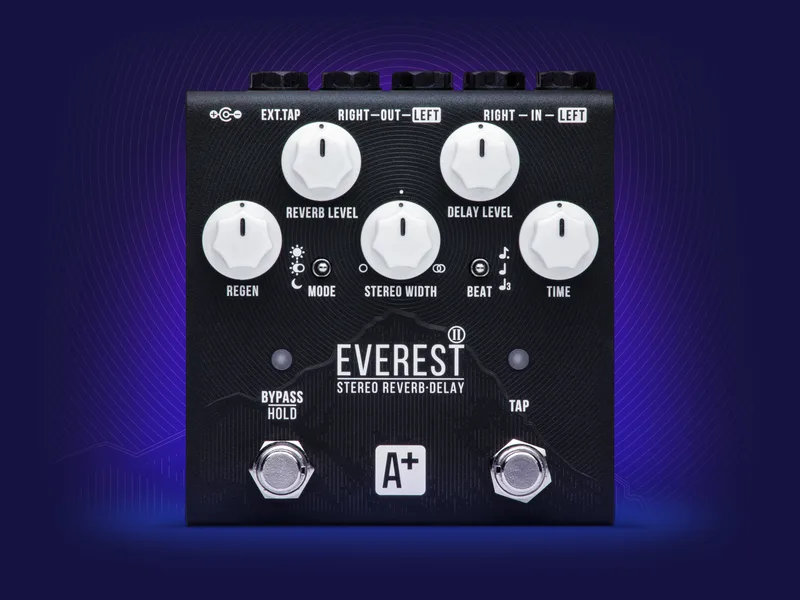
The Everest M is a new revision of the Everest reverb/delay pedal1. Its signal path is mono throughout: a single unbalanced input at 1MOhm impedance and a single unbalanced output at 100Ohm impedance1. Its six modes are split across two banks, with the second bank reached by holding the BYPASS switch while selecting an algorithm1.
| Everest M | Everest II | |
|---|---|---|
| Algorithms | 6, in two banks1 | 12 directly accessible3 |
| Connections | Mono in, mono out1 | MONO, MONO TO STEREO, STEREO/DUAL MONO, DOUBLE PROCESSING3 |
| Power | 9V DC, 80mA, regulated PSU only1 | 9 to 12V universal intake, 100 to 150mA3 |
| Extra controls | None beyond the four knobs and MODE | BEAT switch for subdivisions: UP 3/4 (dotted eighth), CENTER 1/1 (quarter), DOWN 2/3 (quarter triplet)3 |
| Status | Discontinued1 | Black Edition discontinued3 |
The II's MODE switch selects both bank and patch, and its BEAT switch adds delay subdivisions the M does not have3. Both the Everest M and the Everest II Black Edition are listed by the maker as discontinued13, so both are now found on the secondhand market rather than new.
Videos
Chords Of Orion
Brett Kingman
ShurSoma
Questions
Can the Shift Line Everest M run on a battery?
No. The Everest M takes 9V DC at up to 80mA through a 2.1/5.5mm center-negative jack, and Shift Line specifies a regulated power supply only. The maker notes that even if a battery were used, the current draw would limit battery life to an hour or two at most, so a matching PSU is recommended for regular use.
Is the Everest M true bypass?
No. The Everest M uses active bypass rather than true bypass. Shift Line says the dry signal is unaffected in bypass and that the active design means there is no audible clicking when switching the effect on and off.
Is the Shift Line Everest M stereo?
No. The Everest M has a single mono unbalanced 6.3mm input with 1MOhm input impedance and a single mono unbalanced 6.3mm output with 100Ohm output impedance. Stereo operation arrived with its successor, the Everest II, which offers mono, mono-to-stereo, stereo/dual mono and double processing connection modes.
Is the Everest M discontinued?
Yes. Shift Line lists the A+ Everest M as discontinued. The line continued with the Everest II, released in September 2023 as a stereo evolution of the mono Everest M, and the Everest II Black Edition, which is also listed as discontinued.
What is the difference between the Everest M and Everest II?
The Everest II is described by Shift Line as the result of the Everest M evolution. It is stereo rather than mono, offers 12 directly accessible algorithms instead of six, adds a BEAT switch for delay subdivisions, tap tempo and a width control, and runs on a universal 9 to 12V power intake drawing 100 to 150mA.
Sources (3)
- A+ Everest M, Shift Line, 2026
- A+ Everest, Shift-Line, 2026
- A+ Everest II Black Edition, Shift-Line, 2026