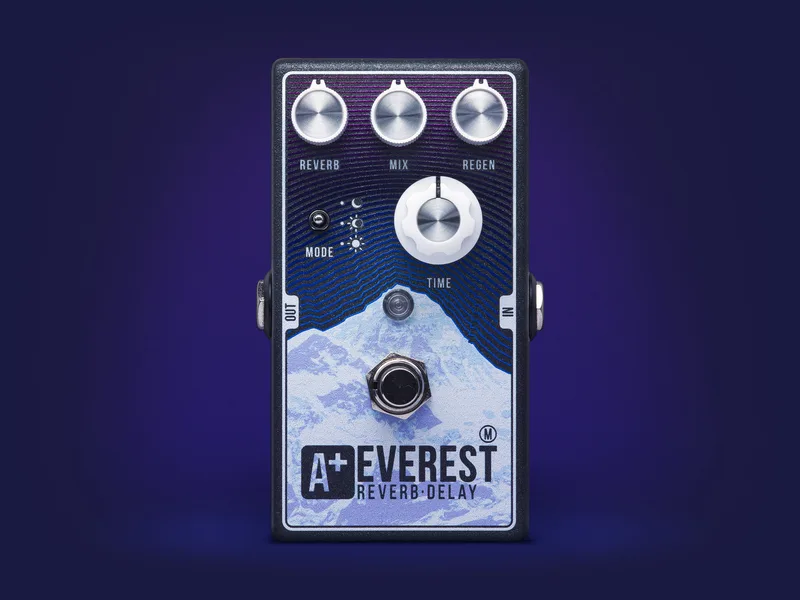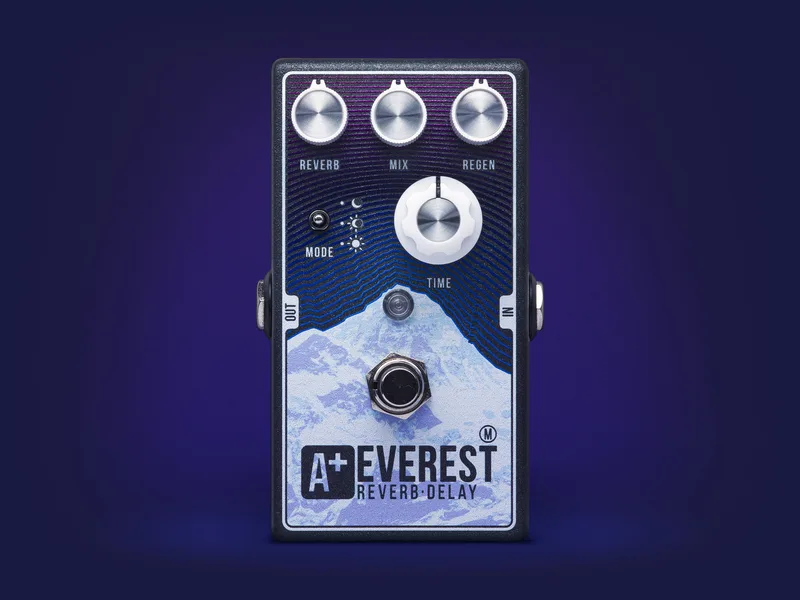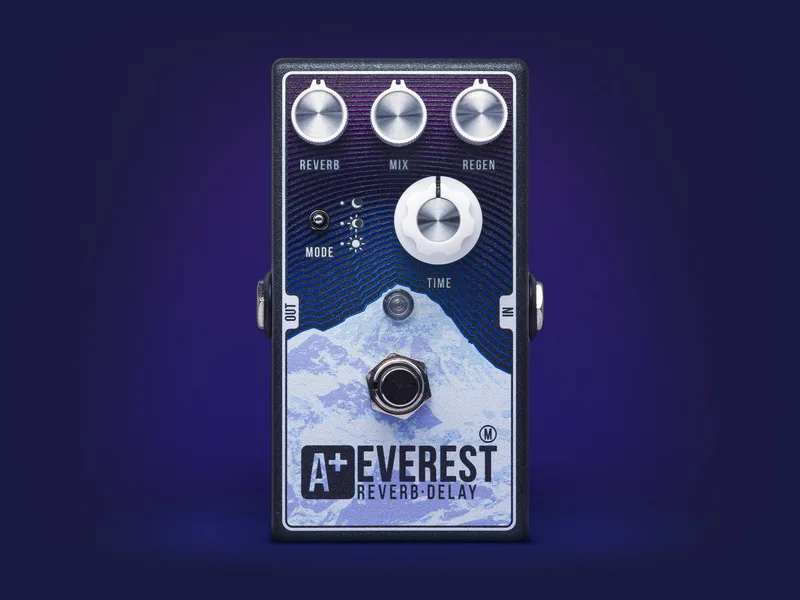


The Shift-Line Everest is a reverb and delay pedal from Russian manufacturer Shift-Line, and its defining idea is that the two effects run in parallel rather than in series. Delay and reverb can be used separately or together, and because each has its own volume control, the pedal gives nine sound options: reverb, delay, or reverb plus delay in each of its three modes1.
The pedal's current draw may reach 70mA, and it uses an all-analog dry path, which means the dry signal is unaffected by the digital circuitry1. It has buffered bypass with optional tails1.
Reverb and delay in parallel
Most reverb/delay pedals chain the two effects, so the delay repeats feed into the reverb. The Everest runs them side by side, so each effect gets the full input signal and its own level in the mix. Delicious Audio, covering the pedal in 2019, described it as "delay and reverb running in parallel, with three modes providing access to an immense sonic palette"1.
The three modes each color both effects:
Because the reverb and delay each have a volume control, either effect can be dialed out completely. The REVERB knob controls the reverb's volume; turn it fully counterclockwise to disengage the reverb1. The result is nine combinations from one pedal, from reverb alone to full parallel wash.
Controls
The Everest keeps its control set compact. The REGEN knob simultaneously controls delay feedback and reverb decay, so one knob sets how long the whole ambient tail sustains3. The MODE switch selects one of the six reverb/delay algorithms on the later Everest M, and on the original Everest it moves between the three modes3.
The Everest runs on a battery, but Shift-Line says battery life is unlikely to exceed 1 or 2 hours, and strongly recommends a matching PSU for regular use1.
Power
The Everest runs on a battery, but not for long. Battery life is unlikely to exceed 1 or 2 hours, so for regular use a matching power supply is strongly recommended1. The pedal's current draw may reach 70mA1.
The Everest can run on a battery, but Shift-Line says battery life is unlikely to exceed 1 or 2 hours, so for regular use the maker strongly recommends a matching PSU1.
Versions: Everest M, Everest II and the Black Edition
The Everest line evolved through several revisions, all now discontinued.
| Version | What changed | Status |
|---|---|---|
| Everest | Original mono reverb/delay pedal, three modes12 | Discontinued2 |
| Everest M | New revision of the Everest reverb/delay pedal3 | Discontinued3 |
| Everest II | Stereo reverb-delay, new architecture with completely reworked algorithms45 | Discontinued5 |
| Everest II Black Edition | Black finish of the Everest II6 | Discontinued6 |
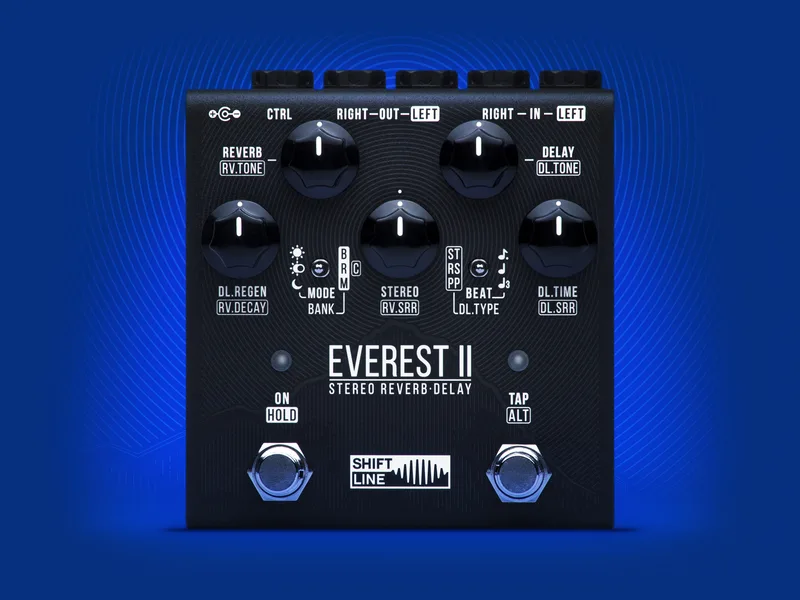
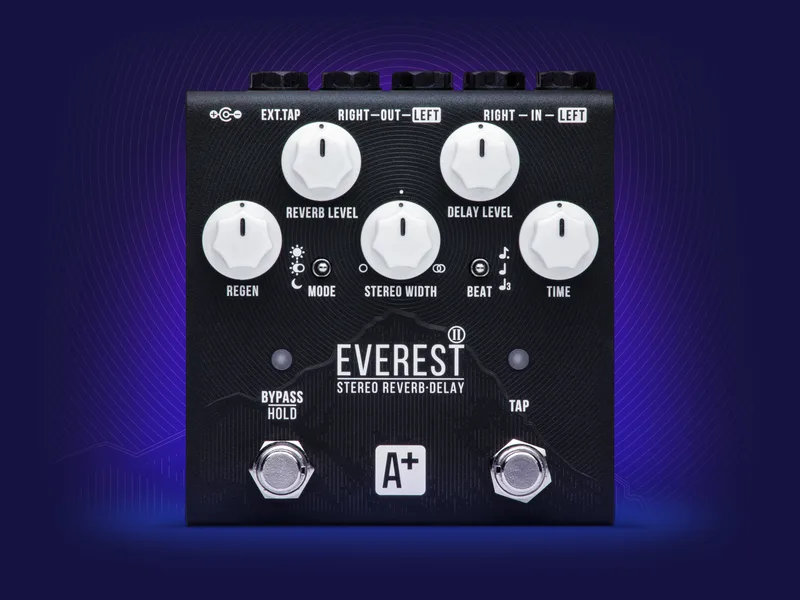
Shift-Line released the Everest II on 8 September 2023 as a stereo evolution of the mono Everest M7. Like the original, the II keeps an all-analog dry path, so the dry signal is unaffected15, and the MODE switch now selects a bank and patch rather than a single mode5.
The Everest II's BEAT switch sets the tap division: UP is 3/4 (dotted eighth note), CENTER is 1/1 (quarter note), DOWN is 2/3 (quarter note triplet)5. Its BYPASS footswitch is multi-function: press once for on/off, press and hold for Hold Mode, press twice to recall the Favorite preset, and hold it while moving the MODE or BEAT switches to select the bank or the bypass mode5. Delicious Audio described Hold Mode as "infinite sustain with a gradual shift into self-oscillation"7.
The Everest II keeps the original's reverb control approach: the REVERB knob controls the reverb's volume, and turning it fully counterclockwise disengages the reverb1.
Bypass and the dry signal on the Everest II
The Everest II uses active bypass rather than the original's buffered bypass. Shift-Line says that because of the active bypass there is no audible clicking, and three global bypass modes are selectable by holding the BYPASS footswitch while pressing the BEAT switch6. An LED above the footswitch shows the mode: Red for No Tails, Blue for Tails, White for Kill Dry with Tails5.
Kill Dry with Tails removes the dry signal completely from the output, which Shift-Line recommends for wet-dry-wet processing or external wet/dry mixing setups5. The II's maximum delay time is 1 second, or 2 seconds in ping-pong mode in a mono setup5, up from the original's 0.85 seconds1. One quirk worth knowing: the first 5% of the TIME knob's range has no effect on delay time, which allows delay filtering without repeats5.
Videos
Chords Of Orion
Brett Kingman
AFX
Questions
Can the Shift-Line Everest run on a battery?
The original Everest can take a battery, but battery life is unlikely to exceed 1 or 2 hours, so a matching power supply is strongly recommended for regular use. The later Everest II versions cannot be battery-powered at all and require a regulated power supply with a 2.1/5.5mm center-negative connector.
Is the Shift-Line Everest true bypass?
No. The original Everest uses buffered bypass with optional tails. The Everest II uses active bypass with switchable tails, which Shift-Line says eliminates audible clicking when switching, and offers three global bypass modes: No Tails, Tails, and Kill Dry with Tails.
How long is the maximum delay time on the Everest?
The original Everest reaches a maximum delay time of 0.85 seconds. The Everest II extends this to 1 second, or 2 seconds in ping-pong mode in a mono setup.
Does the Everest color my dry signal?
No. The original Everest uses an all-analog dry path, so the dry signal passes through unaffected. On the Everest II, the Kill Dry with Tails bypass mode removes the dry signal entirely from the output, which Shift-Line recommends for wet-dry-wet processing or external wet/dry mixing setups.
Is the Shift-Line Everest II still made?
No. Shift-Line lists the Everest II, the Everest II Black Edition, and the Everest M as discontinued products. The Everest II grew out of the Everest M, itself a revision of the original Everest reverb/delay pedal.
Sources (7)
- Shift-Line Everest M Reverb + Delay, Delicious Audio, 2019-01-23
- A+ Everest, Shift-Line, 2026
- A+ Everest M, Shift Line, 2026
- A+ Everest II Ver.1, Shift-Line, 2026
- A+ Everest II Original, Shift-Line, 2026
- A+ Everest II Black Edition, Shift-Line, 2026
- Shift-Line Everest II Reverb + Delay, Delicious Audio, 2023-09-08