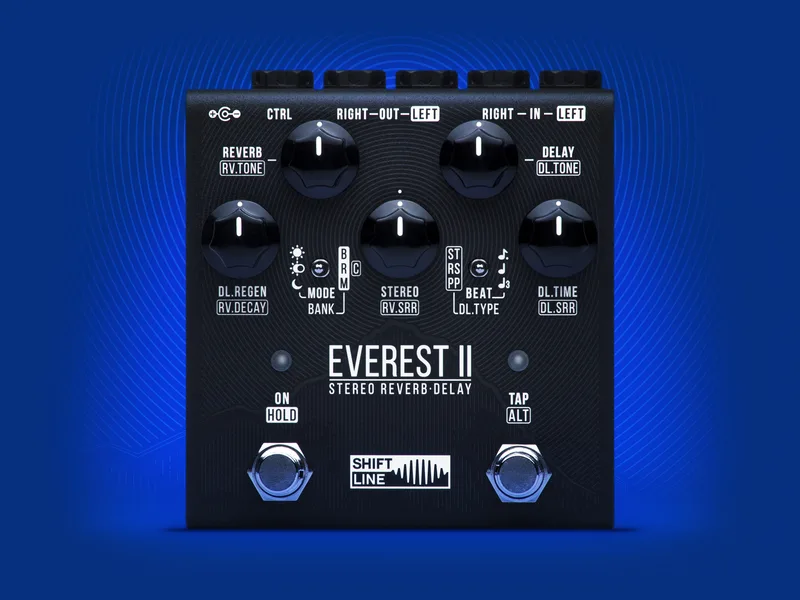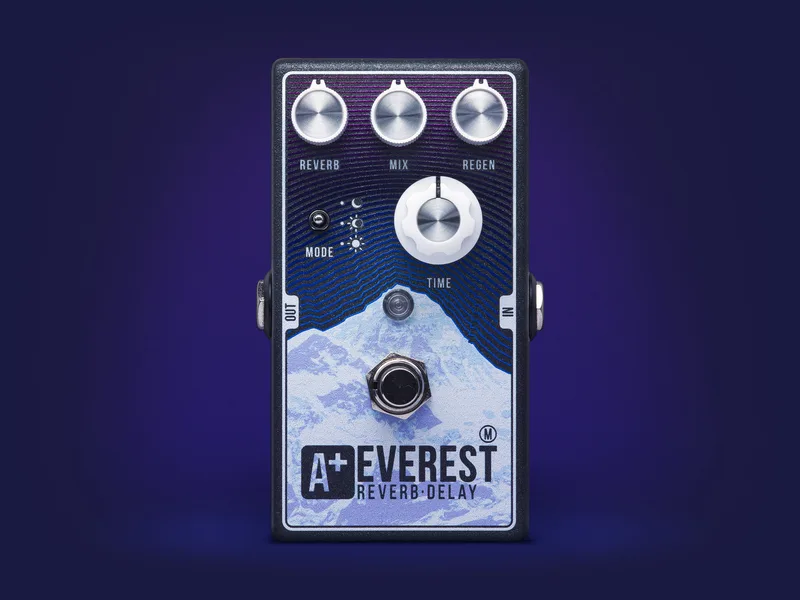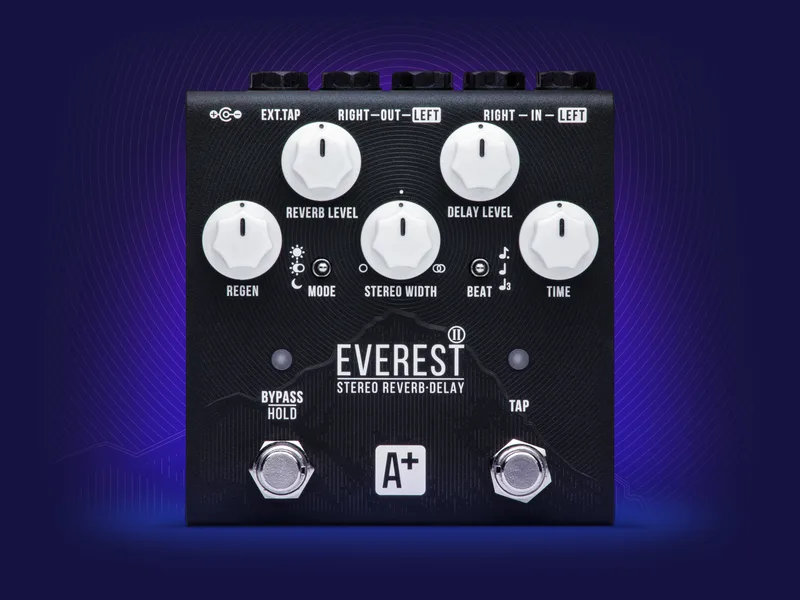



The Shift-Line A+ Everest II Black Edition is a stereo reverb and delay combined in one compact pedal. It offers 12 directly accessible algorithms, with a fully analog dry signal chain and digital processing on the wet side, housed in a lightweight and compact aluminum enclosure with top-mounted jacks1. The maker says the pedal is suited for use with any kind of instrument: guitar, bass, synths, drums, or anything else1.
The pedal carries 12 directly accessible algorithms, organized into banks selected by the MODE switch, and keeps the dry signal path fully analog while the wet side is digital1. Delay and reverb run in parallel, so either effect can be added to the mix at a desired level or turned off, a layout carried over from the Everest M2.
Shift Line marks the A+ Everest II Black Edition as discontinued, as it does the Everest M12. It appears here as a reference for players comparing used units or later Shift Line designs.
A stereo reverb and delay in one pedal
The Everest II Black Edition puts both effects in one box with a shared control set. The delay reaches a maximum of 1 second, or 2 seconds in ping-pong mode in a mono setup1. New additions over the Everest M include a stereo mode with width control, a dual mono mode, tap tempo with external control, and an improved hold mode1.
The 12 algorithms are grouped into banks, each patch pairing a delay character with a reverb character1:
| Bank and position | Patch | Character |
|---|---|---|
| Red Bank, UP | Digital | Clean delay repeats with no audible degradation, like vintage digital delay machines, coupled with bright reverb reflections1 |
| Magenta Bank, UP | Iceman | Bright delay and reverb with 80s-style modulation based on flanging and a resonant filter; the reverb omits low frequencies1 |
| Blue Bank, UP | Sunshine | Bright, cold delay and reverb1 |
| Blue Bank, CENTER | Eclipse | Modulated delay repeats and solemn reverb reflections1 |
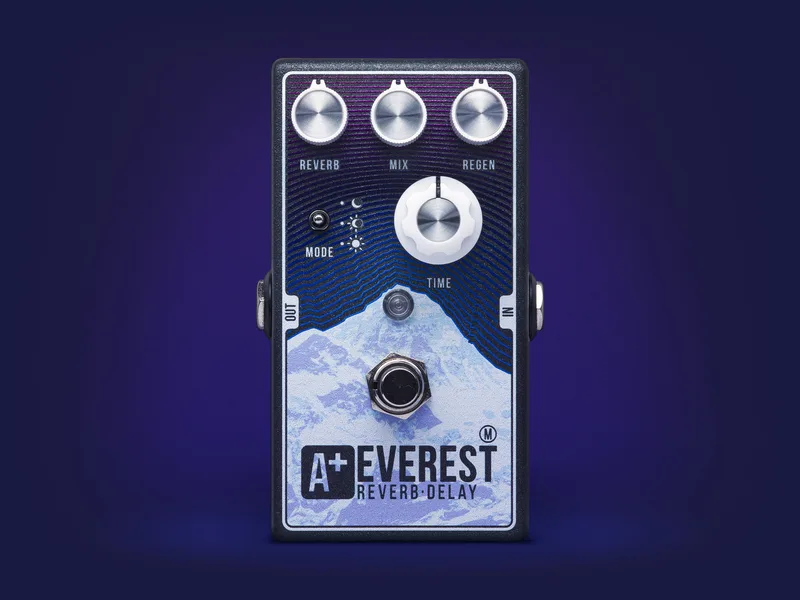
The Eclipse patch also appears on the Everest M, where Shift Line describes it as "a perfect soundscape of the Himalayas at dusk"2.
Controls
| Control | What it does |
|---|---|
| REVERB LEVEL | Reverb volume in the wet signal; fully CCW disengages the reverb1 |
| DELAY LEVEL | Delay volume in the wet signal; fully CCW disengages the delay1 |
| REGEN | Simultaneously controls delay feedback and reverb decay1 |
| TIME | Delay time; fully CCW disengages the delay but keeps the filters on the repeats, and the first 5% of the range has no effect on delay time1 |
| STEREO WIDTH | Stereo image width; turned while holding TAP it controls overall brightness of the wet signal1 |
| MODE | Selects the bank and patch1 |
Because delay and reverb run in parallel, a player can pull either effect out of the mix entirely with its level knob and still use the other, or run both together2.
Power, MIDI and connections
The pedal runs on a universal 9 to 12V power intake, which Shift Line describes as a low current draw by digital device standards: 100 to 150mA overall, specified as 9V DC 150mA or 12V DC 100mA1. The connector is 2.1/5.5mm with a negative tip, the same format as the Everest M12. There is no battery option, and the maker says to use a regulated PSU only1.
Connections are all top-mounted, in a lightweight and compact aluminum enclosure that Shift Line says improves connectivity and makes pedalboard placement easier1. The audio path is stereo: two mono unbalanced inputs at 1MOhm and two mono unbalanced outputs at 100 Ohm, with no TRS support on the inputs1.
MIDI is fully implemented, but not on a dedicated DIN jack. To connect a MIDI signal source, Shift Line specifies a 6.3mm Type A stereo TRS jack, with the MIDI channel set in the config file1. The EXT. TAP jack accepts a 6.3mm normally open momentary button, MIDI Type A, or a 5V analog trigger (S-trig or V-trig) with up to a 1-second interval between two consecutive signals, giving several ways to drive tap tempo externally1.
Bypass modes: tails, no tails and kill dry
The Everest II uses an active bypass with no audible clicking, and offers three independent global bypass modes, selected with the BEAT switch while holding the BYPASS footswitch1.
- "No tails" mode (bypass mode UP): the effect is only heard when the pedal is engaged and turns off immediately when BYPASS is pressed1.
- Standard tails operation: repeats and reverb continue to ring out after bypass, the middle position of the mode selection1.
- "Kill Dry with tails" mode (bypass mode DOWN): the dry signal is completely removed from the output, which Shift Line recommends for Wet-Dry-Wet processing1.
The kill dry option matters for players running a dedicated dry amp or mixer channel: with the dry signal removed at the pedal's outputs, the Everest II feeds only the wet effects to the wet amps, avoiding a doubled dry path1.
Where it came from
The Black Edition's design centers on a fully analog dry signal chain, so the unprocessed signal stays analog from input to output while the digital side handles the wet reverb and delay processing1. Its 12 directly accessible algorithms cover the reverb and delay effects, and the whole thing fits in a lightweight and compact aluminum enclosure with top-mounted jacks, sized at 110 x 104 x 56mm and weighing 350g1.
Videos
Shift Line
Chords Of Orion
Brett Kingman
Questions
Does the Everest II Black Edition have MIDI?
Yes. The pedal offers full MIDI control through a 6.3mm Type A stereo TRS jack, and the MIDI channel is set in the config file. Tap tempo can also be controlled externally via MIDI or an analog trigger through the EXT. TAP jack.
Does the Everest II take a battery?
No. Shift Line specifies a 2.1/5.5mm center-negative power connector, states the pedal cannot be battery-powered, and recommends a regulated PSU only. It runs on a universal 9 to 12V power intake, drawing 150mA at 9V or 100mA at 12V.
How is the Everest II related to the Everest M?
Shift Line describes the A+ Everest II as the result of the Everest M evolution. It is a stereo reverb-delay with a new architecture and completely reworked algorithms, adding stereo mode with width control, dual mono mode, tap tempo and an improved hold mode.
Is the Shift-Line Everest II discontinued?
Yes. Shift Line's product page for the A+ Everest II Black Edition marks the product as discontinued, as does the page for the Everest M. The Everest II was released in September 2023 as a stereo evolution of the mono Everest M.
Sources (2)
- A+ Everest II Black Edition, Shift-Line, 2026
- A+ Everest M, Shift Line, 2026