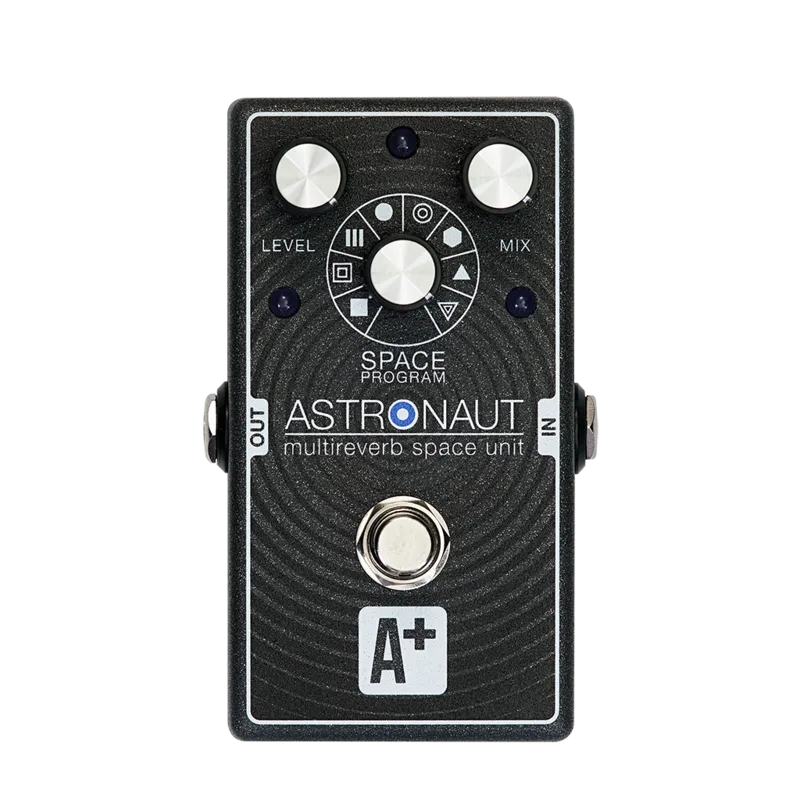


The Shift Line Astronaut is what the maker calls a Multiverb Space Unit: a compact reverb pedal with eight fixed programs that range from a plain room sound to octave-up shimmer and long, filtered "deep space" washes. Shift Line describes it as "reverb unit with fixed deep and cosmic sound modes," an "8-stage rocket to reach deep space"1. It is a small box, 111 x 60 x 30 mm (4.3 x 2.4 x 1.2 inches) without knobs and half a pound, so it fits easily on a crowded board1.
The original Astronaut is discontinued. Shift Line marks it as such on its product page1, and the family carried on through the Astronaut V.2, the Astronaut III and the A+ Astronaut V, each generation expanding on the original's programs.
An eight-program space reverb
The Program knob switches between eight fixed modes, each a different take on space rather than a tweakable reverb engine1:
| Program | What it does |
|---|---|
| Room/Small hall | "Quite straight reverb mode"1 |
| Spring | Spring-like mode1 |
| Shimmer | Octave-up reverb1 |
| Shimmer 2 | Same as Shimmer, different filtration and speed1 |
| Sky Net | Long reverb with filtering1 |
| Ping-pong delay | Delay with straight and reversed repeats1 |
The set covers the ground a player looking for one space pedal usually wants: a normal room, a spring substitute, two shimmers, a big filtered wash and a reverse-flavored delay, all selected with one knob rather than menus1.
The controls
The Astronaut keeps its surface simple: three knobs and a footswitch.
| Control | What it does |
|---|---|
| Program | Switches between the 8 programs1 |
| Mix | Dry/wet balance, up to 100% wet at full clockwise1 |
| Level | Volume boost; unity at full counterclockwise, turn up to keep the signal audible at any effect amount1 |
The Mix knob reaching full wet matters for the ambient end of the pedal's range: with Sky Net or a shimmer at 100% wet, the dry guitar disappears into the wash entirely. Level sitting at unity fully counterclockwise means the pedal can be set transparent, then boosted only when a program needs it1.
The bypass button also hides a function that is not on the panel. As Shift Line explains1:
"If you press button 10 times in 10 seconds after applying power it will switch input muting. This reverb could be fully muted in bypass and will start making reverberation only after engaging it, or could always listen to input signal and play tails right after pressing a bypass button."1
That choice matters in practice. With input muting on, the reverb could be fully muted in bypass and will start making reverberation only after engaging it. With it off, the pedal could always listen to the input signal and play tails right after pressing the bypass button1.
Power: 9V, 25mA
Power comes from a 9V regulated center negative adapter or a 9V battery, drawing 25mA1. The battery option is unusual for a digital multiverb and genuinely usable at that draw, and the low current also means the pedal is easy to place on a shared 9V supply. The center negative polarity matches the common standard, so most pedalboard power supplies fit without an adapter cable.
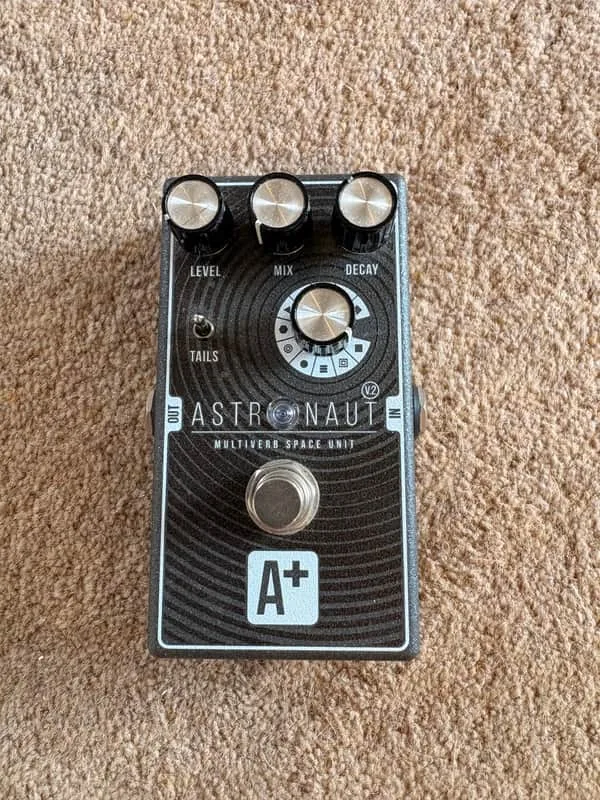
Astronaut V.2: eleven programs and a tails switch
The Astronaut V.2 grew the concept from eight programs to eleven, and Pedal of the Day described it as "a multiverb space reverb unit" in the same spirit as the original2. The added programs push further into experimental territory:
| Program | What it does |
|---|---|
| Skynet | "Long, massive, cosmic"2 |
| ShimUpDown | Both octaves simultaneously2 |
| Octave Arp | With octave arpeggios2 |
| Modulated | Reverb with deep modulation2 |
| Mechanics | Industrial reverb tones2 |
| Ping-Pong | Reversed repeat delay2 |
The V.2's controls work the same way as the original's, with two refinements. Mix still blends wet and dry and can go 100% wet, while Level gained headroom: Pedal of the Day notes it "is your output level boost, with the ability to add up to +10dB when maxed out"2. Decay "controls the length of the reverb, but also has different uses depending on which program you're using," including delay time and rate in some programs2.
The biggest functional change is the Tails toggle. As Pedal of the Day put it2:
"A Tails toggle switch allows you to control how the effects ends once you hit that Bypass switch, too"
Where the original Astronaut buries its tails behavior in a hidden button-press routine, the V.2 puts it on a switch: the Bypass footswitch ends the effect according to the Tails setting, so a ringing reverb can either fade out naturally or stop dead2.
Where the line went next
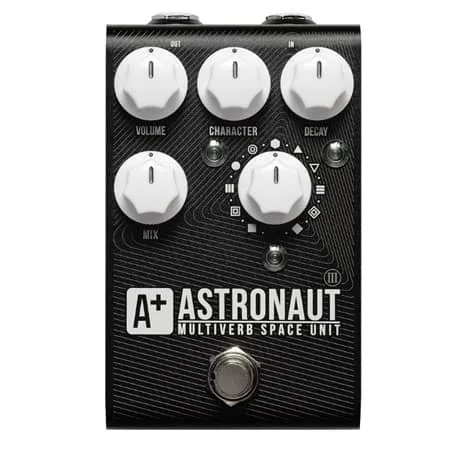
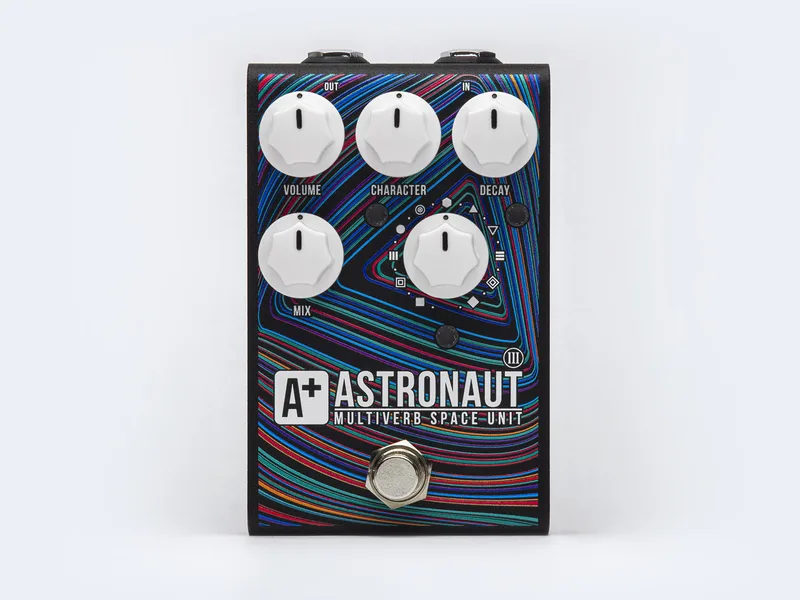
The Astronaut III, the third generation, expanded the format into 22 reverb, delay and sampling algorithms in two banks, with switchable reverb tails in bypass and a multifunctional bypass switch offering press-and-hold Infinity Mode3. Delicious Audio noted the V3 "offers 22 different reverb, delay and sampling algorithms, compared to the 11 reverbs offered by the previous version"4. The III includes extended versions of algorithms from the Astronaut, Astronaut V.2 and Shift Line Force3, so the original pedal's programs live on inside it.
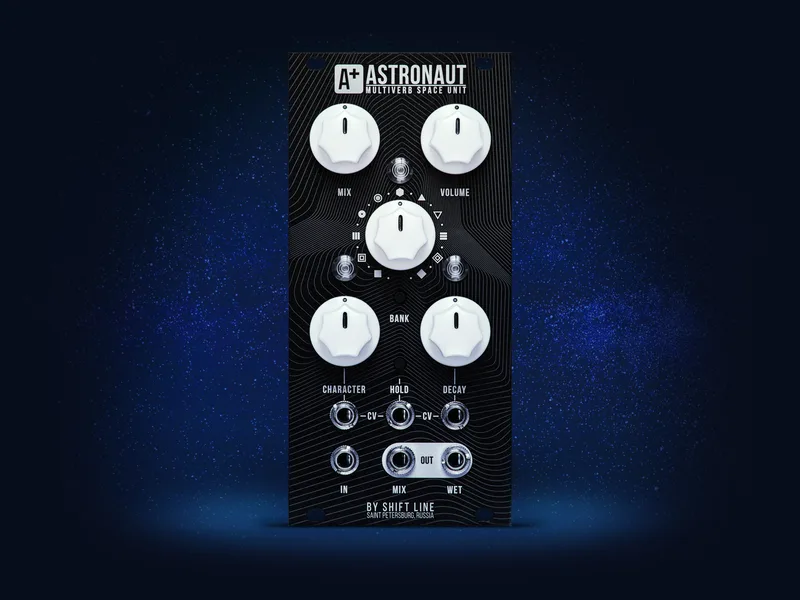
The current A+ Astronaut V continues the family with 22 unique stereo algorithms including reverbs, delays and microsampling, based on an ARM processor5, and RockBoard describes it as able to do "anything from traditional reverb sounds to complex soundscapes, effects and arpeggios"6. There was also a Eurorack-format A+ Astronaut Modular, since discontinued, which ran the same algorithm idea on +/-12V module power7.
For a player weighing the generations: the original Astronaut is the simplest and smallest, eight fixed programs, three knobs, battery power; the V.2 adds three more programs, a +10dB level range and the Tails switch; the III and V multiply the algorithm count and add stereo, sampling and MIDI-style control, at higher current draw12.
Videos
Chords Of Orion
Brett Kingman
shnobel
Questions
Does the Shift Line Astronaut run on a battery?
Yes. The maker specifies a 9V regulated center negative power adapter or a 9V battery, with a power consumption of 25mA. That low draw means a battery is a realistic option, and the pedal is also easy to run from a typical 9V pedalboard supply.
Is the Shift Line Astronaut discontinued?
Yes. Shift Line marks the original Astronaut as discontinued on its product page. The line continued through the Astronaut V.2, the Astronaut III and the A+ Astronaut V, which carry the original's algorithms forward in expanded form.
How do you turn on input muting on the Astronaut?
Press the bypass button 10 times within 10 seconds of applying power. This toggles input muting: the pedal can be fully muted in bypass and only make reverberation when engaged, or it can keep listening to the input and play tails right after you press bypass.
Does the Astronaut V.2 have reverb trails?
Yes. The V.2 has a Tails toggle switch that controls how the effect ends when you hit the Bypass switch, so you can choose whether the reverb tail rings out or cuts off immediately.
Sources (7)
- A+ Astronaut, shift-line.com, 2026
- Shift Line Astronaut Multiverb Space Reverb Unit V.2, Pedal of the Day, 2018-02-02
- A+ Astronaut III Ribbons, shift-line.com, 2026
- Shift-Line's A+ Astronaut III Reverb/Delay/Sampler, Delicious Audio, 2020-03-19
- Guitar Gear Gems: Incinerator fuzz & Astronaut V space reverb, gearnews.com, 2022-07-26
- A+ Astronaut V by Shift Line, RockBoard (www.rockboard.de), 2026
- A+ Astronaut Modular, Shift Line, 2026