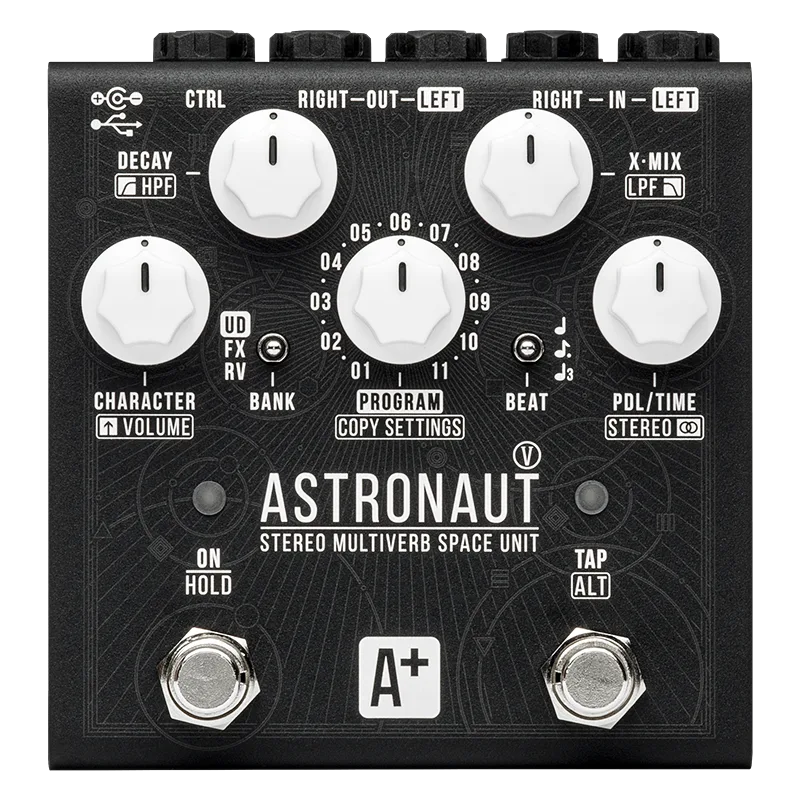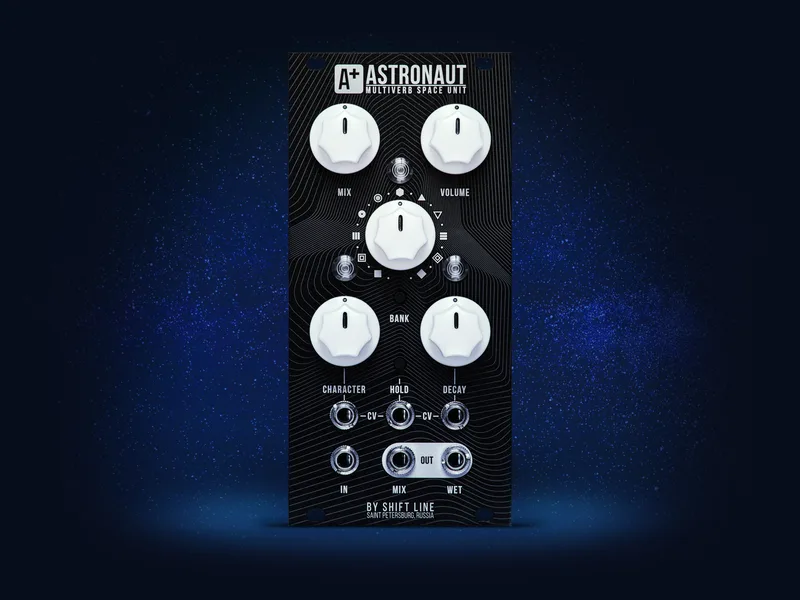


The Shift Line A+ Astronaut V is a digital reverb pedal that Shift Line launched on 26 July 2022. It is built around an ARM processor, Cortex technology and an Analog Devices codec, and it carries 22 stereo algorithms covering reverbs, delays and microsampling, along with 33 presets you can tweak and make your own1. RockBoard's PedalPedia describes its range as broad: the Astronaut V can do anything from traditional reverb sounds to complex soundscapes, effects and arpeggios2.
What it does and how it is built
The Astronaut V is what players often call a multiverb: rather than one reverb circuit, it packs a set of algorithms into one box. Gearnews described it at launch as "a collection of 33 presets that you can tweak and make your own," with "22 unique stereo algorithms including reverbs, delays and microsampling"1. The presets are starting points built on the algorithms, and the player adjusts them from there.
The digital engine is based on the ARM processor, with Cortex technology and an Analog Devices codec handling the audio conversion2. RockBoard's product page classifies the circuit type as digital and the product as a reverb pedal2.
The Astronaut V is a reverb and delay pedal from Shift Line, and it is no longer made: the Astronaut line is listed as discontinued, so the pedal is available only secondhand. Its list price when current was USD 299 MSRP3, and the maker's guide (in English) is still available as a PDF12.
Power and current
The pedal runs on 9V DC with a center negative plug, the common standard for effects pedals2. Its current draw is 200mA2, which is worth noting for anyone planning a pedalboard: that is a real draw for a single compact pedal, and it needs a power supply output that can deliver it.
At 200mA, the Astronaut V draws more current than most analog pedals. Make sure your power supply has an output rated for at least that much before adding it to a board.
From the Astronaut III to the Astronaut V
The Astronaut line goes back several generations, and the V is the stereo, preset-based version of a design that started smaller14.
| Version | Algorithms | Notes |
|---|---|---|
| Astronaut V.2 (2018) | 11 programs | Multiverb space reverb unit, mono3 |
| Astronaut III / V3 (2020) | 22 algorithms in two banks of 11 | Reverb, delay and sampling; fully analog dry path4 |
| Astronaut V (2022) | 22 stereo algorithms, 33 presets | ARM processor based1 |
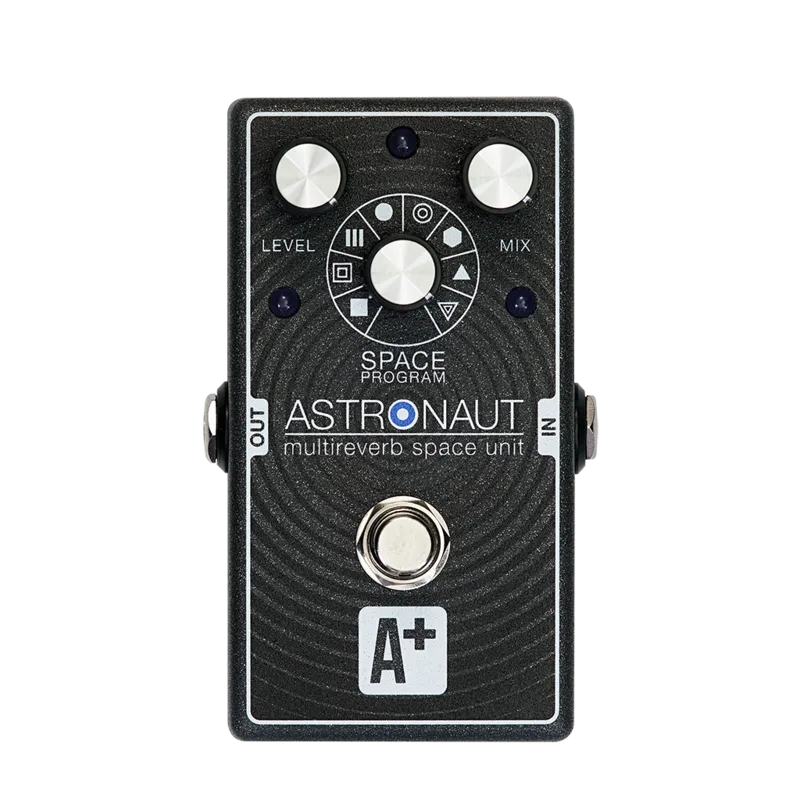
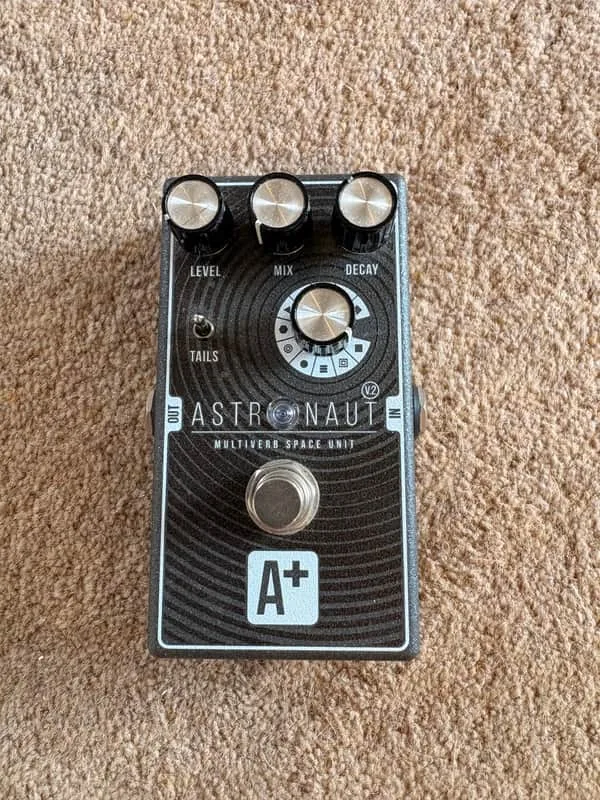
The Astronaut V.2, reviewed by Pedal of the Day in February 2018, was a multiverb space reverb unit with 11 programs3. Those programs already showed the direction of the line: ShimUp (shimmer with octave up repeats), ShimUpDown (both octaves simultaneously), Octave Arp (with octave arpeggios), Modulated (reverb with deep modulation), Mechanics (industrial reverb tones) and Skynet (long, massive, cosmic)3.
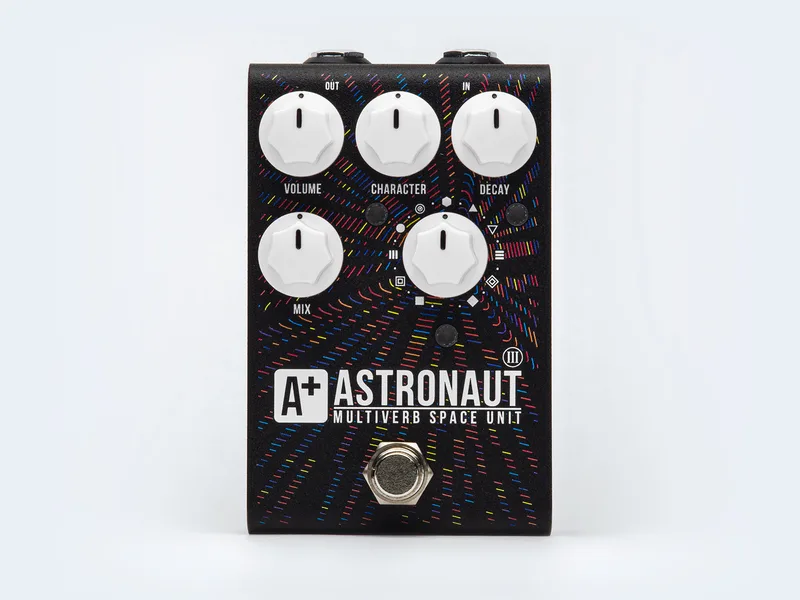
The Astronaut III, covered by Delicious Audio in March 2020, was the third generation, hosted in a slightly wider case than the previous version and offering 22 reverb, delay and sampling algorithms in two banks of 11, compared to the 11 reverbs of the previous version4. Its algorithms included extended versions of some from the Astronaut, Astronaut V.2 and Shift Line Force4. It kept a fully analog dry signal path, so the unprocessed guitar signal stayed analog while the effects were digital4. Delicious Audio also noted three bypass modes: Tails, No tails no input monitoring, and Continuous input monitoring4.
The Astronaut III also had a distinctive listening feature that Delicious Audio highlighted in its multi-reverb buying guide: "it can listen to your signal in bypass and play full and massive reverb tails immediately when switched on"5. That buying guide featured the Astronaut III in its compact/streamlined category of Best Multi-Mode Reverb Pedals4.
Shift Line also produced the A+ Astronaut Modular, a Eurorack-style module version with 22 algorithms plus a Hold mode with CV-controlled infinite sustain, a fully analog dry signal path, and CV inputs with a 10Vptp range. That product is discontinued6. A limited Fireworks cosmetic edition of the Astronaut III was also offered, with no changes to its sound or functions7.
Where the Astronaut V differs
The clearest differences between the V and its predecessors are stereo operation and the preset structure. The V.2 and III were mono designs; the Astronaut V's 22 algorithms are stereo1. The V also moves from the bank-and-knob algorithm selection of the III to a preset-based workflow of 33 tweakable presets1. Its 200mA current draw2 is also higher than the Astronaut III Fireworks edition's 80mA at 9V DC7, reflecting the more powerful processing platform.
Videos
Brett Kingman
Nikita Demchenko
Harp Lady
Questions
Is the Shift Line A+ Astronaut V a digital or analog reverb?
It is a digital pedal, built around an ARM processor, Cortex technology and an Analog Devices codec. Earlier Astronaut versions kept the dry signal path fully analog, so the untouched guitar signal stayed analog while the wet processing was digital.
What power supply does the Astronaut V need?
It takes 9V DC with a center negative plug, the same standard supply as most modern pedals. It draws 200mA, which is more than a typical analog pedal, so it needs a supply with enough current on tap rather than a low-current daisy chain output.
How much current does the Astronaut V draw?
The Astronaut V draws 200mA at 9V DC. That is a substantial draw for a compact pedal, so check that your power supply can spare that much current on one output before adding it to a board.
How many presets does the Astronaut V have?
It ships with 33 presets that you can tweak and make your own. Those presets draw on 22 stereo algorithms covering reverbs, delays and microsampling, so the preset count and the algorithm count are two different things.
Is the Astronaut V a stereo pedal?
Yes. Its 22 algorithms are stereo, covering reverbs, delays and microsampling. Earlier Astronaut versions were mono in and out, so stereo operation is one of the things that separates the Astronaut V from its predecessors.
Sources (7)
- Guitar Gear Gems: Incinerator fuzz & Astronaut V space reverb, gearnews.com, 2022-07-26
- A+ Astronaut V by Shift Line, RockBoard (www.rockboard.de), 2026
- Shift Line Astronaut Multiverb Space Reverb Unit V.2, Pedal of the Day, 2018-02-02
- Shift-Line's A+ Astronaut III Reverb/Delay/Sampler, Delicious Audio, 2020-03-19
- 2024 UPDATE: Best Multi Reverb Pedals, Delicious Audio, 2024-10-25
- A+ Astronaut Modular, Shift Line, 2026
- A+ Astronaut III Fireworks, Shift Line, 2026