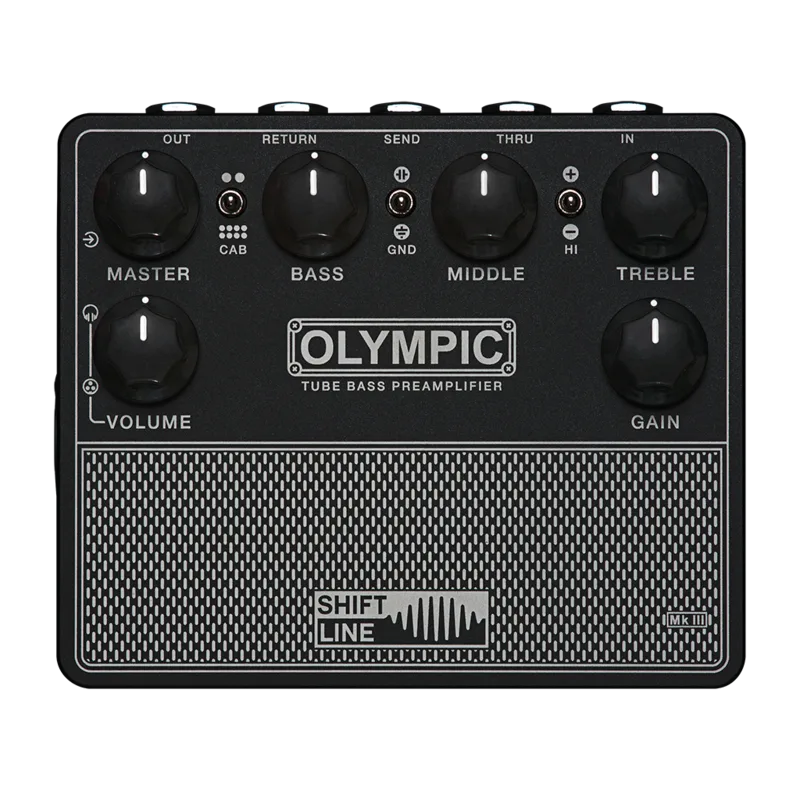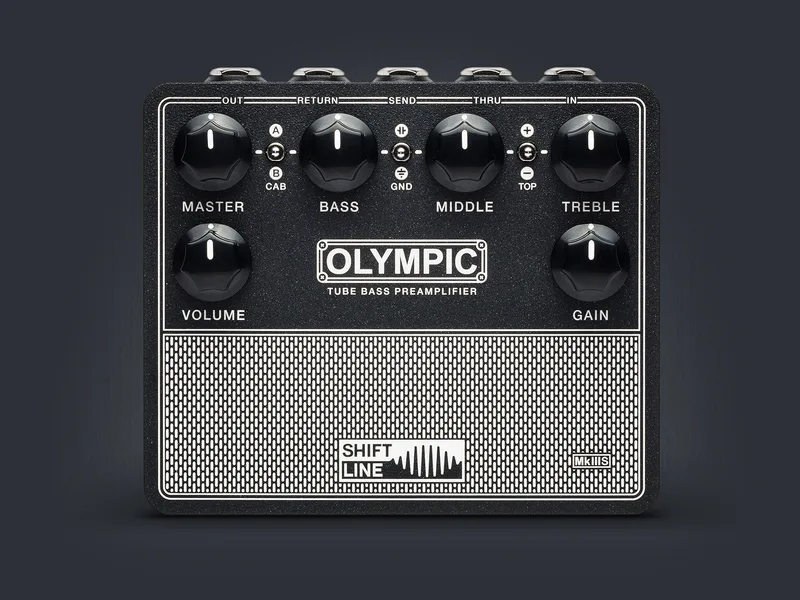


The Shift Line Olympic MkIIIS is a tube bass preamplifier with IR-based cabinet simulation, built as the newest revision of Shift Line's bass preamplifier. The maker describes it as "a compact, fully-featured tube preamplifier with a warm, deep and characteristically compressed sound"1. Its cabinet simulation uses Impulse Response Convolution technology, which Shift Line says provides a realistic and detailed result, and it is aimed at players who want tube tone straight to a PA, a audio interface or headphones without a bass cabinet on stage1.
The unit cannot run on a battery or phantom power: it needs a regulated 12V DC supply rated 650mA, negative tip1. Phantom power will not damage the device, but it will not run it1.
Controls and switching
| Control | What it does |
|---|---|
| BASS, MIDDLE, TREBLE | Classic 3-band passive EQ with mild frequency correction and a characteristic mid scoop at 400Hz1 |
| MASTER | Volume of the signal at the OUT jack1 |
| VOLUME | Volume at the PHONES and BALANCED OUT jacks, independent of MASTER1 |
| TOP | + accentuates highs and attack, - cuts high frequencies for a milder sound, center is neutral1 |
| CAB | A selects a SUNN 200s (2x15) impulse, center disengages cabinet simulation, B selects an AMPEG SVT-810E (8x10) impulse; affects BALANCED OUT and PHONES OUT but not the main OUT1 |
| GND | Handles ground loops with XLR connections: lower connects grounds, middle disconnects them, upper connects them with an additional interference filter; set by ear for minimum 50Hz hum1 |
The CAB switch is the heart of the IR side of the pedal. It selects one of two built-in cabinet impulses, a SUNN 200s 2x15 or an AMPEG SVT-810E 8x10, or switches the simulation off entirely in the center position1. Shift Line notes that the impulse affects the BALANCED OUT and PHONES OUT only, leaving the main OUT untouched, so the simulation is there for the PA or the headphones rather than for a bass rig1.
Jacks, loop and signal levels
The Olympic MkIIIS is well stocked with connections for a compact preamp1:
- IN: the signal source input, 6,3mm mono unbalanced, -20dB, 1MOhm input impedance1
- AUX IN: an external audio input heard only through the PHONES output, handy for playing along to a track1
- THRU: a buffered output for the unprocessed signal split from the IN jack, 6,3mm mono unbalanced, -20dB, 1kOhm output impedance1
- SEND / RETURN: a series effects loop; SEND can also serve as an additional output, 6,3mm mono unbalanced, -10dB, 1kOhm output impedance (SEND) and 1MOhm input impedance (RETURN)1
- OUT: the main output for a power amplifier, 6,3mm mono unbalanced, +20dB, 1kOhm output impedance1
- PHONES: headphones output1
- BALANCED OUT: balanced output for a PA or interface1
The split between MASTER and VOLUME is worth understanding before you plug in. MASTER governs the level leaving the OUT jack toward your power amp, while VOLUME governs the PHONES and BALANCED OUT jacks independently1. That means a silent-stage setup, amp level down and balanced or phones level up, is a matter of the two knobs rather than any rewiring.
Related Shift Line gear
Shift Line also makes the Shift Line Bass IR Pack for players who want more cabinet impulses, and the Olympic MkIII, the earlier revision this MkIIIS updates1. The company's A+ series, including the A+ Buzz, the A+ Buzz V.2 Violet, the A+ Buzz V.2 Deep Blue and the A+ Flex, covers other bass preamp and drive territory1. For a wider view of the category, see Preamp Pedals and Speaker Simulation Pedals.
Videos
Shift Line
IvanBassist
ShurSoma
Questions
Can the Shift Line Olympic MkIIIS run on a battery or phantom power?
No. Shift Line specifies a regulated 12V DC center-negative supply rated 650mA with a 2.1/5.5mm barrel. The maker states that phantom power or battery power is insufficient for the unit, so neither will run it. Phantom power sent down a mic cable will not damage the device, but it will not power it either.
What does the GND switch do on the Olympic MkIIIS?
The GND switch deals with ground loops that can affect the signal when using XLR connections. The lower position connects the grounds, the middle position disconnects them, and the upper position connects them through an additional interference filter. Shift Line suggests selecting the setting by ear for the least 50Hz hum.
Does the Olympic MkIIIS have an effects loop?
Yes. The Olympic MkIIIS has a series effects loop on SEND and RETURN jacks. Shift Line notes that the SEND jack can also be used as an additional output on its own.
What does the TOP switch do on the Olympic MkIIIS?
The TOP switch controls the signal's high frequency harmonic content. The + position accentuates the highs and the attack, the - position cuts the high frequencies for a milder sound, and the center position leaves the signal unaffected.
What is the difference between the MASTER and VOLUME knobs on the Olympic MkIIIS?
MASTER sets the level at the main OUT jack, which feeds a power amplifier. VOLUME sets the level at the PHONES and BALANCED OUT jacks and works independently of MASTER, so you can quiet the stage output without touching what the audience hears, or the other way round.
Sources (1)
- Shift Line Olympic MkIIIS, Shift Line, 2026