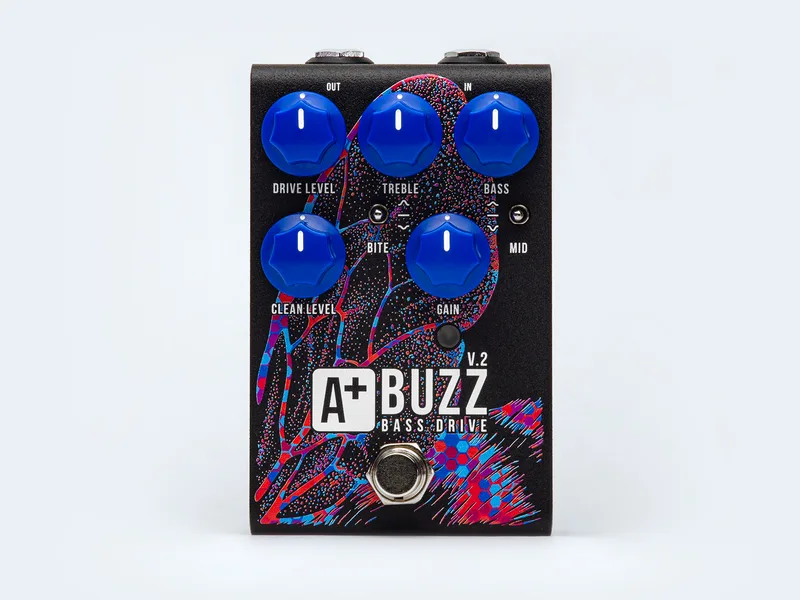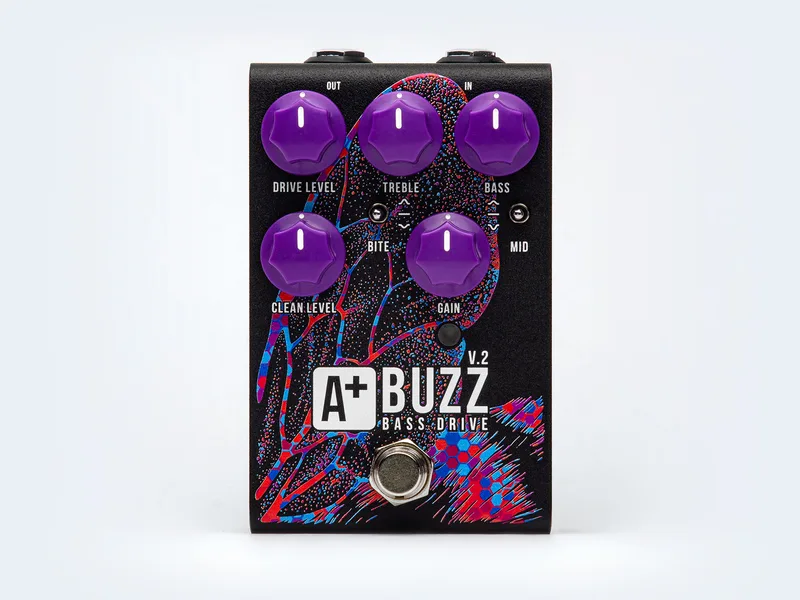


The Shift Line A+ Buzz is a distortion pedal built specifically for bass guitar, from a maker that describes its approach plainly: "Here at Shift Line, we take bass distortion seriously"1. Its defining idea is a parallel signal path: the clean bass signal and the distorted signal each get their own volume control, so you can dial in grind without losing the low end that a bass needs. The original Buzz V.1 is discontinued, and its replacement, the A+ Buzz V.2, is currently listed as out of stock in every color edition1.
Shift Line describes the Buzz family as a bass drive with "excellent dynamic response: clean to full-on distortion", meaning it cleans up as you play softer and saturates harder as you dig in2. The company also says its EQ design makes the pedal work for direct recording, with no excessive high frequencies or "sizzle" in the distorted signal3.
What the Buzz does for a bassist
The core of the pedal is the split between clean and drive. On the V.2, the DRIVE LEVEL knob controls the distorted signal's volume and can be turned down to 0 if needed, while separate dry and wet volume controls include the option to boost the clean signal5. That layout lets a player set a small amount of grit under a full clean tone, push the drive hard and keep just enough clean signal to anchor the bottom, or run the pedal as a clean boost with the drive off.
On the original V.1, the LEVEL knob served the same role for the distorted signal: Shift Line described it as a way "to fine-tune the blend proportion or to drive your tube amp even harder"1. The V.1 also had a HARM switch that, in the UP position (two dots), cut off most of the highs fed into the distortion1.
The V.2's EQ is voiced to avoid the harshness that bass distortion can produce. In Shift Line's words, "Due to well-thought EQ, the pedal sounds good even for direct recording: there are no excessive high frequencies or 'sizzle' in the distorted signal"3.
Controls
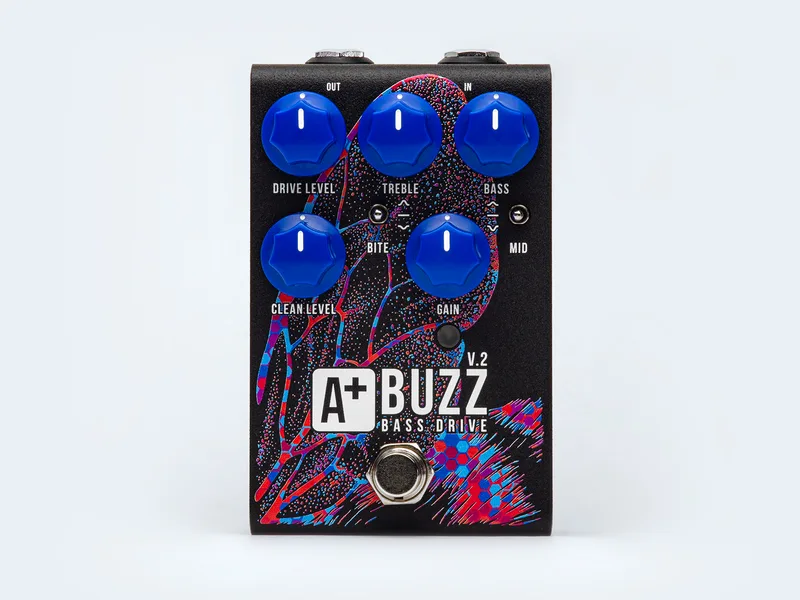
The V.2 keeps the control set small: one knob for drive intensity, one for the drive level, and two voiced switches for shaping the distorted signal23.
| Control | What it does |
|---|---|
| GAIN knob | Controls the intensity of the drive4 |
| DRIVE LEVEL knob | Controls the distorted signal volume; can be turned down to 03 |
| MID switch | Fine control over low mids (650Hz) in the distorted signal: UP +5dB, CENTER 0dB, DOWN -12dB4 |
| BITE switch | Fine control over high mids (2900Hz) in the distorted signal: UP +6dB, DOWN -6dB4 |
| BYPASS switch | Turns the effect on or off4 |
The two switches do more than cut or boost a frequency. Shift Line says the MID switch position shifts the distorted signal's character from vintage to modern, while the BITE switch determines how aggressive the pedal sounds2. The voicing is asymmetric: frequencies are cut with a narrow band and boosted with a wide band4, so the cuts are surgical and the boosts are broad.
Power and bypass
The two versions differ in how they run, and the difference matters if you are moving from a V.1 to a V.2.
- V.1: regulated 9V PSU or 9V battery, 50mA current draw1
- V.2: 9V DC, 60mA, negative tip, 2.1/5.5mm barrel jack, regulated PSU only2
The V.2 has no battery option. Shift Line specifies a regulated PSU only, so an unregulated supply or a mismatched polarity adapter is off the table.
Both versions of the V.2's switching story are player-friendly: the pedal uses a fail-safe relay-based passive (true) bypass circuit2, which means the relay defaults to passing your signal if it ever fails. The V.1's dimensions were 111 x 60 x 50 mm (4.37 x 2.36 x 1.97") in what Shift Line called a sturdy casing built to survive heavy stage use1; the V.2 moved to a compact and lightweight aluminum enclosure at 110 x 67 x 56 mm and 240g, with top-mounted jacks for improved connectivity3.
From the Buzz V.1 to the V.2 and its color editions
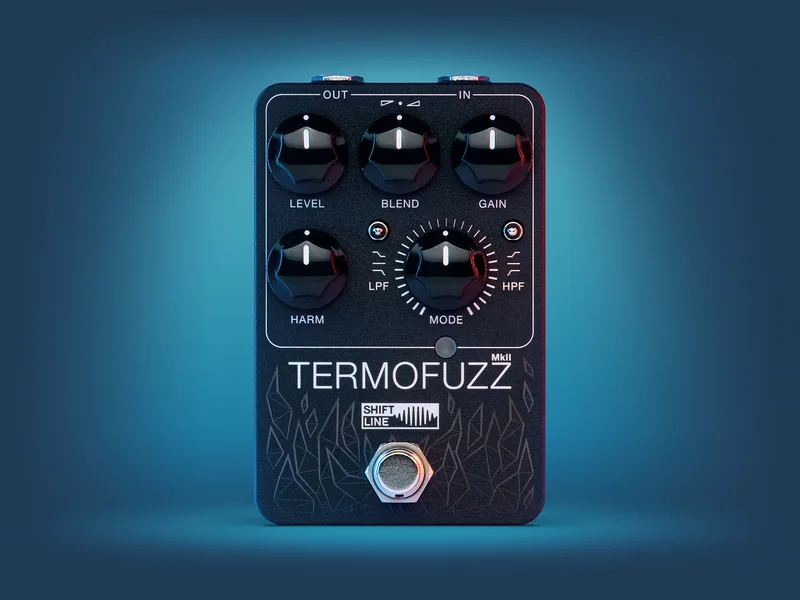
The A+ Buzz V.1 was Shift Line's original design, and the company says it "borrows certain parts of the circuit from our Termofuzz and Mr.Blend pedals"1. The Termofuzz connection carried into the second generation: some elements of the Shift Line Termofuzz are used in the Buzz V.2's schematics as well6.
The V.2 is an improved revision rather than a new design. Shift Line's description of the change257:
"The schematics of the Buzz V.2 are based on the first revision with improvements to the sound palette. If needed, the V.2 can sound exactly like the V.1 while offering much deeper control over the nuances of the sound."6
In practice that means the V.1's sound is still reachable, and the MID and BITE switches are what open up the wider palette. Alongside the circuit work, the V.2 gained the top-mounted jacks and the aluminum enclosure noted above3.
The V.2 has been sold in a range of finishes: Deep Blue, Yellow, Gray, Black, Violet and Orange. Every one of these is a limited cosmetic edition, in Shift Line's own words "with no changes to its sound or functions"3. A player comparing a Deep Blue unit against a Violet one is comparing paint, not circuits. As of 2026, all of the color editions are listed as out of stock23.
Where it sits among bass drives
The Buzz is a dedicated bass drive rather than a guitar overdrive adapted for bass, and its separate clean and drive levels put it in the blend-style camp of bass distortion. Its closest relative inside Shift Line's own range is the Termofuzz, which shares circuit elements with both Buzz generations and uses clickless relay true bypass8. For a player weighing the V.1 against the V.2 secondhand, the practical differences are the V.2's extra MID and BITE switches, the top-mounted jacks, the true bypass relay switching, and the loss of battery power.
Videos
Patrick Hunter
AFX
MrExcane
Questions
Is the Shift Line Buzz still made?
The original A+ Buzz V.1 is discontinued. The improved A+ Buzz V.2 replaced it, but as of 2026 Shift Line lists every V.2 color edition, including the limited cosmetic runs, as currently out of stock.
Does the Shift Line Buzz V.2 sound different from the V.1?
The V.2 schematics are based on the V.1 with improvements to the sound palette. Shift Line says that if needed, the V.2 can sound exactly like the V.1 while offering much deeper control over the nuances of the sound, through its MID and BITE switches.
Do the colored Buzz V.2 editions sound different?
No. Shift Line describes the Yellow, Gray, Black, Orange, Violet and Deep Blue versions as limited cosmetic editions of the pedal with no changes to its sound or functions. The circuit and controls are the same across colors.
Can the Shift Line Buzz run on a battery?
The original Buzz V.1 could run on a regulated 9V PSU or a 9V battery. The V.2 cannot: it takes 9V DC at 60mA through a 2.1/5.5mm center negative jack, and Shift Line specifies a regulated PSU only.
Is the Shift Line Buzz V.2 true bypass?
Yes. Shift Line says the V.2 uses a fail-safe relay-based passive (true) bypass circuit, so if the relay fails the pedal passes signal. The BYPASS footswitch turns the effect on or off.
What frequency does the MID switch on the Buzz V.2 affect?
The MID switch targets the low mids at 650Hz in the distorted signal. Up gives +5dB, center is 0dB, and down cuts 12dB. Cuts use a narrow band and boosts a wide band, and the switch position shifts the character from vintage to modern.
Sources (8)
- A+ Buzz, Shift Line, 2026
- A+ Buzz V.2 Deep Blue, Shift Line, 2026
- A+ Buzz V.2 Gray, Shift Line, 2026
- A+ Buzz V.2 Yellow, Shift Line, 2026
- A+ Buzz V.2 Black, Shift Line, 2026
- A+ Buzz V.2 Orange, Shift Line, 2026
- A+ Buzz V.2 Violet, Shift Line
- Shift Line Termofuzz, Shift Line, 2026