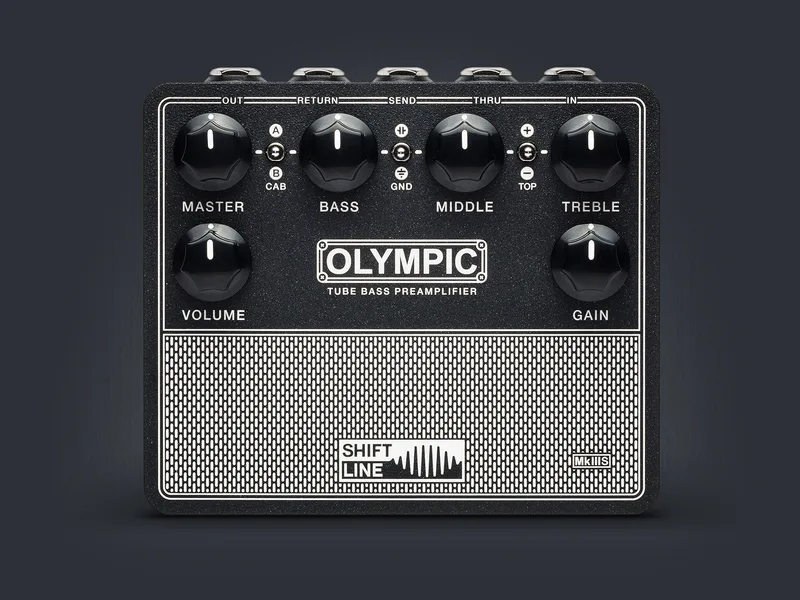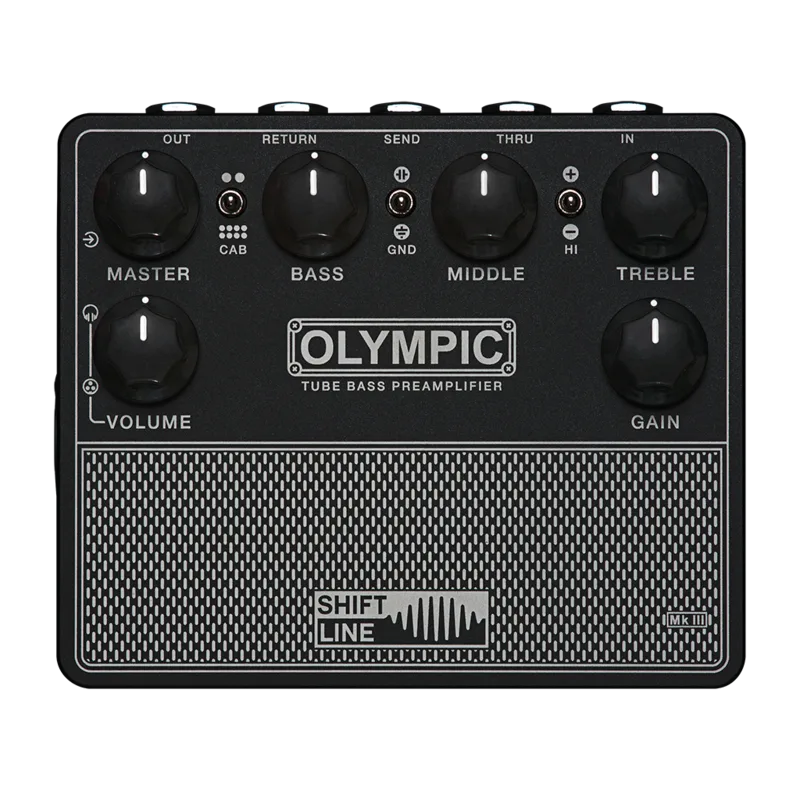


The Shift Line Olympic MkIII is a tube bass preamplifier with IR-based cabinet simulation, built as a compact pedal. Shift Line calls it the third revision of its tube bass preamplifier, and describes it as combining "the classic tube bass sound with modern audio processing technologies, creating a true 'Swiss Army knife' for bass players." The cabinet simulator uses Impulse Response Convolution technology, which the maker says captures the characteristic nuances of a real bass cabinet1.
Shift Line's product page states "THIS PRODUCT IS DISCONTINUED." The MkIII was the third revision of the company's tube bass preamp, and the Olympic MkIIIS is the related model that followed in the range1.
The controls
The MkIII keeps its front panel simple, with each control serving a defined job.
| Control | What it does |
|---|---|
| GAIN | Sets the preamp's input signal amplification. Shift Line says it takes you "from a crystal-clear sound all the way to a classic California-style overdrive." |
| MASTER | Controls the volume of the signal coming from the OUT jack. |
| VOLUME | Controls the volume of the signal from the PHONES and BALANCED OUT jacks, independently of MASTER. |
| HI | Three-position switch for high frequency harmonic content. "+" accentuates highs and attack, "-" cuts high frequencies for a milder sound, and the neutral position leaves the signal untouched. |
| CAB | Selects the cabinet impulse: upper position is a SUNN 200s (2x15), lower position is an AMPEG SVT-810E (8x10), and the central position disengages cabinet simulation. |
| GND | Handles ground loops on XLR connections (see below). |
All control descriptions come from Shift Line's product page1.
The GND switch matters most when you run the balanced output into a PA or interface. In the lower position, the preamp's ground is connected to the signal receiver's ground. The middle position disconnects the grounds. The upper position connects them and engages an additional filter to remove interference1.
Jacks and connections
The MkIII is unusually well connected for a preamp pedal, with six audio jacks plus the power input1:
- IN: 1/4" audio input for the preamp1
- OUT: the main 1/4" output, designed to connect to a power amplifier, such as the RETURN or POWER AMP IN on a bass amplifier or the INPUT on a power amplifier1
- BALANCED OUT: XLR balanced output, mono, +10dB, 1 kOhm output impedance1
- PHONES: 1/8" stereo headphones output, unbalanced, +10dB, 10 Ohm output impedance1
- THRU: 1/4" buffered direct-through output that duplicates the signal from the IN jack, unprocessed1
- SEND/RETURN: the RETURN is a 1/4" input for routing externally processed signal back into the preamp; using both SEND and RETURN sets up a series effects loop1
- AUX IN: 1/8" stereo unbalanced input, 0dB, 10 kOhm input impedance, for an external sound source. Its signal is heard only through the PHONES output1
How the cabinet simulation is routed is worth understanding before you hook the pedal up. Shift Line states that the cab sim affects the BALANCED OUT and PHONES outputs, but not the main OUT. In practice that means a front-of-house engineer or your audio interface gets the simulated cabinet tone, while the signal feeding your power amp does not1.
Power
The Olympic MkIII runs from 12V DC at 600mA with a negative tip, into a POWER IN jack with a 2.1mm/5.5mm diameter. Shift Line specifies using only regulated power supply units1.
At 12V DC and 600mA, the MkIII needs its own regulated supply rated for the full 600mA, rather than a shared output on a multi-supply unit1.
Size and weight
Shift Line publishes the unit's dimensions and weight on its product page, and the page carries more than one weight figure, so the published weights disagree with each other1.
Videos
Shift Line
Patrick Hunter
Adam Aarts
Questions
Is the Shift Line Olympic MkIII discontinued?
Yes. Shift Line's own product page states plainly that the Olympic MkIII is discontinued. It was the third revision of the company's tube bass preamplifier, and the MkIIIS remains a related model in the range. Because it is no longer made, availability depends on remaining stock or the second-hand market.
Does the cabinet simulation affect the main output?
No. According to Shift Line, the cabinet simulation affects the BALANCED OUT and PHONES outputs only. The preamp's main 1/4-inch OUT, which feeds a power amplifier, is not affected by the cab sim, so the signal reaching your amp's power section stays unsimulated.
What does the GND switch do?
The GND switch deals with ground loops that can cause noise over XLR connections. In the lower position the preamp's ground is connected to the signal receiver's ground. The middle position disconnects the grounds. The upper position connects them and adds a filter to remove interference.
What power supply does the Olympic MkIII need?
It needs a 12V DC supply rated for 600mA with a negative tip, into a 2.1mm/5.5mm barrel connector. Shift Line specifies using only regulated power supply units, so a standard 9V pedal supply will not do.
How much does the Shift Line Olympic MkIII weigh?
Shift Line's product page gives the unit weight as 480 g (1.06 lbs). The same page also lists 120 g (0.26 lbs) elsewhere, so the maker's own figures disagree; the heavier figure is the one given as the unit weight.
Can you plug headphones into the Olympic MkIII?
Yes. The PHONES jack is a 1/8-inch stereo headphones output. It receives the cabinet-simulated signal, and you can also feed an external sound source into the 1/8-inch AUX IN, which is heard only through the PHONES output for practising along with tracks.
Sources (1)
- Shift Line Olympic MkIII, Shift Line, 2026