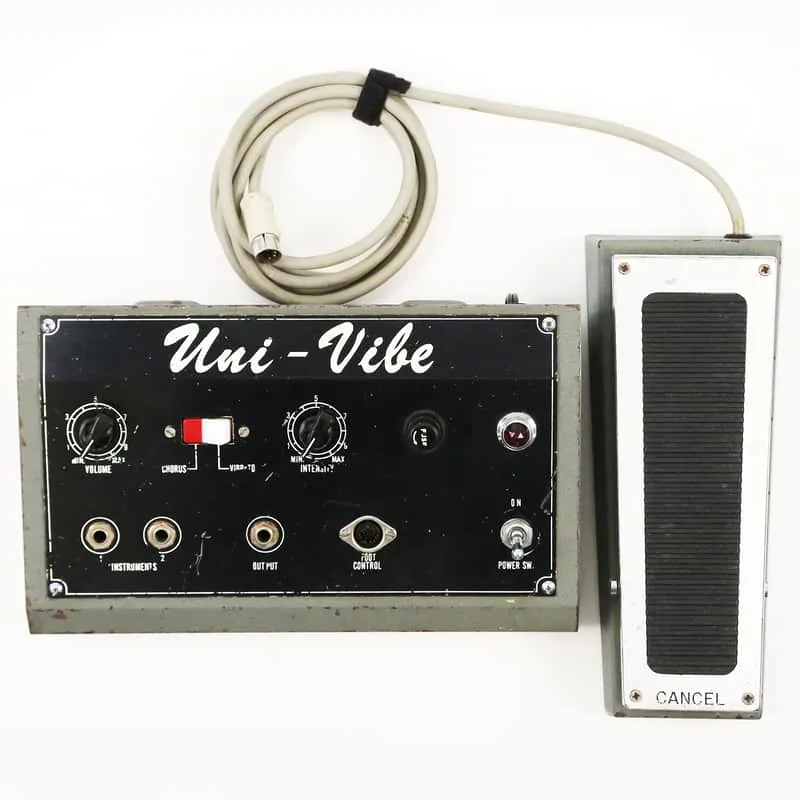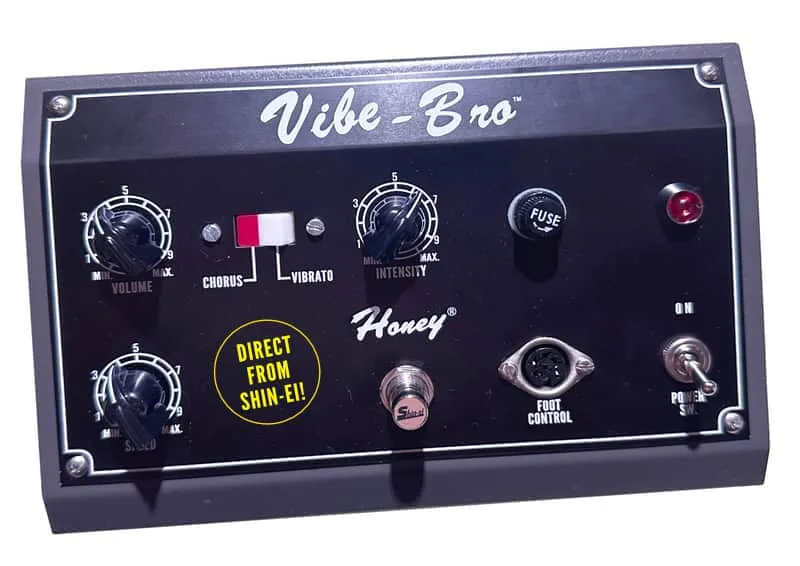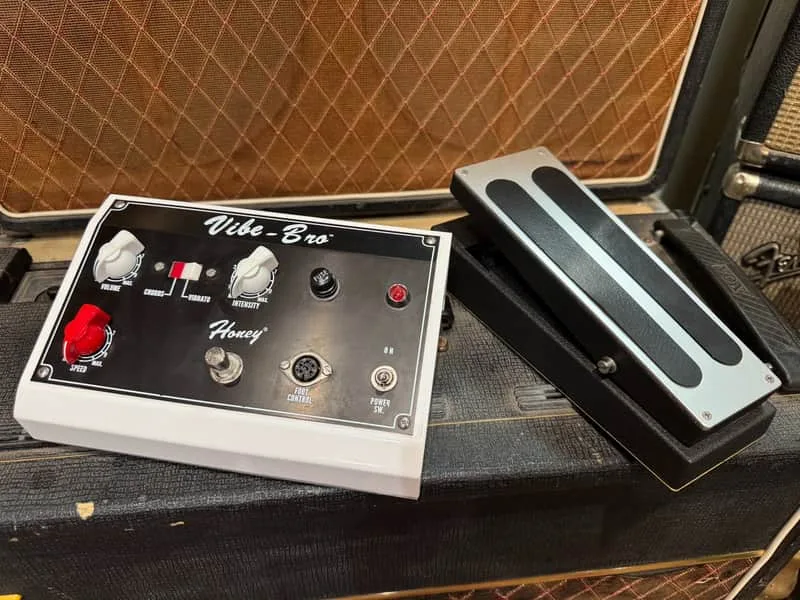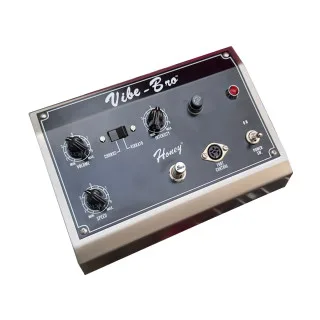


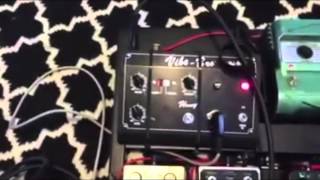
The Shin-Ei Vibe-Bro is a chorus/vibrato pedal that re-creates the circuit of the original Shin-ei/Univox Uni-Vibe, the phase-shifting effect Shin-Ei introduced in Japan in the 1960s. Announced on May 19, 2016, it was the company's first new product in forty years, hand-built in Austin, Texas from a mix of carefully selected new and old components, including NOS (new old stock) parts12. Like the Uni-Vibe it is based on, it offers both chorus and vibrato modes, and it runs on mains power rather than a battery34.
The maker describes the design goal as recreating the past as closely as possible while adding some modern design techniques, and the launch release promised "the deep, luscious warmth and trademark pulsating bottom end found only in our vintage Honey and Shin-ei Uni-Vibe units"31.
A recreated Uni-Vibe: chorus and vibrato
The Vibe-Bro is an updated version of the classic Uni-Vibe machine, the effect Shin-ei introduced in the 1960s as a Leslie speaker emulator46. The original featured a chorus/vibrato switch on the front and produced its effect through four-stage phasing with photo resistors7. The Vibe-Bro keeps both of the selectable modes found on the original: chorus, the watery, rotating-speaker-like sweep the Uni-Vibe is known for, and vibrato, a pitch-wobbling version of the same modulation.
The two modes are selected via a rare and original NOS Red/White Miyama switch, one of the old-stock parts the builders sourced for the reissue4. Gearnews described the resulting sound as "instantly recognisable for its deep low and organic sounding modulation effect. It is very 'Hendrix'-sounding"2.
The pedal is hand-built using a mix of carefully selected new and old components, and Delicious Audio's buying guide notes it was designed to recreate the vintage unit's exact sound and behavior, with a few modern improvements8. It is slightly smaller than the original version and solidly built, with what the launch release called pedalboard friendly and heavy-duty construction18. Finishes at launch were Vintage Black and Machine Gun Gray12; the maker's current page also lists a Stainless Steel 10th Anniversary Edition3.
The controls
Each mode is assisted by three controls, mirroring the layout of the original Uni-Vibe4:
| Control | What it does |
|---|---|
| Volume | Sets the output level of the effect |
| Intensity | Sets how deep the modulation sweep is |
| Speed | Sets how fast the chorus or vibrato moves |
| Chorus/Vibrato switch | Selects between the two modes, via an NOS Red/White Miyama switch4 |
For foot control of the speed, Shin-Ei reissued the optional vintage styled foot switch used to control the speed of the effect2. It was available in two models, a Vibe-Bro version or a vintage Shin-Ei "Honey Series" version, priced from $199 at launch24. The speed input uses a 6-pin DIN connector, so only the Shin-Ei expression pedal works with it, not a standard expression pedal8. This follows the original design: the Uni-Vibe originally came with an external expression pedal.
The Vibe-Bro also offers two ways to take the effect out of your signal: innovative true bypass, which removes it from the chain entirely, and vintage-style preamp signal-path switching, which leaves the preamp in line1. Pedal of the Day's reviewer found that "both modes sound great here, and produce the unmistakeable deep, luscious warmth and pulsating bottom end that the Uni-Vibes have been known for"4.
"Both modes sound great here, and produce the unmistakeable deep, luscious warmth and pulsating bottom end that the Uni-Vibes have been known for."
Power: built for one mains voltage
Unlike most modern pedals, the Vibe-Bro runs on mains power rather than a battery. The U.S. version runs on 120 Volts, the standard current in North America, and a removable IEC wall cable is provided with each unit manufactured for use in North America4.
The maker states that Vibe-Bro transformer voltages are not auto-self-switching: each unit is built specifically for the voltage of the country of destination3. A U.S. 120V unit cannot simply be plugged into European mains. At launch, international models were available in 100V, 220V and 240V13, and Gearnews reported the unit came in either a US or a European version running at different voltages2.
From the Uni-Vibe to the Vibe-Bro
The Uni-Vibe was introduced in the 1960s by Shin-ei, a Japanese effects maker, as a Leslie speaker emulator6. On That Pedal Show, the presenters noted that "it was originally introduced by Shin-ei in the 1960s"9. The original units were built in Japan; the Vibe-Bro reissues are made in Austin, Texas2.
The Vibe-Bro was created by a team of respected "old school" industry professionals3, and Shin-Ei says everything about it is based on the original units from the 60s and 70s2. Announced in Austin on May 19, 2016, it was Shin-ei's first offering in forty years, sold directly to consumers rather than through dealers12. Gearnews noted at the time that "the new Vibe-Bros look very close to the original units from yesteryear, so hopefully they will sound as good too"2, and reported that it was already being used by big names like Eric Johnson, who is from Austin himself2.
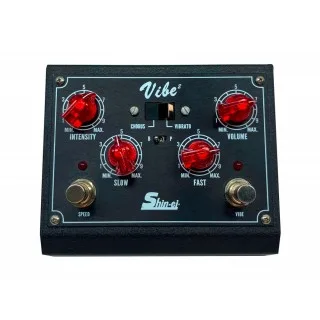
A smaller version of the Vibe-Bro later launched, sharing most of the NOS components of its big brother, including true bypass, and described as a lot more affordable8.
In 2021, Shin-Ei announced it was shutting down pedal production, ceasing production of both the Uni-Vibe and Vibe-Bro5. One of the very last pedals the company produced was a special custom Vibe-Bro made for Joe Bonamassa, with a picture of him on the cover510. The maker's current listing for the Vibe-Bro 120V U.S. Only Version is $1,295.003.
Videos
Shin-ei
Shin-ei
Shin-ei
Questions
Is the Shin-Ei Vibe-Bro true bypass?
Yes. The Vibe-Bro offers true bypass plus a vintage-style preamp signal-path switching mode, so you can take the effect out of the chain entirely or leave the vintage preamp in the signal path. Pedal of the Day's reviewer found both bypass modes sound great and produce the deep, luscious warmth and pulsating bottom end the Uni-Vibes are known for.
Does the Vibe-Bro work with any expression pedal?
No. The speed-control input uses a 6-pin DIN connector, so only the Shin-Ei expression pedal works with it. The optional foot pedal was priced at $199 when the Vibe-Bro launched in 2016 and came in a Vibe-Bro version or a vintage Shin-Ei Honey Series version.
Can a US Vibe-Bro be used in Europe?
Not directly. The US version runs on 120V only, and the maker states the transformer voltages are not auto-self-switching: each unit is built specifically for the mains voltage of its country of destination. At launch, international models were available in 100V, 220V and 240V, so a European player needs the version built for that voltage.
How much is the Shin-Ei Vibe-Bro?
The maker's current listing prices the Vibe-Bro 120V U.S. version at $1,295.00 USD. When it launched in May 2016 it carried a recommended retail price of $699, with the optional speed-control foot pedal from $199. A smaller version sharing most of the NOS components was described as a lot more affordable.
Does Eric Johnson use the Vibe-Bro?
He has been seen using the reissue. Gearnews reported in 2016 that the Vibe-Bro was already being used by big names like Eric Johnson, who is from Austin, Texas, the city where the reissues are built. A special custom Vibe-Bro was also made for Joe Bonamassa as one of the company's final pedals.
Sources (10)
- Shin-ei Unveils the Vibe-Bro, Premier Guitar, 2016-05-19
- Shin-Ei Retro FX Vibe-Bro Chorus Vibrato pedal reissued, gearnews.com, 2016-05-24
- Shin-ei Vibe-Bro chorus/vibrato effects pedal,Uni-Vibe, Shin-ei
- Shin-Ei Vibe-Bro Vintage Chorus-Vibrato, Pedal of the Day, 2016-08-01
- Shin-ei announces it is shutting down pedal production, gearnews.com, 2021-06-29
- Retro Corner: Uni-Vibe, Delicious Audio, 2012-11-21
- Everything you need to know about modulation pedals, Guitar World, 2025-01-08
- The 9 Best Uni-Vibe Pedals In 2024: A Guide To UniVibe Clones, Delicious Audio (delicious-audio.com), 2024-02-16
- That Pedal Show, That Pedal Show, 1960
- Shin-ei, the company behind the Uni-Vibe, announces closure, Guitar.com, 2021-06-30
 Joe Bonamassa