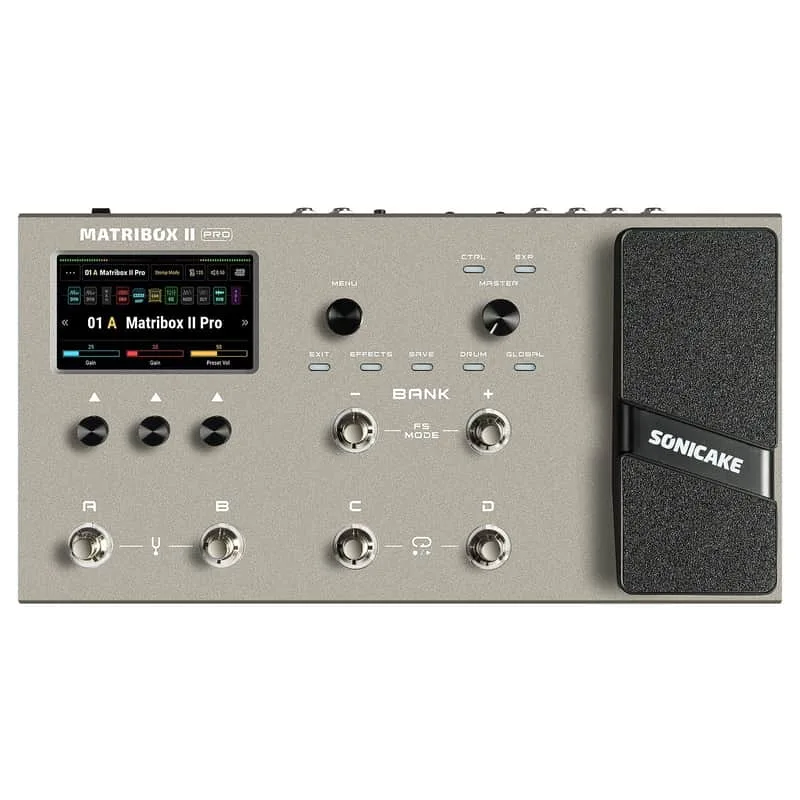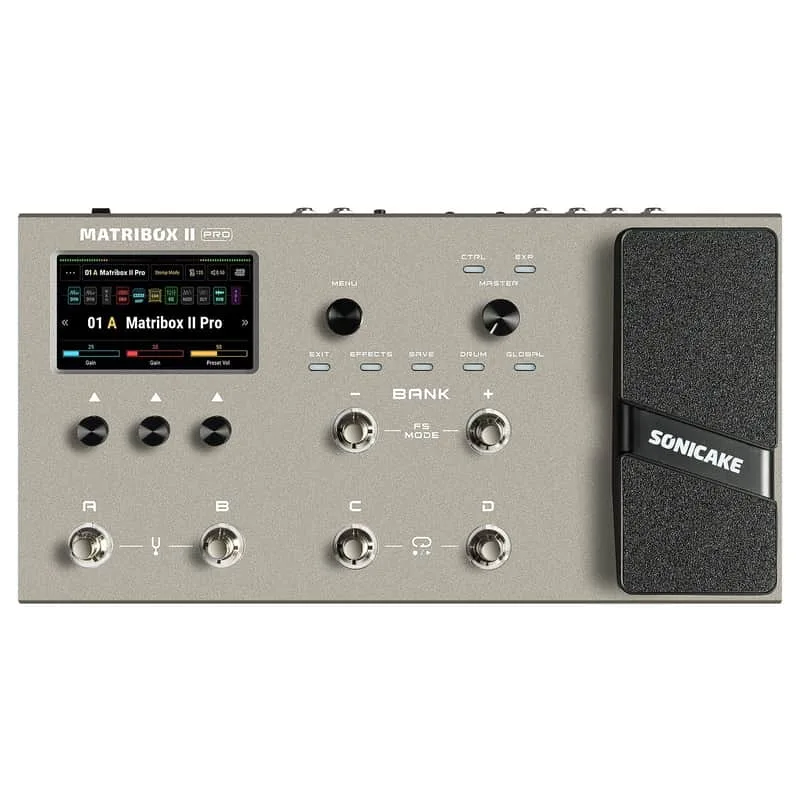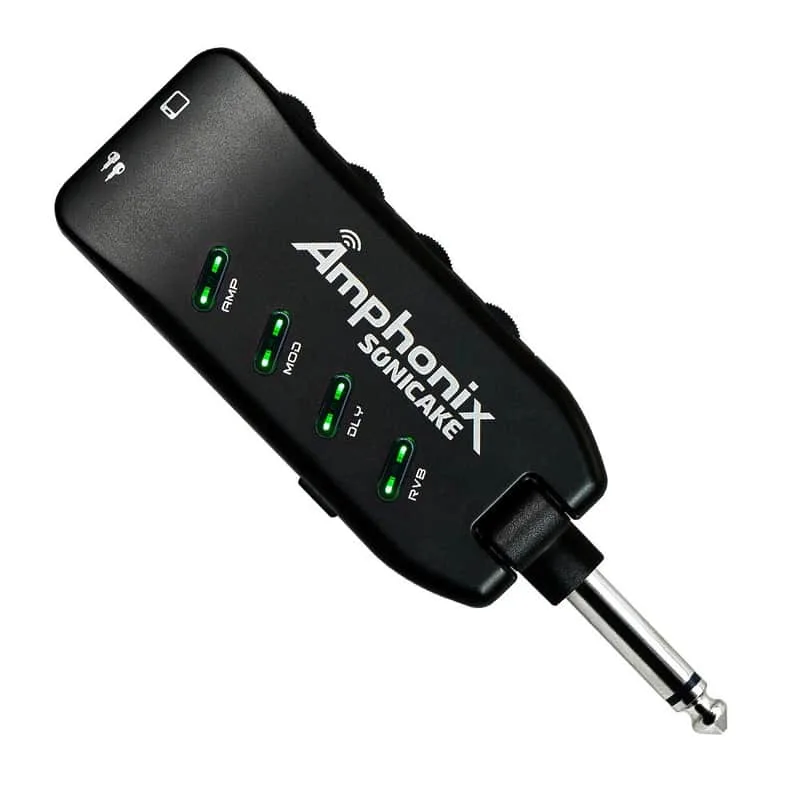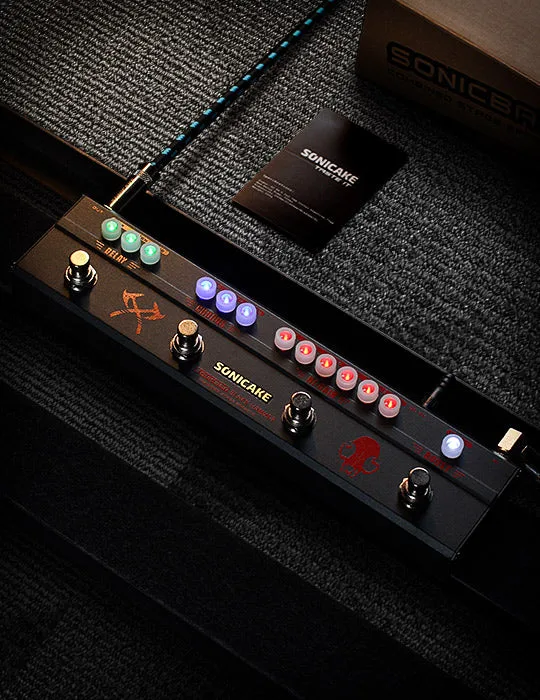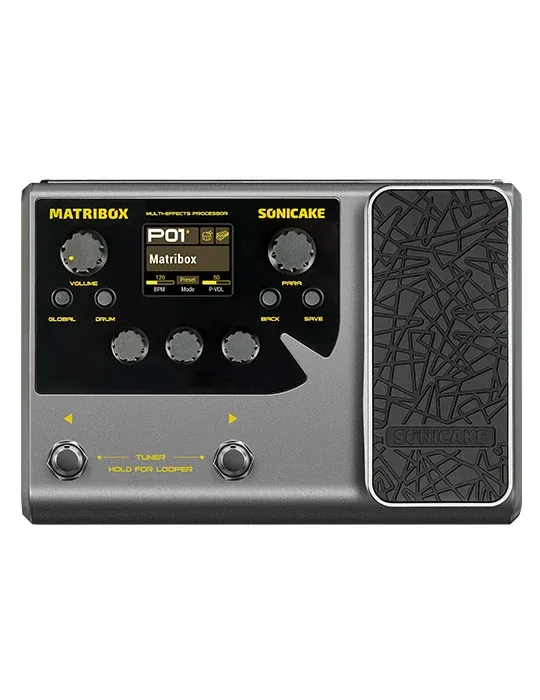


The Sonicake Matribox QME-50 is a compact digital multi-effects processor made by Sonicake, a maker whose range also includes the Matribox, the Matribox II and the Matribox II Pro. It puts amp modeling, cabinet simulation, effects, a looper, a drum machine and a tuner in one metal floor unit with a built-in expression pedal, at a regular price of $129.991.
The unit runs 24-bit 44.1kHz digital signal processing and uses what Sonicake calls white-box digital modeling technology, which the maker says delivers an "organic living tone"12. In practice, white-box modeling means the amp models are built from circuit-level descriptions of amplifiers rather than only from recorded samples of them.
Amp models, IR cabinets and effect blocks
The QME-50's core is its modeling engine: 40 amp models, which Sonicake describes as "legendary" amp models, paired with 38 IR cabinet simulations1. An IR, or impulse response, is a file that captures how a particular speaker cabinet and microphone combination colors the sound, so the amp and cab stages together form a complete recorded-amp signal.
On top of the amp and cab stages sit 130 built-in effects covering guitar, bass and acoustic use1. The signal chain is adjustable, with a maximum of 9 simultaneous effect blocks, so you choose which effects run at once and in what order1. Everything is stored in 198 presets, split into 99 factory patches and 99 user patches1.
| Modeling stage | What it gives you |
|---|---|
| 40 amp models | Guitar and bass amplifier emulations1 |
| 38 IR cabinet simulations | Speaker cabinet and mic profiles1 |
| 15 user IR slots | Load your own impulse responses1 |
| 130 effects | Guitar, bass and acoustic effect types1 |
| 9 effect blocks | Maximum simultaneous effects in the chain1 |
The unit also supports NAM captures. NAM (Neural Amp Modeler) captures are community-made amp profiles, and the latest software for the QME-50 supports the NAM A2 format1. Sonicake's update path has two steps: you must use software V1.0.2 to perform the update, then download the latest software to enable NAM captures1.
NAM capture support is not enabled out of the box on older units. The update requires software V1.0.2 first, followed by the latest software download1.
Looper, drum patterns and tuner
For practice and solo performance, the QME-50 includes a 90-second looper and 100 built-in drum patterns, which Sonicake describes as "high quality"1. A built-in chromatic tuner handles quick tuning checks between songs or takes1. The built-in expression pedal adds real-time control over parameters such as volume or wah without needing a separate expression pedal on your board1.
Connections and USB audio
The connection set covers the main ways a player would use the unit:
- 1/4" stereo outputs for running into an amp, a mixer or monitors1
- 1/8" headphone output for silent practice1
- Stereo 1/8" Aux input for playing along with backing tracks from a phone or player1
- USB audio interface function with stereo audio streaming, so the unit doubles as a recording interface1
Connecting to a guitar amp is supported in two ways. Sonicake says you can disable the amp and cab modules and connect it directly to a guitar amp, or enable "no cab" mode in the global settings and connect to the fx loop return of your amp1. Both approaches avoid stacking the unit's cabinet simulation on top of your amp's own speaker.
Modes, software and build
The QME-50 offers stompbox and preset modes for different situations3. In stomp mode the footswitches turn individual effects on and off like separate pedals; in preset mode they switch between complete patches. Free Mac and Windows software handles sound editing and preset managing1.
The build is a durable metal chassis with metal footswitches1, and the unit runs from a DC 9V power supply1, the same standard as most pedals, so it fits a normal pedalboard power supply.
Where it sits in the Sonicake range
The QME-50 is the entry point of Sonicake's Matribox modeling line. The second-generation Matribox II, announced in August 2023, raised the counts to 63 amp models and 93 effects at a $229.99 price, and the Matribox II Pro followed in September 2024 at $299. Against those, the QME-50 offers fewer models and effects at less than half the Pro's price, while keeping the same core feature set of amp modeling, IRs, a looper, drums and USB audio.
Videos
Subharaj Ghosh: Guitarist | Music Educator
kvto
Perry Frank
Questions
Can I use the Sonicake Matribox QME-50 with a guitar amp?
Yes. Sonicake says you can disable the amp and cab modules and connect it directly to a guitar amp, or enable 'no cab' mode in the global settings and connect it to the fx loop return of your amp. Both routes bypass the unit's cabinet simulation so it does not double up with your amp's own speaker.
Does the Matribox QME-50 support NAM captures?
Yes. The latest software supports NAM A2 captures. Sonicake's update instructions say you must use software V1.0.2 to perform the update, then download the latest software to enable NAM captures. NAM (Neural Amp Modeler) captures are amp profiles made from real amplifiers by the player community.
Can I load my own IRs into the QME-50?
Yes. The unit supports storing 15 user IRs (impulse responses) alongside its 38 built-in IR cabinet simulations. IRs are files that reproduce the sound of a specific speaker cabinet and microphone setup, so loading your own lets you tailor the cab sound to your taste.
Does the Sonicake QME-50 work for bass?
Yes. Its 130 built-in effects are described by Sonicake as guitar, bass and acoustic effects, and its 40 amp models cover guitar and bass amplifiers, so bass players get dedicated models rather than guitar-only presets.
What power supply does the Matribox QME-50 need?
It runs on a DC 9V power supply, the same standard voltage as most guitar pedals. Sonicake lists no battery option, so it needs a 9V supply on your pedalboard or power brick.
How many amp models does the Sonicake QME-50 Matribox have?
It has 40 built-in amp models, which Sonicake describes as 'legendary' amp models, plus 38 IR cabinet simulations. That is fewer than the second-generation Matribox II, which was announced in 2023 with 63 amp models.