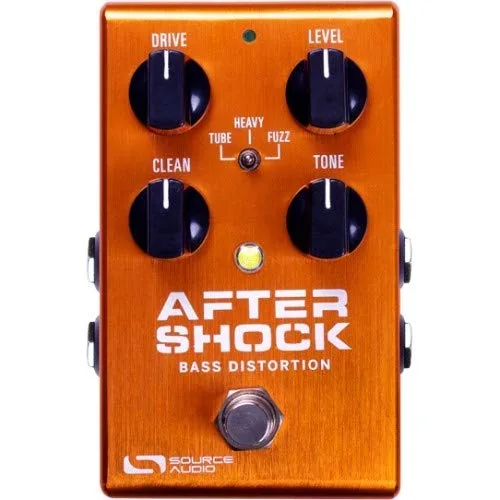


The Source Audio Aftershock Bass Distortion is a bass distortion pedal that covers the full range of low-end crunch, from smooth and natural overdrive to full-on fuzz attack1. Released by Source Audio on May 12, 2016 as part of its One Series line2, it packs three overdrive engines into one box, selected with a center toggle21.
What it does
Source Audio describes the Aftershock as spanning "the gamut of low-end crunch, from smooth and natural overdrive to full-on fuzz attack"1. Premier Guitar's launch coverage called it three bass overdrive engines in one pedal, ranging "from smooth and organic overdrive to full-on fuzz attack"2.
The three engines are selected with the center toggle1:
The FUZZ engine's lineage is the Bass Big Muff, so players chasing that fuzz character on bass get it alongside the other two modes without another pedal on the board1.
Controls
Guitar World's buying guide lists the controls as Drive, Level, Clean, Tone, and a 3-Mode Distortion switch3. The Clean knob is the key control for bass players: it blends your dry, unaffected signal with the overdriven signal so the bass tone stays clear and defined3. Source Audio's own description says the Clean Mix control maintains low-end clarity and bass fundamentals1, and Guitar Interactive's Jonathan Graham wrote that the Clean knob lets you "mix in just enough clean signal to maintain a rock-solid low-end without compromising the pedal's SONIC GROWL"4.
"The Clean knob lets you to mix in just enough clean signal to maintain a rock-solid low-end without compromising the pedal's SONIC GROWL."
Routing and connections
The Aftershock has stereo I/O with several routing options1:
- Distort upstream stereo signals1
- Split a mono signal to dual outputs1
- Use the additional in and out as an external effects loop1
Source Audio also lists effects send, multi signal mixing, and mono signal splitting among the routing possibilities1.
Presets, MIDI and expression control
The center toggle offers six slots arranged as two banks of three1. Bank 1 (green) works like a standard pedal, with sounds reflecting the current knob positions, while Bank 2 (red) provides three preset slots with fixed settings1.
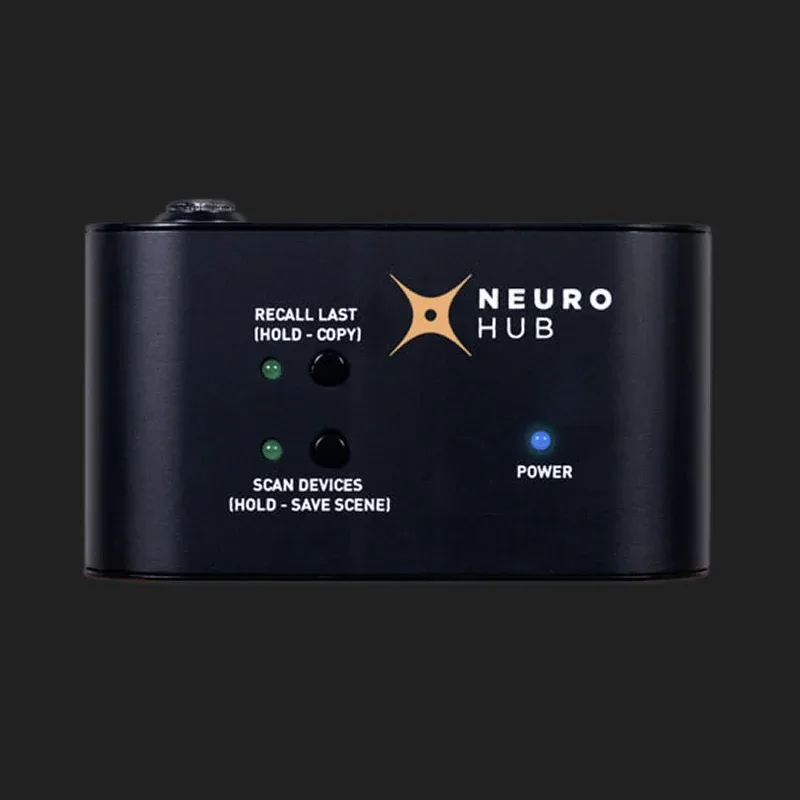
The pedal has full MIDI capability, including program change (PC) and control change (CC) messages1. Paired with the Neuro Hub, up to five OneSeries pedals can be connected to create 128 multi-pedal scenes with expression control, recallable via MIDI program change messages1. Every pedal in the One Series line is compatible with the Neuro Mobile App, a free download for iOS or Android4.
For expression control, connect the Neuro Hub to any TRS (tip hot) expression pedal for on-the-fly control of any adjustable parameter1.
Bypass and build
The Aftershock uses what Source Audio calls Universal Bypass: you select between high-quality signal relays for true bypass and transparent buffers for analog bypass1. The enclosure is brushed anodized aluminum1.
What reviewers said
Guitar World included the AfterShock (SA246) in its roundup of distortion pedals for bass, calling it "a super versatile and great sounding bass distortion pedal; it's hard to get a bad sound out of this"3. The guide's reasons to buy were its versatility, its range of tones, and the clean blend; under reasons to avoid it listed nothing3.
Videos
sourceaudioeffects
sourceaudioeffects
sourceaudioeffects
Questions
What are the three engines in the Source Audio AfterShock?
The center toggle selects one of three distortion engines: TUBE, a warm tube overdrive; HEAVY, a high gain distortion; and FUZZ, which is based on the Bass Big Muff. Each engine is a different take on low-end crunch, so one pedal covers overdrive through fuzz territory.
Which pedal is the AfterShock fuzz engine based on?
The FUZZ engine is based on the Bass Big Muff, according to Source Audio's product page. It is one of three engines selectable with the center toggle, alongside TUBE (warm tube overdrive) and HEAVY (high gain distortion).
Is the AfterShock true bypass?
It offers what Source Audio calls Universal Bypass: you can select between high-quality signal relays for true bypass and transparent buffers for analog bypass. That lets you choose true bypass or keep a buffered signal in the chain depending on your setup.
Does the AfterShock have MIDI?
Yes. The pedal has full MIDI capability, including program change and control change messages. Connected to the Neuro Hub, up to five OneSeries pedals can share 128 multi-pedal scenes with expression control, recallable via MIDI program change messages.
Can you connect an expression pedal to the AfterShock?
Yes, through the Neuro Hub. Source Audio says you can connect the Neuro Hub to any TRS (tip hot) expression pedal for on-the-fly control of any adjustable parameter on the pedal.
How many presets does the AfterShock store?
The center toggle offers six slots arranged as two banks of three. Bank 1 (green) works like a standard pedal, with sounds reflecting the current knob positions, while Bank 2 (red) provides three preset slots with fixed settings.
Sources (4)
- Aftershock Bass Distortion, sourceaudio.net
- Source Audio's New Guitar and Bass Effects Pedals, Premier Guitar, 2016-05-12
- Best distortion pedals for bass: thicken up your low end, Guitar World, 2022-08-17
- AfterShock Bass Distortion: Shake the Foundation, Guitar Interactive Magazine, 2016-05-18