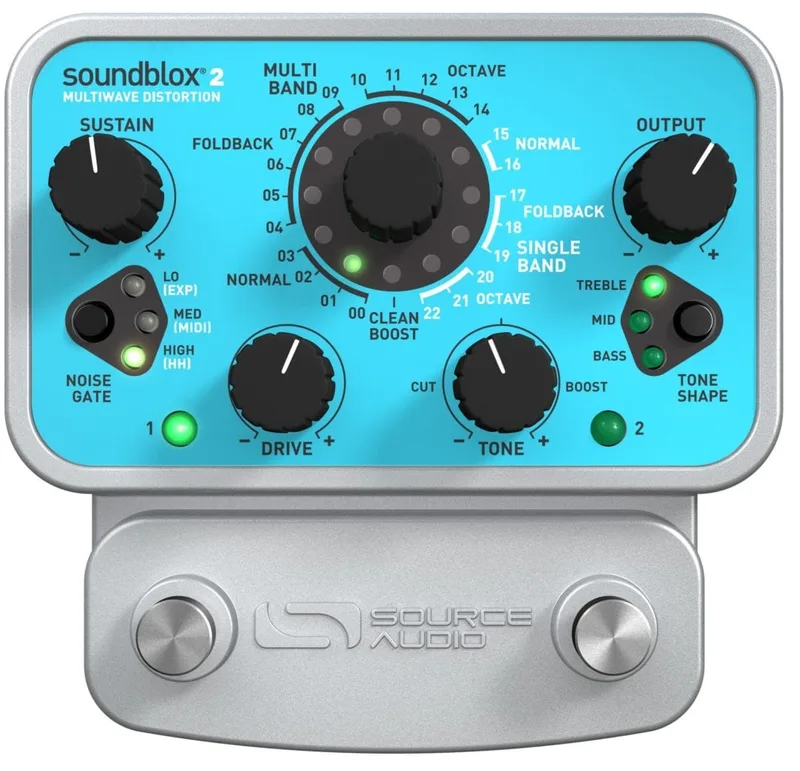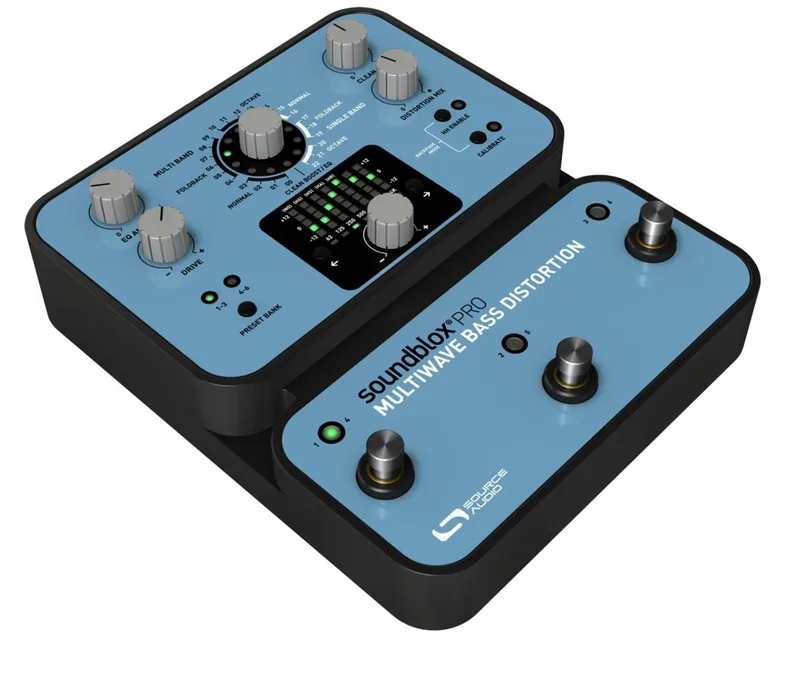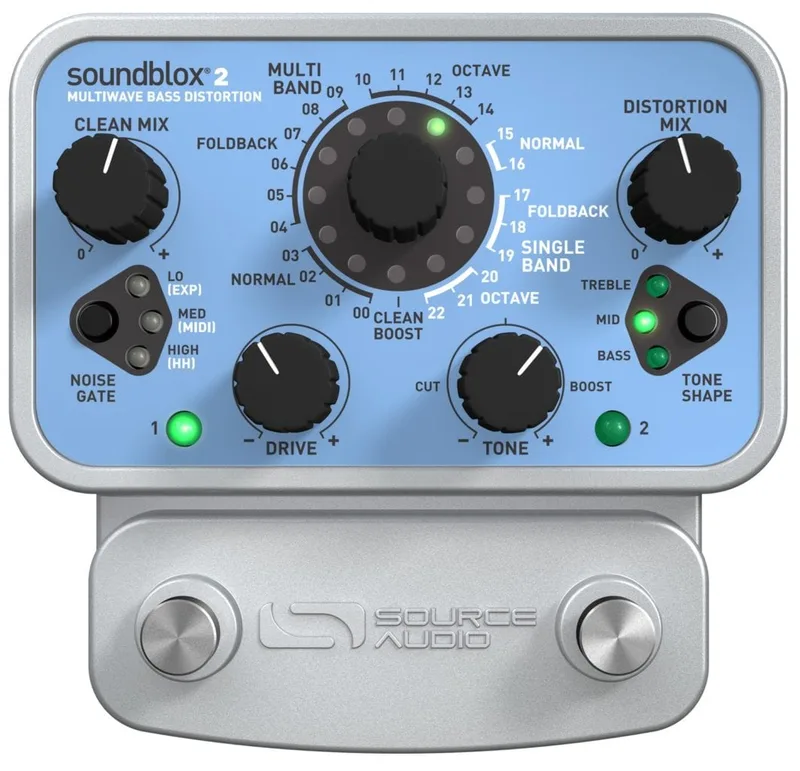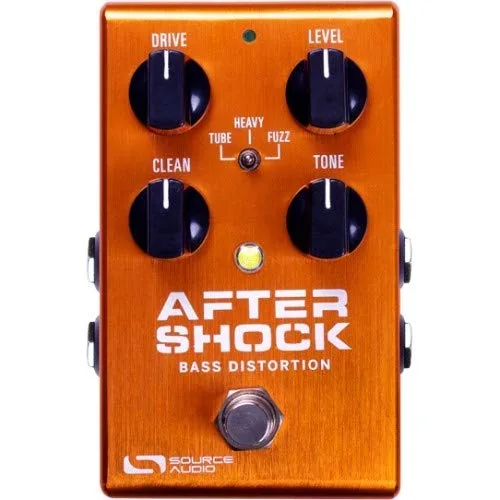


The Source Audio Soundblox Multiwave Bass Distortion is a digital bass distortion pedal built around one central idea: instead of distorting your whole bass signal at once, it splits the signal into ten frequency bands, distorts each band separately, and then recombines them. That multiband approach, which Source Audio adapted from its original Multiwave guitar pedal to the bass guitar's frequency range, is meant to give you more clarity and articulation than a conventional distortion circuit, where heavy clipping on the low frequencies can turn the tone to mud1.
The pedal is the scaled-down, non-programmable version of the Soundblox Pro Multiwave Bass Distortion, which Source Audio introduced at the January 2010 NAMM show21. It carries twenty-one presets selected by a rotary dial, grouped into multi-band and single-band banks and divided into Normal, Foldback, and Octave sections, plus a Calibrate position for the Hot Hands accessory3. It launched at $169 list with a $119 street price2, and a 2011 review put it at MSRP $189, selling for approximately $1203.
What it does: ten bands distorted separately
Multiband distortion is the pedal's main algorithm. As John Montalbano described it in his MusicPlayers.com review, the pedal "takes the input bass signal and divides it up into ten frequency bands," distorting each one separately before recombining them3. Because the low frequencies are clipped independently of the mids and highs, the technique keeps the low end articulate where a single-band distortion would smear it. No Treble's Kevin Johnson made the same point about the Pro version: multiband processing "breaks a signal into multiple band and distorts it individually for more clarity and articulation"1.
The payoff for a bass player is that you can pile on gain without losing the foundation of your tone. The trade-off is that multiband distortion is a digital technique: as Delicious Audio's reviewers noted when covering the Soundblox 2 version, it is "technology (multiband distortion) that would only be available in the digital domain"5. An analog pedal cannot split and recombine the signal this way.
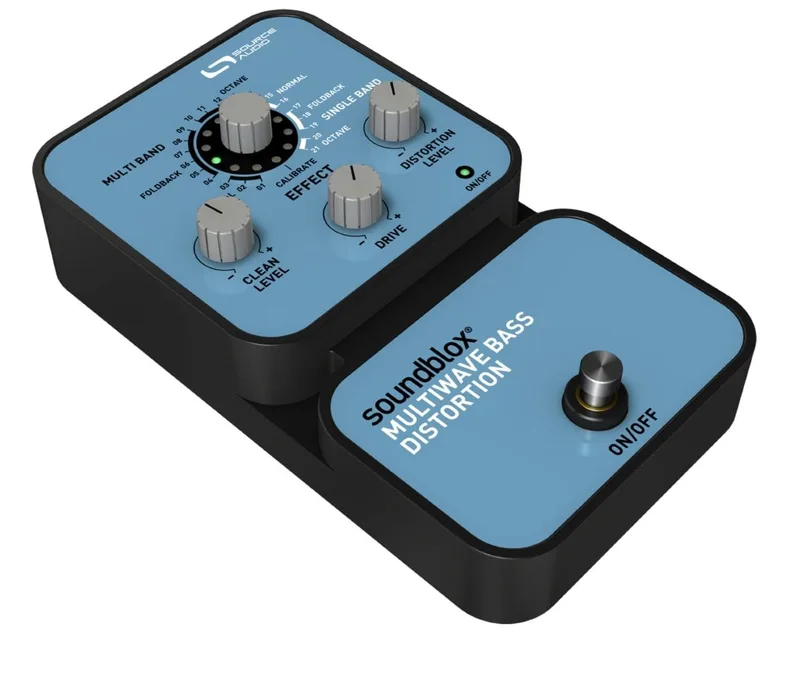
The twenty-one presets are grouped into two banks, multi-band and single-band, and each bank breaks down into three sections: Normal (single band), Foldback, and Octave. The Octave setting adds higher octaves into the mix3.
The controls
The face of the pedal is simple. The Effect rotary dial selects presets, with a positive detent at every position marked radially by LEDs, so you can scroll through sounds without looking down3. The Drive knob adjusts the amount of distortion, and the Distortion Level knob balances the amount of distorted signal against your clean signal independently, so you can keep clean low end underneath the grit3.
| Control | What it does |
|---|---|
| Effect rotary dial | Selects one of twenty-one presets, with detents marked by LEDs3 |
| Drive knob | Adjusts the amount of distortion3 |
| Distortion Level knob | Balances clean and distorted signal independently3 |
| Footswitch | Carling-style metal footswitch for bypass3 |
The remaining preset position is labeled Calibrate, which is used with the Hot Hands accessory (not included)3.
Hot Hands
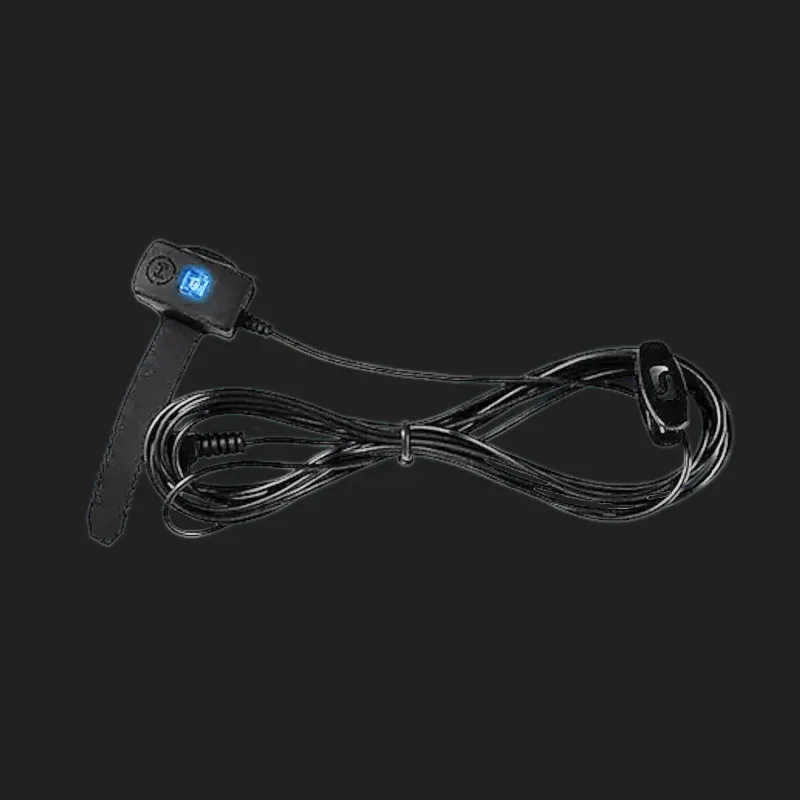
The pedal works with Source Audio's Hot Hands motion/expression sensor, which gives you dynamic and expressive real-time control over your tone through hand motion, controlling the amount of Drive in the effect36. The Calibrate position on the Effect dial is there to set the sensor up. The accessory is sold separately.
Power and connections
The rear panel is straightforward: Guitar In and Guitar Out 1/4" jacks, plus a power input connector for a 9V, 110mA power supply3. The unit also runs on four AA batteries behind a quick-release battery door on the bottom3.
At 110mA, this pedal draws more current than a typical analog stompbox. If you run it from a pedalboard supply, check that the output can deliver it; a small daisy-chain output may not be enough.
The enclosure is a lightweight but durable plastic with screwed-on rubber feet, at 7"L x 4"W x 2"H, with a Carling-style metal footswitch3.
How it differs from the Pro and the Soundblox 2 version
The standard Multiwave Bass Distortion is the non-programmable version of the Soundblox Pro Multiwave Bass Distortion. The Pro adds six memory presets via three footswitches, a seven-band graphic EQ, and MIDI control over parameters31. Both share the same 56-bit DSP with 24-bit converters2.
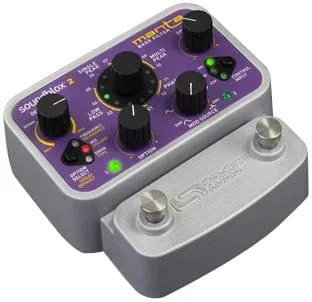
In 2012, Source Audio folded the pedal into its Soundblox 2 line, repackaging its distortion tones into a smaller and more affordable unit, the Soundblox2 Multiwave Bass Distortion78. That version moved to a cast-aluminum housing, offered 23 modes plus a 24th for clean boosting, added dedicated dry and wet level controls, an adjustable multi-level noise gate, a choice of buffered or true bypass, two programmable presets, and a $169 street price7.
What reviewers said
John Montalbano's MusicPlayers.com review, which tested the pedal with instruments including a Hofner, found a wide tonal range: "We were able to get a wall of mud distortion, especially with the Hofner; all the way up to a pleasant buzz saw effect," along with subtle distorted auto-wah sounds and almost synth-like voices in the Foldback settings3. He rated it 3.6 overall, which earned it a WIHO Award, calling it "a well-built stomp box with plenty of dirty distortions, subtle overdrives, and edgy synth-like tones"3.
Premier Guitar's review of the Soundblox 2 version, using a Fano Alt de Facto PX4 bass and a Verellen Meatsmoke tube amp, found the multi-band modes "possessed wider, more 3-D qualities that greatly helped the overdriven tones' low end and midrange" even at large amounts of gain, while the single-band modes gave a vintage-rock grind and the foldback modes held some of the pedal's fiercest, nastiest fuzz tones7. The same reviewer also found that "extreme settings on the octave and foldback modes can be overwhelming," and praised the octave and Moog-ish synth tones for superb tracking and muscular lows7. The overall verdict: "an excellent tool for adding grind and grit to your bass tone" with enough sonic options to carve a place in a rock or metal band's mix7.
Of the original guitar Multiwave, Premier Guitar's reviewer noted one drawback that cuts both ways: "other players will think you're using multiple effects and you'll want to brag that all of these sounds are coming out of" one pedal6.
Videos
Premier Guitar
sourceaudioeffects
sourceaudioeffects
Questions
Does the Soundblox Multiwave Bass Distortion run on batteries?
Yes. The pedal runs on four AA batteries behind a quick-release battery door on the bottom, and it also has a power input connector for a 9V, 110mA power supply. Either option works, so you can use a pedalboard supply or take it out with batteries.
What does the Hot Hands accessory do with the Multiwave Bass Distortion?
The Hot Hands motion sensor accessory (sold separately) gives you dynamic, expressive real-time control over your tone through hand motion, controlling the amount of Drive in the effect. The pedal has a dedicated Calibrate preset position used in conjunction with the Hot Hands accessory to set it up.
What is the difference between multi-band and single-band modes?
Multi-band mode divides your input signal into ten frequency bands, distorts each band separately, and then recombines them, which keeps the low end and midrange clear even at high gain. Single-band mode processes the whole tone at once, like a standard distortion or fuzz box, giving a more conventional grind.
Is the Multiwave Bass Distortion programmable?
The standard Soundblox Multiwave Bass Distortion is a scaled-down, non-programmable version of the Soundblox Pro Multiwave Bass Distortion. The Pro adds six memory presets via three footswitches, a seven-band graphic EQ, and MIDI control over parameters.
Sources (8)
- Gear Watch: Soundblox Pro Multiwave Bass Distortion Pedal, No Treble, 2010-01-12
- Source Audio Unveils Soundblox Pro Pedals at NAMM 2010, Premier Guitar, 2010-01-06
- Source Audio Soundblox Multiwave Bass Distortion Pedal, MusicPlayers.com, 2011-08-11
- New Soundblox pedals offer unique sounds, MusicRadar, 2008-01-10
- Review: Audio Source Multiwave Bass Distortion, Delicious Audio, 2012-07-22
- Review: Source Audio Soundblox Multiwave Distortion, Premier Guitar, 2008-08-06
- Soundblox 2 Multiwave Bass Distortion Pedal Review, Premier Guitar, 2012-09-05
- Source Audio Unveils Soundblox 2 Series at NAMM, No Treble, 2012-01-28