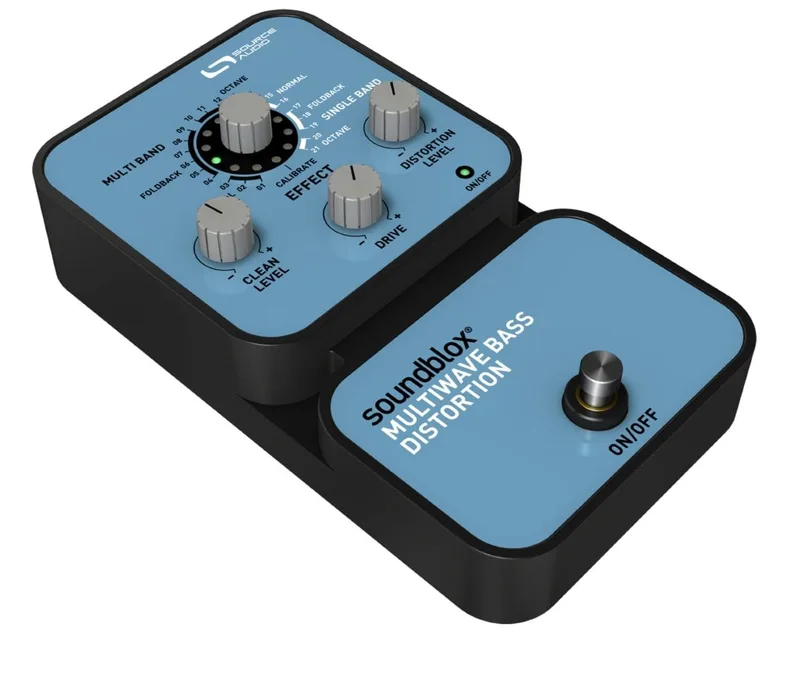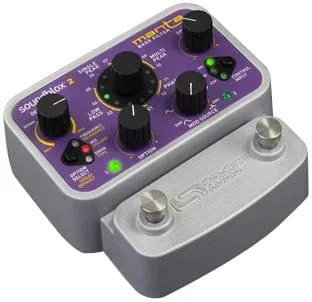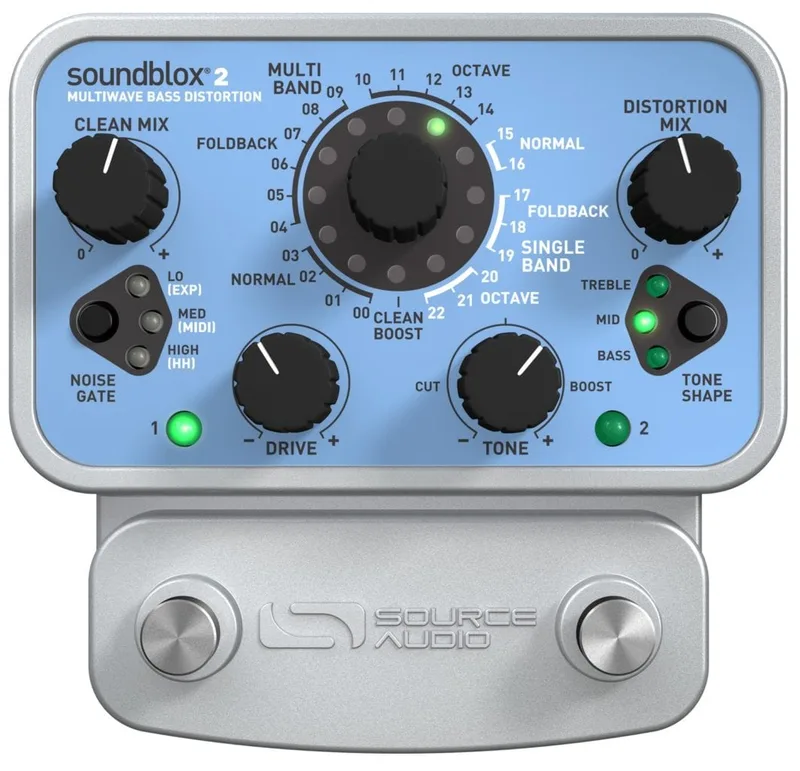


The Source Audio Soundblox 2 Multiwave Bass Distortion is a digital bass distortion pedal that takes an unusual approach to gain. Instead of distorting the whole signal at once, its multi-band modes split your bass into ten frequency bands and distort each one individually before recombining them, all handled by a 56-bit digital processor1. The payoff for a bassist is that the low end stays articulate and controlled even when the gain is piled on, which is where most single-circuit distortion pedals turn to mud.
The pedal is a repackaged version of Source Audio's earlier Multiwave Bass Distortion, brought into the Soundblox 2 line as a smaller and more affordable unit1. It sits in a cast-aluminum housing1 and carried a street price of $169 at the time of Premier Guitar's review1.
Multiband digital distortion for bass
Multiband distortion is a technique that, as Delicious Audio noted when introducing the pedal, "would only be available in the digital domain"3. An analog distortion circuit clips everything together, so the harmonics generated in your low end smear into the rest of the signal. A digital processor can divide the signal first, apply different amounts and types of distortion to each band, and then reassemble it. On this pedal, the multi-band set splits the signal into ten frequencies and distorts them individually1.
Alongside the multi-band modes, the pedal also has a single-band mode that processes the tone like a standard distortion or fuzz box1, so you can get conventional results when you want them. The Soundblox 2 line, unveiled at NAMM in January 2012, carried this Universal Bypass feature across all its pedals4, and No Treble reported that the Multiwave Bass Distortion builds upon the original Soundblox series5.
Premier Guitar's reviewer found the multi-band approach did exactly what it promises:
"the multi-band modes possessed wider, more 3-D qualities that greatly helped the overdriven tones’ low end and midrange"1
The same review's overall verdict called it "an excellent tool for adding grind and grit to your bass tone, a" with more than enough sonic options to carve a place in a rock or metal band's mix1.
The modes and controls
Mode selection is handled by a rotary knob: 23 distortion modes, plus a 24th mode for conventional clean boosting1. Performer Mag described the same set as "23 varieties of unique distortion algorithms"2. The modes span several families of sound, and Premier Guitar's reviewer, working with a Fano Alt de Facto PX4 bass and a Verellen Meatsmoke tube amp, characterized them like this1:
| Mode family | What the reviewer found |
|---|---|
| Single-band | A vintage-rock grind, with meatier tones as gain increased1 |
| Foldback | Some of the pedal's fiercest, nastiest fuzz tones1 |
| Octave and synth | Beautiful octave and Moog-ish synth tones with superb tracking and muscular lows1 |
| Envelope filter | Very wild and bizarre envelope filtering1 |
| Clean boost | Conventional clean boosting via the 24th mode1 |
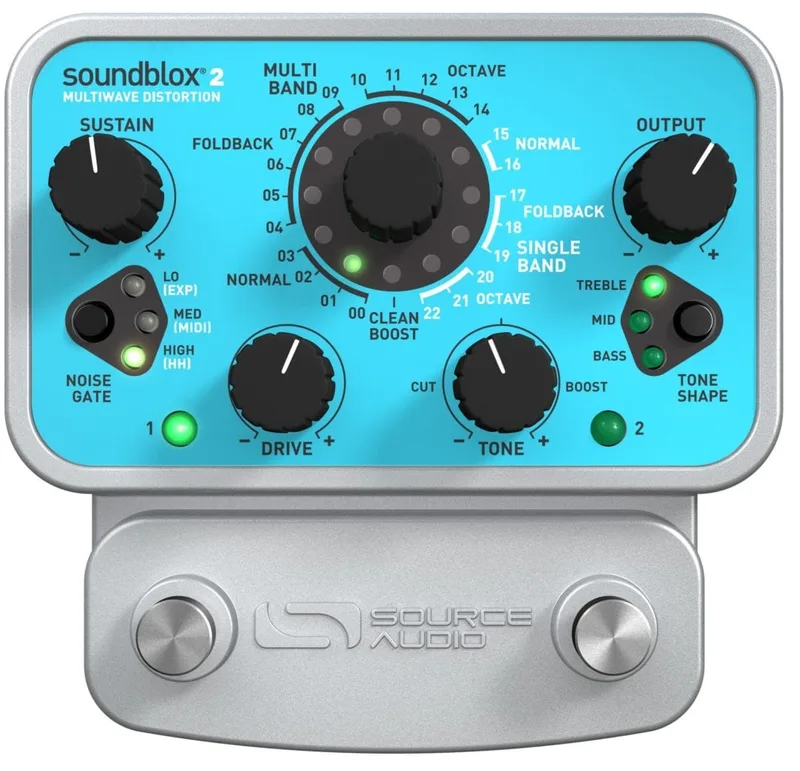
The front-panel controls are simple: Drive, Voice, Tone, and Output2. The Tone section is a 3-band tone control2, and the pedal also provides dedicated controls for dry and wet levels1, which lets you blend your clean bass signal under the distorted one, a key feature for keeping fundamental low end in the mix.
A few practical points worth knowing:
- Noise gate: an adjustable multi-level noise gate1, described by Performer Mag as an easily activated 3-level gate6, tames hiss at high gain.
- Presets: two programmable presets1 let you store a second sound and recall it from the pedal.
- Bypass: selectable buffered or true bypass1, so it can sit anywhere on a pedalboard.
- MIDI: the pedal is MIDI capable2, opening it up to remote preset switching in larger rigs.
What reviewers made of it
Premier Guitar's pros list was direct: "Tons of range. Great response. Multi-band modes are just the ticket for keeping even the wildest distortions tight and c"1. The review was not entirely uncritical, though; the reviewer noted that "Extreme settings on the octave and foldback modes can be overwhelming"1, so the wildest sounds need some restraint.
Performer Mag's take, from Chris Devine, was similarly positive on the basics: "PROS: Good selection of distortions, flexible controls."2 Devine also framed the pedal's appeal as combining programmability with stompbox simplicity, writing that "Source Audio has brought all the plusses of programmable distortion with the simplicity of a stompbox"6.
Where it sits in Source Audio's line
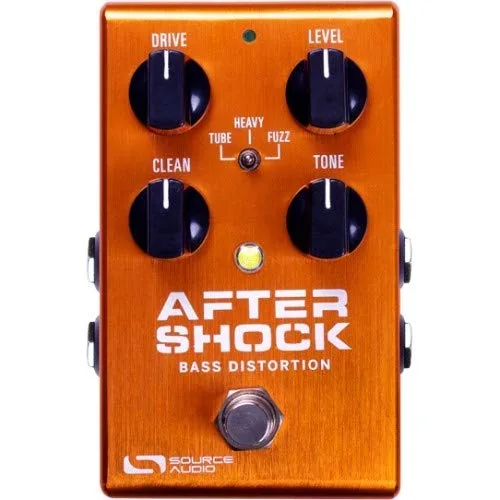
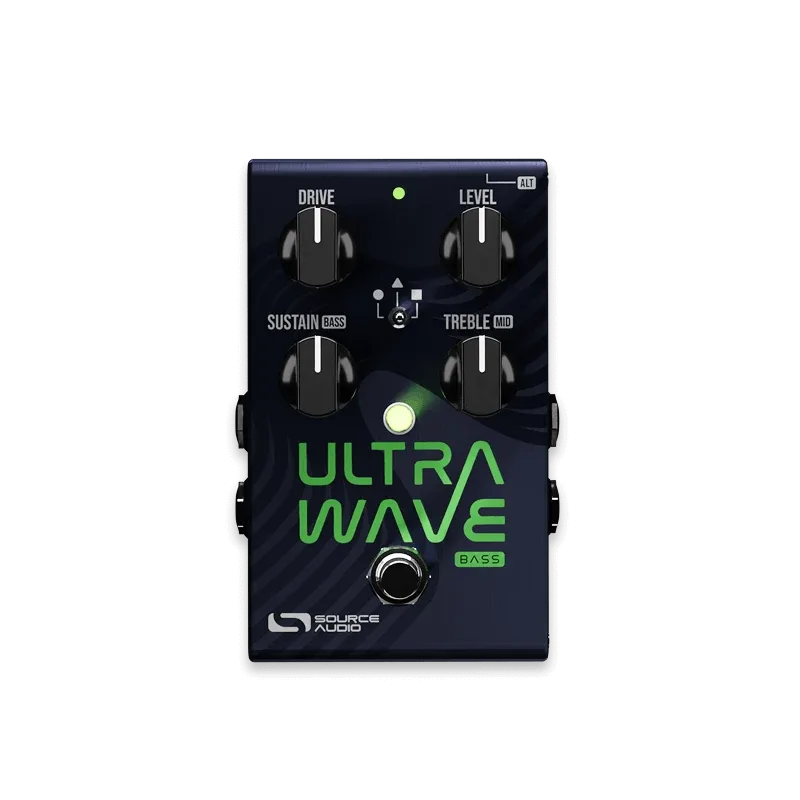
The pedal is a smaller, more affordable repackaging of the earlier Source Audio Soundblox Multiwave Bass Distortion1. Source Audio later expanded its bass distortion offerings with the Aftershock Bass Distortion and the Ultrawave Multiband Bass Processor, which continues the multiband concept. Players comparing options today may also want to look at the broader bass pedals and distortion pedals categories.
Videos
sourceaudioeffects
sourceaudioeffects
Gear 'n Gigs
Questions
What is multiband distortion?
Multiband distortion splits your signal into separate frequency bands and distorts each band on its own before recombining them. On the Multiwave Bass Distortion, the multi-band modes split the signal into ten frequencies and distort them individually. Because your low frequencies are processed separately from the mids and highs, they stay tight and articulate even at heavy gain settings.
Is the Soundblox 2 Multiwave Bass Distortion true bypass?
It offers both. Like all Soundblox 2 pedals, it uses Source Audio's Universal Bypass, which lets you select either buffered or true bypass operation, so you can match it to the rest of your pedalboard.
How many presets does the Soundblox 2 Multiwave Bass Distortion store?
It stores two programmable presets, so you can keep a second sound ready and switch to it without redoing your knob settings. Premier Guitar's review noted this as part of its programmable distortion features in a stompbox format.
Does the Multiwave Bass Distortion have a noise gate?
Yes. It includes an adjustable, multi-level noise gate that Premier Guitar highlighted among its features, and Performer Mag described it as an easily activated 3-level noise gate. The gate helps control noise when running high gain settings.
Is the Multiwave Bass Distortion MIDI capable?
Yes. Performer Mag listed MIDI capability alongside its DSP processing among the pedal's features. MIDI control lets you integrate the pedal with a larger rig, such as switching presets remotely.
Sources (6)
- Soundblox 2 Multiwave Bass Distortion Pedal Review, Premier Guitar, 2012-09-05
- Source Audio SoundBlox 2 Multiwave Distortion Pedal Review, Performer Mag, 2014-11-20
- Review: Audio Source Multiwave Bass Distortion, Delicious Audio, 2012-07-22
- NAMM 2012: Source Audio to release Soundblox 2 line of guitar, bass effects, MusicRadar, 2012-01-15
- Source Audio Unveils Soundblox 2 Series at NAMM, No Treble, 2012-01-28
- Source Audio SoundBlox 2 Multiwave Distortion Pedal Review, Performer Mag, 2014-12-03