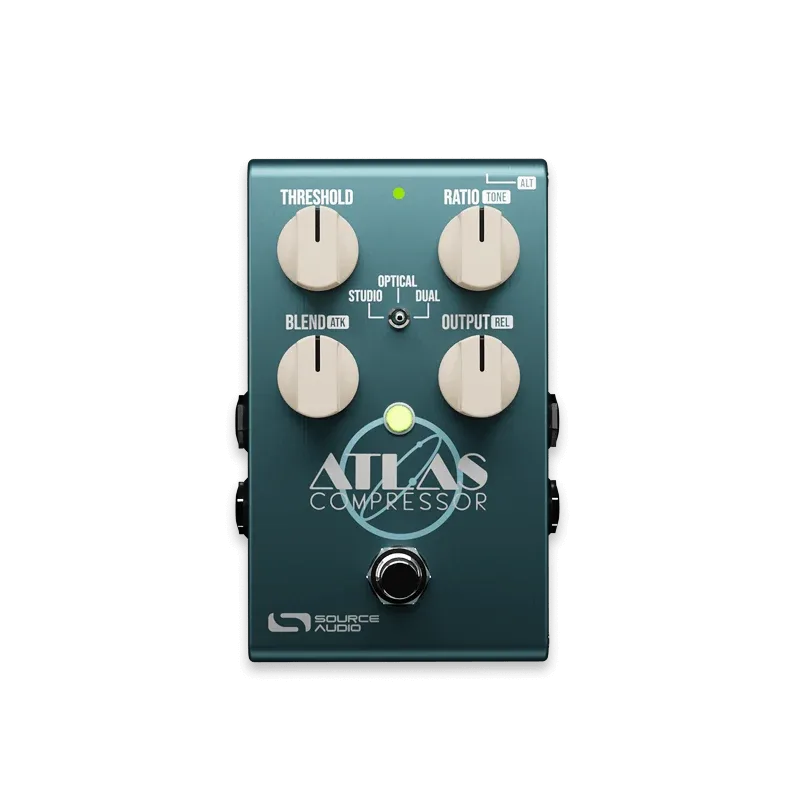


The Source Audio Atlas Compressor is a compressor pedal from Source Audio that packs a collection of compression circuits into one compact stompbox. Rather than offering a single compression voice, it gives you six compression types modeled on studio and pedal classics, from the smooth optical character of the LA2A to the fast, full-bodied 1176 FET compressor, along with a dual-engine mode and a bass mode. Source Audio describes it as "a tour guide through the history of compressor equipment"12.
It was announced on 6 May 2022 and was available from launch at $22913. The maker's page lists it at a sale price of $229.00 as of October 20264.
The compression modes: Optical, Studio 76 and Dual
Three compression modes are accessible through a toggle switch on the pedal itself: Optical, Studio 76 and Dual2.
- Optical is inspired by the LA2A, a smooth, two-knob, semi-automatic compression that works well on clean guitars2. Delicious Audio describes the result as "a very smooth and gentle attack that imparts a full-bodied and natural sound on guitar, bass, or vocal"2. Premier Guitar notes it delivers "the resulting warm and smooth compression that has been the standard in studios since the 1950s"6.
- Studio 76 is a recreation of the 1176 Urei studio rack FET compressor, more tweakable than the LA2A and better suited to percussive parts2. Premier Guitar describes the 1176 as "known for its full body and super-fast attack"6.
- Dual provides an independent set of controls for both high and low frequencies, also known as multi-band compression2. Premier Guitar adds that the dual compressors can be run in Series, Parallel, or Band Split mode6.
Beyond the three toggle-switch modes, the Atlas offers six compression types in total4, with additional engines loaded through the Neuro app. These include recreations of the Dan Armstrong Orange Squeezer and the Diamond Compressor2, an LED Optical Compressor inspired by pedals that swap the LA2A's electro-luminescent panel for an LED and a quicker, dirtier response2, and Cubic Zirconia, an optical engine with faster attack and release times and a slightly dirtier sound, suited to tight and funky guitar parts2.
The LA2A Optical Compression type is described as a faithful recreation of an electro-luminescent panel combined with a photo resistor2, while the 1176 Feedback FET type is based on the solid state FET compressor26.
The controls
Each compression engine has onboard controls for Threshold, Ratio, Attack, Release, Output, Tone and Blend6. On the pedal's surface, the knobs handle Threshold, Ratio and Output duties, with alternate functions for Tone, Attack and Release2.
| Control | What it does |
|---|---|
| Threshold | Sets the level at which compression kicks in2 |
| Ratio | Sets how hard the signal is compressed2 |
| Output | Sets the output level2 |
| Tone (alt) | Tone shaping, alternate knob function2 |
| Attack (alt) | Sets how fast compression engages, alternate knob function2 |
| Release (alt) | Sets how fast compression lets go, alternate knob function2 |
| Blend | Reintroduces clean signal under the compressed one for parallel compression2 |
The Blend knob is worth noting for players who want to keep their attack intact: it allows what is commonly known as parallel compression, reintroducing some of the clean signal underneath the compressed signal2.
The Atlas also includes Auto Makeup Gain, which increases or decreases the makeup gain depending on the amount of compression applied4. Editing goes deeper through the Neuro app, which allows fine-tuned control over the compact One Series hardware26.
Presets, MIDI and bass mode
The Atlas holds 128 presets in memory. Six are accessible via the pedal's toggle switch, and all 128 are available via MIDI, recallable with MIDI PC messages over Mini USB4. This makes it practical for MIDI pedal users who want a different compression setting per song.
For bass players, the Atlas can be converted to a special Bass Mode with compressor engines specifically optimized for bass4. Combined with the Dual mode's band-split compression, it covers a lot of ground for bass pedal setups.
History and designers
The Atlas was announced on 6 May 2022 and was available immediately at $22913. Guitar World reported it as "more than a decade in the making"3. MusicRadar named the designers as Bob Chidlaw, Jesse Remignanti and Christopher Venter, who "worked long and hard on this one"1.
The pedal is part of Source Audio's One Series hardware line, the same compact format used across the range2.
What reviewers said
Premier Guitar's John Bohlinger summed up the Atlas as offering "Scores of superb, deep compression emulations in a super-easy-to-use format"6.
"This all adds up to a pro-spec compressor, just in a very neat and compact stompbox format. I can see this being a great tool for musicians that gig, or work as session players."
Gearnews also noted the dual inputs and outputs as a fit for most guitar and bass rigs, and that the pedal runs on an included 9V DC power supply5.
Videos
Premier Guitar
Pete Thorn
sourceaudioeffects
Questions
Is the Source Audio Atlas digital or analog?
It is digital. The Atlas runs on a DSP-powered engine that models a collection of compression circuits, including recreations of the LA2A optical compressor and the 1176 FET studio compressor, rather than using an analog compression circuit.
Does the Atlas Compressor have a bass mode?
Yes. The Atlas can be converted to a special Bass Mode with compressor engines specifically optimized for bass. It also has a Dual mode with independent controls for high and low frequencies, which Source Audio describes as multi-band compression.
How many presets does the Atlas Compressor hold?
It holds 128 presets in memory. Six of them are accessible directly from the pedal's toggle switch, and all 128 can be recalled with MIDI PC messages sent over Mini USB.
Is the Source Audio Atlas true bypass?
It uses what Source Audio calls Universal Bypass, which is selectable between two options: high-quality signal relays for true bypass, or transparent buffers for analog buffered bypass. You choose which behavior you want.
Does the Atlas have a blend knob for parallel compression?
Yes. The Blend knob reintroduces clean signal underneath the compressed signal, which is commonly known as parallel compression. Blend is one of the onboard controls available on every compression engine.
What is the Cubic Zirconia mode on the Atlas?
Cubic Zirconia is an optical compression engine loaded via the Neuro app. It uses optical technology usually found inside effects pedals, with faster attack and release times and a slightly dirtier sound than the LA2A-style engine, suited to tight and funky guitar parts.
Sources (6)
- Source Audio launches the Atlas Compressor, a greatest hits of compression packed with functionality, MusicRadar, 2022-05-06
- Source Audio Atlas Multi-Mode Compressor, Delicious Audio, 2022-08-23
- Source Audio promises a comprehensive library of compression with new Atlas Compressor pedal, Guitar World, 2022-05-06
- Atlas Compressor, sourceaudio.net
- Source Audio Atlas Compressor pedal offers studio grade compression, www.gearnews.com, 2022-05-06
- Source Audio Introduces the Atlas Compressor, Premier Guitar, 2022-05-09