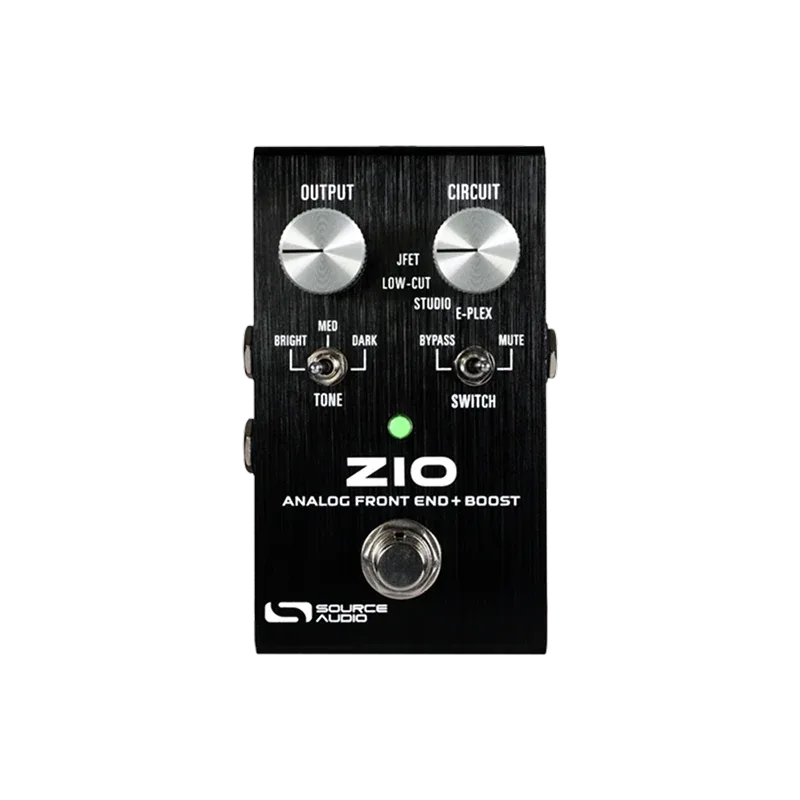


The Source Audio ZIO Analog Front End + Boost is an all-analog preamp and boost pedal with a choice of four preamp circuits and up to +20dB of clean signal boost1. Announced in January 2022, it was the company's first all-analog effects pedal, designed in collaboration with Christopher Venter, the owner and sole engineer at SHOE Pedals2. It is built around high-fidelity, noise-free Burr-Brown op amps, which Source Audio credits with the pedal's clarity and responsive pick dynamics1.
The idea behind the pedal is signal conditioning: it takes a guitar's high impedance signal, sweetens it with one of the four preamp circuits, and outputs a strong low impedance signal that is unaffected by the buffered dry tones of other pedals further down the chain3. Gearnews described it as working almost like a buffer, preamp and booster all in one2.
A transparent preamp, buffer and boost
Source Audio designed the ZIO, in its own words, to "make everything sound better"4. In practice it does three jobs at once. As a boost pedal, the Output control delivers up to +20dB of signal boost1. As a buffer, it converts the guitar's high impedance signal into a strong low impedance one that holds up over long cable runs and through other pedals3. And as a preamp, each of its four circuits adds its own character, from fully transparent to gently voiced1.
Guitar World's reviewer, Trevor Curwen, noted that the pedal "acts as a buffer and has a Tone switch that offers three different levels of capacitance"4. The JFET circuit is the cleanest of the four: in Curwen's testing, it "will retain your core tone but make it louder and more robust," with unity gain sitting at about the 10 o'clock position on the Output knob4.
The pedal is compact, at 4.1 inches long by 2.36 inches wide by 2.22 inches high including the knobs, in a brushed anodized aluminum housing3. It is made in China4.
Four preamp circuits: JFET, Low-Cut, Studio, E-Plex
The Circuit switch selects one of four discrete preamp circuits, each with up to +20dB of boost available12.
| Circuit | What it does |
|---|---|
| JFET | Completely transparent signal boost with zero coloring or distortion; similar in character to a clean tube amp input with very low distortion1 |
| Low-Cut | Reduces "tubby" bottom-end for a tighter sound with added headroom1 |
| Studio | Adds clarity by cutting "mud frequencies" and adding mid-range articulation, based on the "Pultec Trick"1 |
| E-Plex | Captures the focused and subtle grit of the preamps found in vintage Echoplex tape delay units1 |
The JFET mode is the reference point: Source Audio describes it as "a completely transparent signal boost with zero coloring or distortion," with a character and behavior similar to a clean tube amp input1. Low-Cut trims the low end, which Source Audio says gives a tighter sound with more headroom, useful with gain-heavy overdrive and distortion pedals or dark amplifiers1.
The Studio circuit is the most studio-flavored of the four. It is built on the "Pultec Trick," an EQ approach used on records since the 1950s and still in use today1. Guitar World's reviewer called it "a real tone-sweetener that combines a mild lower-mid" scoop with a higher boost for clarity and articulation4. The E-Plex circuit, meanwhile, reaches for the preamp stage of the vintage Echoplex tape delay, a unit long prized by players as a front-end boost; Source Audio says it captures that preamp's focused and subtle grit1.
"The JFET is the most transparent of the preamp circuits and will retain your core tone but make it louder and more robust."
Guitar World's review summed up the four-circuit approach as a plus, listing "four preamp options" among the pedal's strengths4.
Power and connections
The ZIO runs on 9V DC, center negative, drawing about 20mA, so it fits a standard pedalboard power supply3. Connections are a standard input and standard outputs, plus an extra Tuner/Line output for feeding a tuner or a second line destination without tapping the main signal143.
Both the ZIO Analog Front End + Boost and the ZIO Analog Bass Preamp + DI are listed as sold out at Source Audio's store as of October 202615.
The bass version: ZIO Analog Bass Preamp + DI
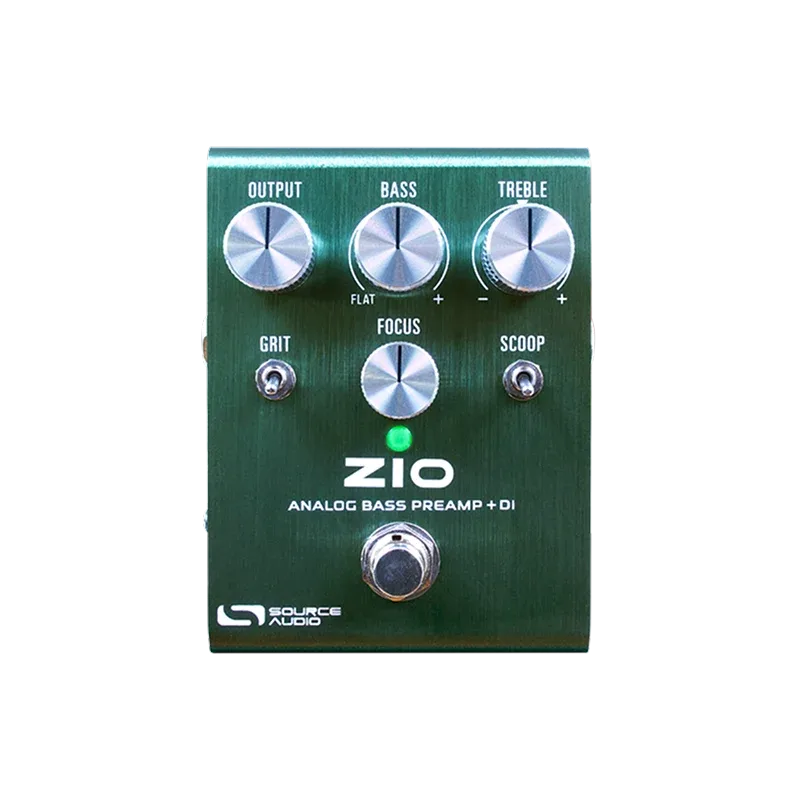
Bass players get their own variant. The ZIO Analog Bass Preamp + DI is a compact, easy-to-dial-in pedal that Source Audio says works equally well in front of an amplifier or as a preamp and direct box via its balanced XLR output5. Like the guitar version, it is all-analog with true bypass and the same brushed anodized aluminum housing5.
Its Output knob offers up to +16dB of overall boost above unity gain, or up to -6dB of cut5. It also carries a SCOOP toggle that engages an EQ curve based on the same Pultec trick as the guitar pedal's Studio mode: a low-mid cut to remove mud frequencies, a gentle presence boost in the upper midrange, and a natural-sounding high pass filter5. More bass pedals are covered separately on the site.
Where it came from
The ZIO Analog Front End + Boost was designed in collaboration with Christopher Venter, the owner and sole engineer at SHOE Pedals3. Delicious Audio's 2024 coverage described it as Source Audio's first all-analog effects pedal, built with high-quality components and Burr-Brown JFET op-amps, in a catalog otherwise known for digital designs3. The same coverage noted that the pedal takes a guitar's high impedance signal and outputs a strong low impedance signal unaffected by buffered dry tones of other pedals3.
Videos
Pete Thorn
Sweetwater
sourceaudioeffects
Questions
Is the Source Audio ZIO true bypass?
Yes. Source Audio lists the ZIO Analog Front End + Boost as true bypass, so with the pedal off the signal passes through without active circuitry in the path. It also acts as a buffer when engaged, converting the guitar's high impedance signal to a strong low impedance output.
How much boost does the ZIO give?
The Output control offers up to +20dB of signal boost, and each of the four preamp circuits can deliver that full amount. The JFET circuit reaches unity gain at roughly the 10 o'clock position on the Output knob, so anything above that adds level.
What is the Pultec trick on the ZIO?
It is the EQ curve behind the Studio circuit. The Pultec trick is a studio technique used on records since the 1950s that cuts mud frequencies in the low mids while boosting for clarity and articulation. Source Audio based the Studio mode's voicing on it.
Is there a bass version of the ZIO?
Yes. Source Audio also makes the ZIO Analog Bass Preamp + DI, a compact pedal that works in front of a bass amp or as a preamp and direct box through a balanced XLR output. Its Output knob offers up to +16dB of boost or up to -6dB of cut.
Is the Source Audio ZIO analog or digital?
The ZIO is all-analog. It was Source Audio's first all-analog effects pedal, built around Burr-Brown op amps with an all-original circuit design, and it was designed in collaboration with Christopher Venter of SHOE Pedals.
Sources (5)
- ZIO Analog Front End + Boost, Source Audio
- Zio Analog Front End + Booster, gearnews.com, 2022-01-13
- Source Audio ZIO Analog Preamp/Boost, Delicious Audio, 2024-01-09
- Source Audio ZIO Analog Front End + Boost, Guitar World, 2022-06-10
- ZIO Analog Bass Preamp + DI, Source Audio